

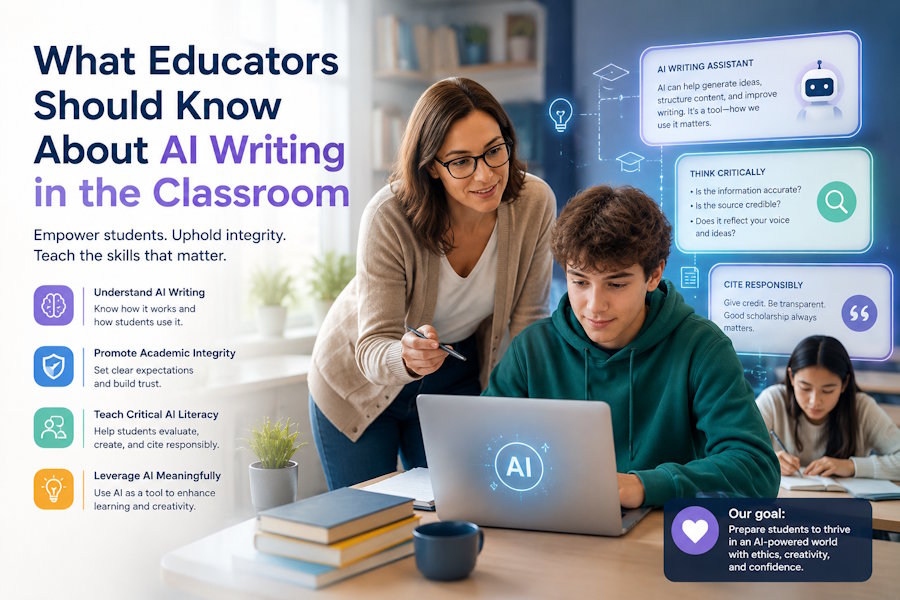
In today’s world, AI technology is spreading more and more widely, including in the education industry. Students now find themselves using AI writing tools for their homework, essays, or even scientific papers. This trend appears to be abrupt for some teachers.
While there are concerns that AI would make pupils lazy or decrease their level of critical thinking, others see in AI a useful technological solution that may positively affect teaching when applied appropriately. However, AI writing cannot simply be brushed aside by schools' administration any longer.
Educators should learn to handle it, teach students how to make use of it responsibly, and incorporate AI technologies into education practices where necessary. This article discusses all the basics teachers must know about AI writing in education, succinctly and practically.
Understanding AI Writing in Simple Terms
In case the user requests information on any topic, the computer program generates instant responses. These may range from writing an essay, summarizing material, answering a query, or developing a story. Many educators also wonder what AI detector do teachers use to identify such content, especially as these tools become more common in classrooms.
The reason why AI writing is so effective is the high level of quality that it has. Usually, it produces coherent texts that are easy to understand and use. For this reason, sometimes it is difficult to distinguish between students' work and an AI-generated product.
However, despite such high levels of efficiency, AI cannot really understand different issues. AI uses prediction based on learning algorithms. That is why sometimes it may provide wrong information.
Why AI Writing is Growing in Classrooms
AI tools have been gaining popularity among students because of several factors. Firstly, they save time. Rather than wasting many hours on how to approach their assignment, students receive drafts instantly. Secondly, AI is helpful for those students who find writing challenging. They receive guidance with structuring, grammar, and ideas. For many of them, it seems like hiring a private tutor.
Lastly, AI tools are very convenient because they are always available, even free. Thus, artificial intelligence is not a temporary trend but rather a reality in today's education process.
The Benefits of AI Writing for Education
If used effectively, AI writing can provide many benefits. The technology can benefit both the students and teachers. To begin with, the AI can facilitate effective learning through guiding in understanding challenging topics as well as providing immediate feedback for errors.
Secondly, the teacher would save time because he/she would not engage in repetitive and boring activities but rather use the tool to develop lesson plans and feedback for students. Additionally, AI writing facilitates personalized learning whereby the learner progresses at his/her own pace.
The Challenges Teachers Should Be Aware Of
Though there are advantages to using AI, there are also some problems associated with its use. The use of AI also brings with it other issues related to academic integrity. For instance, there is a risk of students submitting AI-written essays that they fail to comprehend. One other disadvantage brought about by the use of AI is the tendency for students to be over-dependent on it.
Accuracy is yet another challenge that might arise from the use of AI. Inaccuracies may result if students trust the information given by the tool without double-checking the facts.
Lastly, AI detection software may also pose a challenge in determining whether papers were written by humans or generated using artificial intelligence tools.
How Students Are Actually Using AI
From this table, we see that the problem does not lie in the AI itself but rather in how students apply it. There are varying methods through which students apply the technology.
|
Positive Use |
Negative Use |
|
Brainstorming ideas |
Copying full answers |
|
Improving grammar |
Submitting without understanding |
|
Learning concepts |
Avoiding effort |
|
Drafting outlines |
Replacing original thinking |
What Teachers Can Do to Manage AI Writing
Instead of banning artificial intelligence, it is advisable to make optimal use of the technology. Firstly, the teacher needs to make the students aware of the presence of artificial intelligence and its pros and cons.
Creating policies for the use of AI will help teachers control its use in learning activities. For instance, AI may be used in the ideation stage, but not in the submission phase.
Additionally, the teacher can formulate assignments that require students' personal involvement. By doing so, students will find it difficult to use AI for their work.
Asking students to elaborate on the content they write is another way of controlling the usage of artificial intelligence. A student who uses AI will struggle to explain their work.
Designing Assignments That Work in the AI Era
The tasks should change according to the development of technologies. The conventional assignment types, like simple writing, are not difficult for artificial intelligence. Instead, the teacher should develop assignments based on cognition and reflection. For instance, one could ask the student to reflect upon how certain concepts relate to real life.
Reflection tasks are highly recommended since they imply individual cognitive activity. Discussions, presentations, and process-oriented tasks may also be effective against artificial intelligence abuse. Such an approach focuses primarily on learning rather than on outcomes.
Using AI as a Teaching Tool
This software tool can be used both by teachers and students. It can help generate ideas, develop questions, provide quick feedback on homework assignments, and therefore make the work easier for all involved.
Moreover, with the help of AI, the shortcomings of students and their requirements can be identified. This software tool can prove extremely useful, provided that it is applied correctly.
AI Writing vs Human Writing
This comparison helps teachers explain to students why human thinking still matters.
|
AI Writing |
Human Writing |
|
Very structured |
More flexible |
|
Fast and efficient |
Slower but thoughtful |
|
Lacks personal experience |
Includes personal ideas |
|
Can be inaccurate |
Based on understanding |
Building AI Awareness in Students
Not only should there be regulations for the use of AI, but teachers should also develop awareness in their learners. Students should know the mechanisms behind the operations of AI technology, as well as its weaknesses and the correct way to utilize it.
They must be taught how to confirm the accuracy of information that AI generates. AI technology should not replace the human brain, which means that students should understand that AI is just a tool.
The Future of AI in Education
AI is bound to evolve even further in the next few years. Early adopters of AI in schools would be in a much better position. One day, perhaps, AI could be as common in classes as calculators or computers. The emphasis would not be on whether or not to integrate AI but on how to use it better.
Teachers familiar with AI now will be able to teach their students more effectively later.
Conclusion
AI writing is revolutionizing the educational process; however, it does not necessarily need to be viewed as a threat. Instead, it is a very effective tool when approached the proper way. Educators need to act in their capacity as instructors who can direct the process and ensure that their pupils know the rules.
Their task is not to prohibit the use of AI. Instead, it is to teach students to make proper use of AI technologies. In such a case, both sides will benefit from the innovation.
FAQs
Should teachers permit AI writing in class?
Yes, but with conditions. AI should be employed to facilitate learning rather than take its place.
Is the use of AI in assignments cheating?
It may be cheating if done improperly, but it isn't when used for research purposes.
Does AI aid in learning?
Yes, it can assist pupils in learning new topics and improving their writing abilities.
How can teachers distinguish between genuine and AI-produced papers?
They might use detection software or assess pupils personally.
What is the most dangerous consequence of AI in education?
Its overreliance may undermine the development of critical thinking and learning.
How can pupils use AI responsibly?
By researching, verifying information, and writing in their unique style.

