

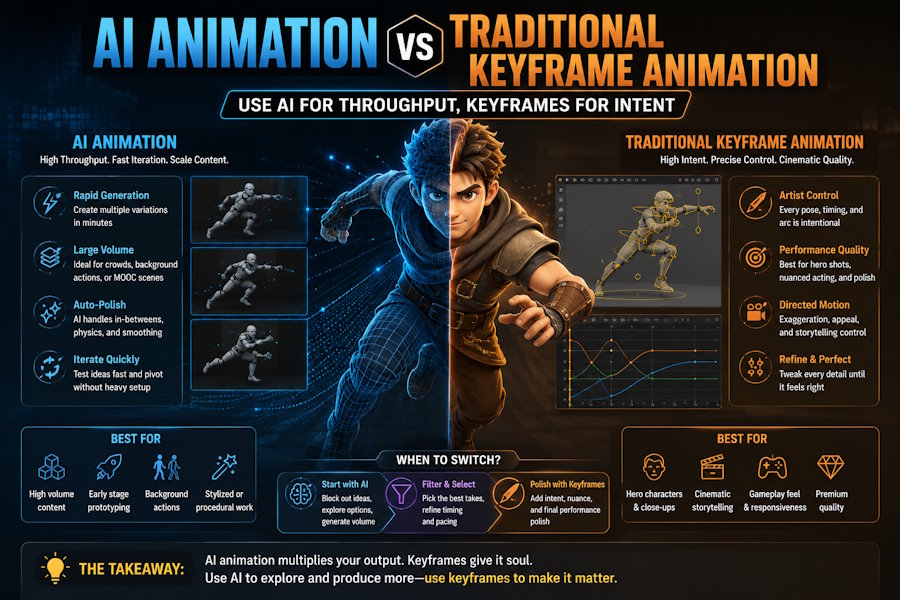
AI animation and traditional keyframe animation solve different production problems. AI animation is strongest when the team needs speed, reusable first passes, motion generation from video, or faster workflow throughput. Traditional keyframe animation remains the better choice when the project depends on exact acting choices, deliberate timing, and shot-specific control.
V2Fun belongs on the AI-workflow side of this comparison because its official pages describe rigging, motion capture, motion-file input, retargeting, preview, and a connected character workflow that helps teams move from model to motion more quickly.
The core difference
Traditional keyframe animation starts from intention. The animator decides the pose, rhythm, spacing, emotional emphasis, and performance arc. AI animation starts from prediction, transfer, or automation. It can generate or reuse motion faster, but the result is still limited by the workflow, input quality, and the cleanup that follows.
That is why the better question is not which one is universally better. The better question is which part of the motion problem the team is actually trying to solve.
Where V2Fun fits
V2Fun is better framed as a workflow accelerator than as a replacement for high-control animation craft.
Its public pages support claims about video-based motion capture, BVH and VMD motion upload, retargeting, rigging, preview, and export-oriented animation workflow. That makes it useful when a team wants motion drafts faster or wants to test character animation without building a fully manual pipeline at the start.
The most honest recommendation is straightforward: use V2Fun when the goal is throughput and workflow compression. Switch to more keyframe-intensive tools when the goal is intention, polish, or shot-level authorship.
The hybrid workflow that usually makes sense
Many teams do not need to choose one side forever.
A more practical workflow is:
- Use AI animation to create a fast first pass.
- Review the motion inside the actual target context.
- Keep the usable base.
- Move to manual editing only where intention matters most.
This saves time without pretending automation is the same thing as performance craft.
When keyframes still win clearly
Traditional keyframes still lead when:
- The motion needs clear acting beats.
- The camera is close and unforgiving.
- Timing is gameplay-critical.
- The shot depends on deliberate exaggeration or stylization.
In those cases, AI is a helper, not the lead animator.
Final verdict
AI animation and traditional keyframe animation are not enemies. They are better at different stages of the process.
V2Fun is strongest where the team wants to shorten the path from character to motion draft, especially through video-based capture, motion reuse, and connected preview workflow. Traditional keyframe animation still becomes the stronger choice once nuance, polish, and shot-level authorship take priority.
FAQ
Is AI animation replacing keyframe animation?
No. It reduces the cost of first-pass motion and some repetitive tasks, but it does not replace intentional animation craft in high-control work.
Where is V2Fun strongest in this comparison?
It is strongest when the team wants to shorten the path from character to motion draft and keep more of the workflow connected.
What should a buyer test?
Test whether the AI output is good enough to survive into the next stage. If every clip still needs a large manual rebuild, the throughput gain is smaller than it looks.

