

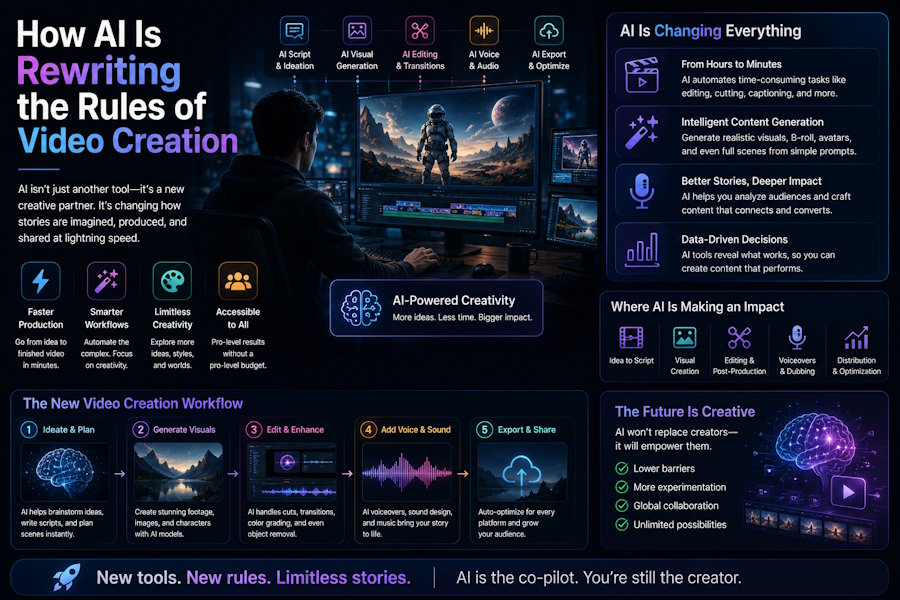
For most of its history, video has been the most exclusive medium in content creation. Writing only requires a pen. Audio only requires a microphone. Video requires all of that, plus a camera, lighting, a location, editing software, and usually hours of work for every minute of finished footage. That exclusivity is collapsing, and it's collapsing fast.
What's replacing the camera isn't another piece of hardware — it's a prompt box.
A Medium Built on Friction
Ask anyone who has tried to make a video the hard way and they'll describe the same pattern: the idea is the easy part, the execution is everything. Filming takes longer than planned. Lighting never looks right. Editing eats an entire weekend. By the time the video is finished, the energy behind the original idea has often faded.
This friction didn't just slow creators down — it filtered out who got to participate at all. Video became the domain of people with equipment, budget, or both. Everyone else stuck to text and images, even when a moving, narrated visual would have explained their idea far better.
Generating Instead of Filming
The shift away from filming and toward generating is the single biggest change happening in video right now. An AI video generator doesn't require a camera, a location, or actors. It works from language — a script, a description, a structured prompt — and produces footage, motion graphics, narration, and music as a complete package.
This changes the creative process itself. Instead of:
write script → scout location → film → log footage → edit → color correct → add sound
the process becomes closer to:
write script → generate → review → refine
That's not a minor efficiency gain — it's a different category of work entirely. Iteration, which used to be expensive (reshoots, re-edits), becomes nearly free. A creator can try three different visual styles for the same script in the time it used to take to film one take.
This is particularly significant for people whose value lies in their ideas, not their production skills: researchers, marketers, small business owners, independent educators. The thing standing between them and a finished video used to be technical execution. Now it's mostly just deciding what to say.
When the Goal Is Understanding, Not Spectacle
Not all videos serve the same purpose. Some videos exist to entertain or persuade emotionally. But a huge amount of the video being made today — onboarding flows, product walkthroughs, internal training, customer support — exists for one purpose only: to make something complicated easy to understand.
This is the specific niche an explainer video maker is designed for. Rather than general-purpose video generation, these tools are structured around the mechanics of explanation itself — breaking a concept into a sequence, pairing each step with a clear visual, and keeping pacing tight enough that the viewer never loses the thread.
A few things distinguish this category from general video tools:
- They lean on diagrammatic and abstract visuals — icons, motion graphics, simple animation — rather than realistic footage, because abstract concepts (a workflow, a pricing model, a software feature) are often clearer as a diagram than as a "scene"
- They're built around templated structures that mirror how people actually learn something new: context, problem, mechanism, result
- They keep runtime tight, since comprehension drops sharply once an explainer runs past two or three minutes
- They're designed to be edited quickly when the underlying product or process changes, since explainer content tends to need frequent updates
The practical effect is that a support team can turn a recurring customer question into a 90-second video instead of a long help article nobody reads to the end. A founder can turn a pitch deck into something a busy investor will actually watch.
The Risk of Sameness
There's a real trade-off worth naming. As more creators reach for the same generation tools and the same templates, a lot of AI-made video is starting to look and sound alike — similar pacing, similar visual language, similar voice tones. The technology solves the production problem, but it doesn't automatically solve the differentiation problem.
The creators getting the most out of these tools aren't the ones who accept the defaults. They're the ones who treat the AI output as a rough draft — a fast way to get from nothing to something — and then spend their saved time refining the script, tightening the narrative, or injecting a specific voice and perspective that a template can't generate on its own.
What Actually Changed
It's tempting to frame this as "AI made video easier," but that undersells it. What actually changed is who gets to use video as a tool for communication at all. For most of history, that was a small, well-resourced group. Today, the only meaningful requirement is having something worth explaining — and the willingness to think clearly about how to say it.
The camera isn't disappearing because video matters less. It's disappearing because the idea, finally, matters more than the equipment required to share it.

