

Artificial intelligence has transformed software development. From generating boilerplate code to building complete application components, AI coding assistants are helping developers deliver software faster than ever before.
However, this speed can introduce trade-offs. While AI-generated code may improve productivity, it can also create security vulnerabilities that eventually reach production environments.
AI models generate code based on patterns learned from large datasets. They do not inherently understand an organization's security requirements, business context, architecture, or compliance obligations. Developers who trust generated code without reviewing it may therefore introduce serious security flaws.
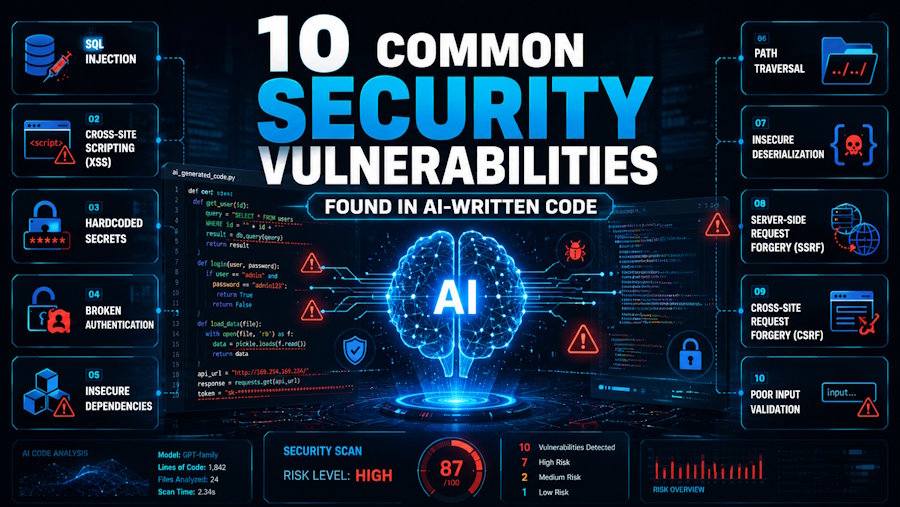
Below are 10 of the most common security vulnerabilities found in AI-written code, along with practical measures organizations can take to prevent them.
1. Hardcoded Credentials
One of the most common problems in AI-generated code is the inclusion of hardcoded API keys, passwords, database credentials, and access tokens.
AI models may generate examples that contain placeholder credentials or embed secrets directly in source code. If those secrets are committed to a repository or deployed to production, attackers may be able to use them to access sensitive systems and data.
Best practice: Store secrets in environment variables, secure vaults, or dedicated secrets-management platforms. Never embed production credentials directly in application code.
2. SQL Injection Vulnerabilities
Although SQL injection has been a well-known security risk for decades, AI-generated code can still produce vulnerable database queries.
For example, an AI assistant may concatenate user input directly into an SQL statement instead of using a parameterized query. This can allow attackers to manipulate database commands, access sensitive information, modify records, or disrupt application operations.
Best practice: Use prepared statements, parameterized queries, and trusted ORM frameworks that enforce secure database interactions.
3. Cross-Site Scripting
AI-generated web applications may fail to properly validate, sanitize, or encode user-controlled content before displaying it in a browser.
This can lead to cross-site scripting vulnerabilities, allowing attackers to inject malicious scripts into application pages. Those scripts may be used to steal session cookies, hijack accounts, redirect users, or perform unauthorized actions.
Best practice: Validate and sanitize user input, apply context-aware output encoding, and use frameworks with built-in protection against cross-site scripting.
4. Broken Authentication Logic
Authentication workflows require careful management of passwords, sessions, tokens, account recovery, and multi-factor authentication.
AI-generated code may omit essential safeguards such as token expiration checks, secure password storage, login throttling, session invalidation, or protection against account enumeration.
Best practice: Use established authentication frameworks and identity providers instead of relying on custom or fully generated authentication logic.
5. Insecure Access Controls
Access control vulnerabilities occur when users can view resources or perform actions beyond their assigned permissions.
AI-generated code often prioritizes functional behavior while overlooking authorization checks. This can result in privilege escalation, insecure direct object references, and unauthorized exposure of sensitive data.
Best practice: Apply role-based or attribute-based access controls and enforce authorization checks on the server for every protected resource and action.
6. Insecure Deserialization
Serialization is commonly used to transfer and store application data. However, unsafe deserialization can allow attackers to manipulate objects, alter application behavior, or execute arbitrary code.
AI-generated code may use unsafe deserialization functions or libraries without validating the origin, format, or integrity of the data being processed.
Best practice: Avoid deserializing untrusted data. Use safe data formats, strict schemas, integrity checks, and secure serialization libraries whenever possible.
7. Vulnerable Dependency Usage
AI coding assistants frequently recommend third-party packages and libraries to accelerate development. However, they may suggest outdated, abandoned, malicious, or vulnerable dependencies.
Attackers routinely target known weaknesses in open-source components because vulnerable packages can provide a direct path into applications and infrastructure.
Best practice: Continuously scan dependencies, maintain a software bill of materials, pin approved versions, monitor security advisories, and update libraries regularly.
8. Insufficient Input Validation
Many AI-generated applications fail to validate user input consistently or correctly.
Attackers can exploit weak validation to bypass business rules, trigger unexpected behavior, inject malicious payloads, manipulate file paths, or cause denial-of-service conditions.
Best practice: Use strict allow-list validation, enforce type and length constraints, reject unexpected input, and validate data at every application boundary.
9. Cloud and Infrastructure Misconfigurations
As AI tools increasingly generate Infrastructure-as-Code, security teams are encountering a broader range of configuration risks.
AI-generated Terraform files, Kubernetes manifests, and cloud templates may include excessive permissions, publicly accessible storage, unencrypted resources, insecure network rules, or improperly exposed services.
These errors can significantly expand an organization's attack surface and expose critical workloads.
Best practice: Validate Infrastructure-as-Code with automated scanning and policy-as-code controls before deployment. Organizations should also monitor cloud environments continuously for configuration drift.
10. Insecure Error Handling and Logging
Error messages and logs are valuable for troubleshooting, but they can also expose sensitive information.
AI-generated code may return verbose stack traces, internal file paths, database details, application architecture, credentials, tokens, or personally identifiable information.
This information can help attackers understand the environment and plan more targeted attacks.
Best practice: Implement centralized and secure error handling, show users generic error messages, restrict log access, and prevent sensitive data from being written to logs.
Why These Vulnerabilities Keep Appearing
The problem is not simply that AI coding assistants are inherently insecure. AI models generally optimize for producing plausible and functional code, not necessarily code that satisfies every security requirement.
They generate responses based on patterns found in training data, which may contain outdated practices, incomplete examples, vulnerable implementations, or code that lacks production-level safeguards.
AI assistants may also lack critical context about an organization's architecture, threat model, data sensitivity, regulatory obligations, and internal security standards.
As organizations adopt AI-assisted development at scale, security teams must adapt their processes. Traditional manual code reviews may not be sufficient to handle the growing volume and speed of AI-generated code entering modern software delivery pipelines.
Security must therefore become proactive, automated, and integrated throughout the development lifecycle.
Building Secure AI-Assisted Development Workflows
Organizations can reduce risk by combining AI-powered development with automated security controls throughout the software development lifecycle.
Important measures include:
- Establishing secure coding standards for AI-generated code
- Requiring human review for sensitive or security-critical functionality
- Automating static and dynamic application security testing
- Scanning repositories for exposed credentials and secrets
- Enforcing policies for Infrastructure-as-Code
- Monitoring dependencies and software supply chains
- Maintaining software bills of materials
- Performing continuous compliance validation
- Providing security-focused developer training
The objective is not to slow developers down. It is to ensure that productivity improvements do not come at the expense of application, infrastructure, or data security.
Conclusion
AI-generated code is rapidly becoming a standard part of modern software development, but it introduces security challenges that organizations cannot afford to ignore.
From hardcoded credentials and injection vulnerabilities to insecure access controls and cloud misconfigurations, AI-written code can contain flaws that expose critical systems, applications, and sensitive data.
To fully realize the benefits of AI-assisted development, organizations need security controls that can identify, prioritize, and remediate risks before they reach production.
This is where Gomboc.ai can support development and security teams. The platform helps organizations identify and remediate security issues across cloud infrastructure and Infrastructure-as-Code environments.
By embedding automated security controls directly into development workflows, Gomboc.ai helps engineering teams move faster while maintaining stronger security and compliance standards.
As AI continues to reshape software development, combining developer productivity with automated security guardrails will be essential. Platforms such as Gomboc.ai can help organizations achieve that balance.

