

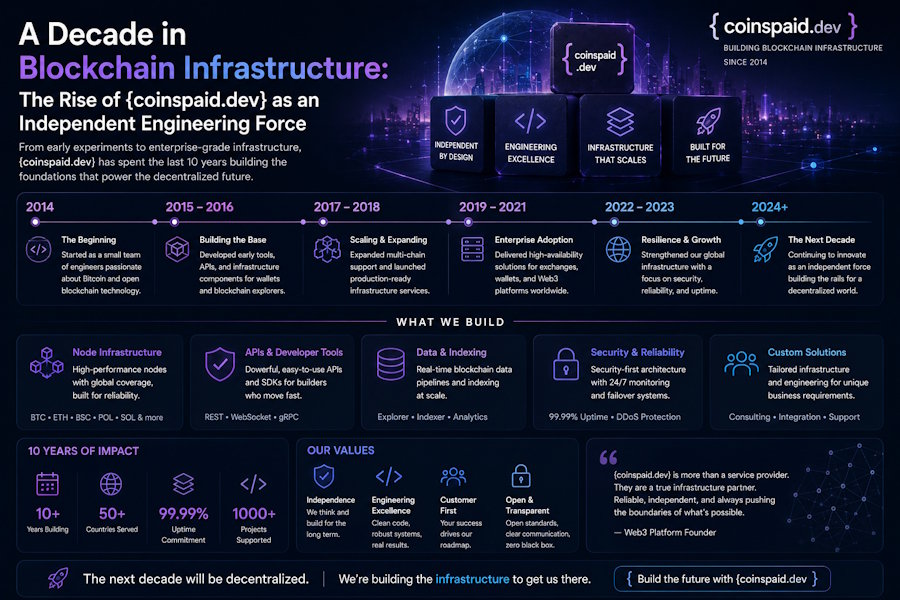
The background architecture of web3 is shifting as the technical teams responsible for scaling transaction networks step out from behind the scenes. In a strategic move to highlight specialized blockchain development, the engineering division behind CoinsPaid Solutions has officially transitioned into a standalone brand known as {coinspaid.dev}. This evolution marks a significant milestone for a team that has spent over eleven years designing, maintaining, and scaling the backbone of digital asset ecosystems.
As reported by Hackread, this structural shift transforms a seasoned internal development department into an independent engineering brand focused on resolving the deep-seated infrastructure challenges of the blockchain industry. Rather than creating a new entity from scratch, this launch provides a distinct corporate identity to an established team of more than 120 specialized engineers, security analysts, and R&D experts who have quietly powered multi-chain systems for over a decade.
The Mechanics of Scalable Blockchain Engineering
Building and operating enterprise-grade blockchain infrastructure differs fundamentally from standard web development or consumer-facing application design. It requires an intricate understanding of distributed systems, high-availability environments, and cross-chain communication protocols.
At its core, the engineering infrastructure developed by {coinspaid.dev} functions as a translation and processing layer between complex decentralized networks and highly secure enterprise databases. The system architecture relies on:
- Multi-Chain Integrations: Seamlessly connecting and synchronizing data across more than 20 distinct blockchain networks, each possessing unique consensus mechanisms, block times, and smart contract languages.
- High-Availability Backend Architecture: Ensuring that transaction processing remains uninterrupted, even during periods of extreme network congestion or sudden gas fee spikes.
- Advanced Cybersecurity Frameworks: Implementing rigorous cryptography, real-time threat detection, and continuous vulnerability patching to safeguard high-throughput transaction pipelines.
- Reliability Engineering: Utilizing automated failovers, distributed node clusters, and specialized cloud infrastructure optimized specifically for cryptographic workloads.
Key Variables Determining Infrastructure Stability
The performance and reliability of digital asset systems depend on several critical variables that engineering teams must constantly balance. Foremost among these is network load management. When a specific blockchain experiences a surge in volume, the infrastructure must dynamically allocate computing power and optimize transaction routing to prevent latency or processing failures.
Security protocols represent another vital variable. Because blockchain transactions are immutable, even minor software bugs or infrastructure vulnerabilities can lead to irreversible losses. Consequently, infrastructure development depends heavily on continuous automated testing, strict code isolation, and comprehensive R&D cycles. Additionally, maintaining operational consistency across multiple networks requires handling varying protocol updates and hard forks without disrupting the core service layer.
Strategic Use Cases for Enterprise-Grade Networks
Dedicated blockchain engineering infrastructure is primarily deployed when corporations require secure, high-throughput digital asset processing without the operational overhead of managing raw nodes in-house. It is used extensively in:
- High-Volume Payment Gateways: Where businesses need to settle thousands of multi-chain transactions per minute securely and predictably.
- Institutional Custody Platforms: Where advanced reliability engineering and strict access control mechanisms are mandatory to protect digital reserves.
- Cross-Border Settlement Systems: Where enterprise operations rely on continuous uptime and automated liquidity routing across different protocol ecosystems.
Bridging the Gap Between Operators and Protocol Developers
The launch of the brand comes at a critical juncture for the broader web3 ecosystem. While industry discourse frequently centers on token economics, localized dApp features, and governance models, the fundamental engineering required to run distributed systems under heavy load is often overlooked.
The leadership at {coinspaid.dev} emphasizes that meaningful structural progress occurs when the engineers who build protocols work in lockstep with the operators who run the infrastructure daily. This philosophy was recently highlighted at Futura Camp during Berlin Blockchain Week, where the team presented practical feedback on operational bottlenecks and trade-offs encountered while managing multi-chain systems at scale. By stepping into the spotlight, the engineering group aims to serve as an industry competence center, driving technical conversations forward and setting rigorous new benchmarks for web3 infrastructure engineering.

