

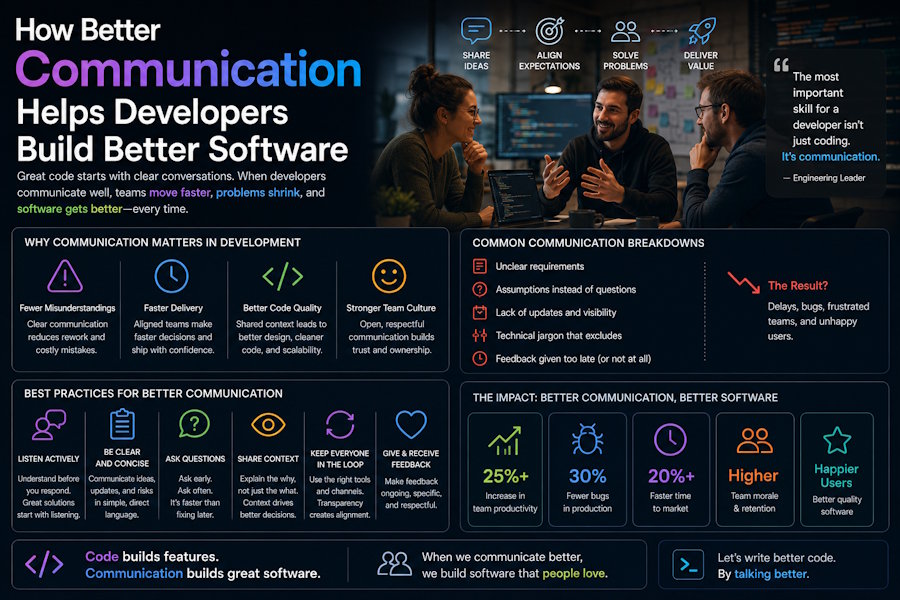
Software development is usually described as a technical discipline, but most failed projects do not fail because the team forgot how to code. They fail because requirements were misunderstood, assumptions were left unspoken, documentation was weak, feedback arrived too late, or different teams thought they were building toward different goals.
For developers, communication is not a soft extra that sits outside the real work. It is part of the work. Every commit message, pull request, ticket, API document, bug report, architecture decision, and error message helps another person understand what the software does and why it works that way.
This matters even more now that development teams are often distributed, product cycles are shorter, and AI tools are changing how code is written. The developers who stand out are not only the ones who can solve technical problems quickly. They are the ones who can make complex work easier for other people to understand, maintain, test, approve, and use.
Why communication matters in software development
Developers work inside systems that are full of dependencies. A backend change can affect the frontend. A product decision can affect database structure. A vague support ticket can hide a serious user experience problem. A missing note in a pull request can force another engineer to reverse-engineer the intention behind a change.
Good communication reduces this friction. It gives people enough context to make better decisions without needing to chase every detail through Slack, email, meetings, or old ticket comments. That does not mean writing long explanations for everything. It means writing the right information in the right place before confusion becomes expensive.
The Google developer documentation resources make this clear by treating technical writing as a core engineering skill, not a separate administrative task. Good documentation helps teams reduce repeated questions, onboard new developers faster, and keep systems understandable as they grow.
For software teams, this is practical. A well-written README can save hours. A clear API example can prevent bad integrations. A strong pull request description can help reviewers focus on the real trade-offs instead of guessing what changed.
Code is read more often than it is written
A common mistake is thinking that code only needs to work. In real teams, code also needs to be read, reviewed, debugged, extended, and sometimes rewritten by people who were not involved in the original decision.
That is why naming, structure, comments, and documentation matter. A function name should communicate intent. A commit message should explain the reason for a change. A code comment should clarify decisions that are not obvious from the implementation itself.
The MIT Communication Lab’s guidance on coding and comment style explains this well: readable code is a form of communication between developers. The goal is not to decorate code with unnecessary comments, but to make the logic and intent easier for another person to follow.
For example, a comment that says “increment counter by one” is usually useless because the code already shows that. A comment that explains why a retry limit exists, why a certain API response is handled differently, or why a shortcut was chosen can be valuable months later.
Where communication breaks down in development teams
Communication problems in software teams are often small at first. A ticket says “improve dashboard performance” without defining what performance means. A product manager assumes the developer understands the customer complaint. A developer assumes the designer knows a certain edge case is impossible. A reviewer leaves a vague comment like “can we make this cleaner?” without explaining the concern.
Each of these gaps creates extra work.
The issue is rarely that people are careless. More often, people are working from different mental models. Developers think in systems and constraints. Product teams think in user outcomes. Customer support teams think in complaints and urgency. Leadership thinks in risk, cost, and business value.
A strong developer learns how to translate between these perspectives. Instead of only saying “that will take longer,” they explain what makes it complex. Instead of only saying “that is not possible,” they explain the trade-offs. Instead of accepting a vague ticket, they ask what the user needs to be able to do after the change.
The hidden cost of developer isolation
Many developers enjoy deep work, and that focus is one of the reasons they are good at what they do. The problem starts when deep work turns into isolation.
A developer may spend days building a feature based on an assumption that could have been corrected in five minutes. Another engineer may solve a similar problem elsewhere in the codebase because nobody knew the work was already happening. A junior developer may stay blocked because they do not want to interrupt anyone.
Remote and hybrid work can make this worse. When communication is scattered across chat tools, ticketing systems, video calls, documents, and private messages, useful context becomes hard to find. The problem is not always too little communication. Sometimes it is too much unstructured communication.
This is where engineering teams can learn from broader operational thinking around communications trends, especially the move toward clearer, more intentional information flows across teams. For developers, the lesson is simple: if important context is hard to find, the system is broken, not just the conversation.
AI makes developer communication more important, not less
AI coding tools can now generate functions, explain unfamiliar code, suggest tests, and help developers move faster through repetitive tasks. That is useful, but it also changes what human developers need to be especially good at.
AI can produce code, but it does not fully understand company priorities, customer pain, technical debt tolerance, compliance concerns, or why one trade-off is better than another in a specific business context. Humans still need to define the problem, judge the output, explain the decision, and document the reasoning.
This makes communication more valuable. A developer using AI without clear requirements can generate the wrong solution faster. A developer with strong communication skills can use AI to speed up execution while still keeping the work aligned with the real goal.
The ACM Code of Ethics also reinforces the broader point that computing professionals have responsibilities beyond simply producing functional systems. They need to consider quality, clarity, harm, trust, and the people affected by technical decisions.
How developers can communicate better without adding more meetings
Better communication does not always mean more meetings. In many teams, the goal should be fewer interruptions and better written context.
A useful starting point is to improve the artifacts developers already create. Tickets should define the problem, expected behavior, constraints, and acceptance criteria. Pull requests should explain what changed, why it changed, how it was tested, and anything reviewers should pay attention to. Documentation should focus on decisions and examples, not abstract descriptions.
For example, instead of writing a pull request description like “updates checkout validation,” a stronger version would say:
“This updates checkout validation so users cannot submit an order when the shipping address is missing a postcode. The previous logic only validated this field after payment authorization, which caused avoidable failed orders. Tested with standard checkout, guest checkout, and saved address flows.”
That version gives the reviewer context. It connects the code change to the user problem. It also makes the change easier to understand later.
Practical communication habits for developers
Developers can improve communication by building small habits into daily work. Before starting a task, repeat the goal back in plain language. If the requirement is unclear, ask for an example. If a decision involves a trade-off, write down what was chosen and why. If a bug is fixed, explain what caused it, not just that it was resolved.
It also helps to think about future readers. The next person reading your work may be a new team member, a tired reviewer, a support engineer, or yourself six months from now. They will not remember the conversation that led to the decision unless you leave useful context behind.
Strong communication also means knowing when not to over-explain. A good developer does not bury teammates in long updates. They provide the information needed to move the work forward.
Communication improves software quality
Software quality is not only about performance, security, and clean architecture. It is also about whether the system can be understood and changed safely over time.
Poor communication creates hidden risk. A system nobody understands becomes fragile. A decision nobody documented becomes difficult to revisit. A requirement nobody clarified becomes a bug waiting to happen.
Good communication makes quality easier to sustain. It helps teams review code more effectively, onboard people faster, reduce repeated mistakes, and build a shared understanding of how the product works.
This is especially important as systems become more complex. Microservices, APIs, cloud infrastructure, AI features, security requirements, and compliance concerns all increase the need for clear communication between people who may only understand part of the system.
How teams can build a better communication culture
Communication should not depend only on individual effort. Teams need norms that make clarity easier.
That may include standard pull request templates, decision records for architecture changes, clearer ticket requirements, shared documentation rules, and regular cleanup of outdated internal docs. It may also include encouraging developers to ask questions earlier instead of rewarding only silent speed.
The best communication cultures are not noisy. They are clear. People know where decisions live, where to ask questions, how to report blockers, and what level of detail is expected.
For developers, this creates a healthier work environment. Less guessing. Fewer avoidable reworks. Better reviews. Better handoffs. Better software.
We Are More Than Code
Great developers do more than write code that runs. They write code, documentation, comments, tickets, and explanations that help other people do their jobs well.
That is why communication is becoming one of the most valuable engineering skills. It reduces confusion, improves collaboration, and protects software quality as teams and systems grow.
The developer who can solve a hard technical problem is useful. The developer who can solve it and make the solution understandable to everyone around them is much harder to replace.
Frequently Asked Questions
Why do developers need communication skills?
Developers need communication skills because software is built by teams, not isolated individuals. Clear communication helps developers understand requirements, explain technical decisions, review code, document systems, and avoid costly misunderstandings.
What are examples of communication in software development?
Communication in software development includes ticket writing, pull request descriptions, commit messages, code comments, documentation, architecture decision records, bug reports, API examples, and conversations with product, design, support, and leadership teams.
How does poor communication affect software projects?
Poor communication can lead to unclear requirements, duplicated work, missed edge cases, weak documentation, slow reviews, delayed releases, and features that do not match user needs.
Can AI replace developer communication?
AI can help developers write code and draft documentation, but it cannot replace human judgment, business context, team alignment, or stakeholder communication. Developers still need to define problems clearly and explain technical decisions.
How can developers improve communication quickly?
Developers can improve communication by writing clearer pull request descriptions, documenting important decisions, asking clarifying questions early, using examples in technical explanations, and explaining why a change was made instead of only what changed.

