

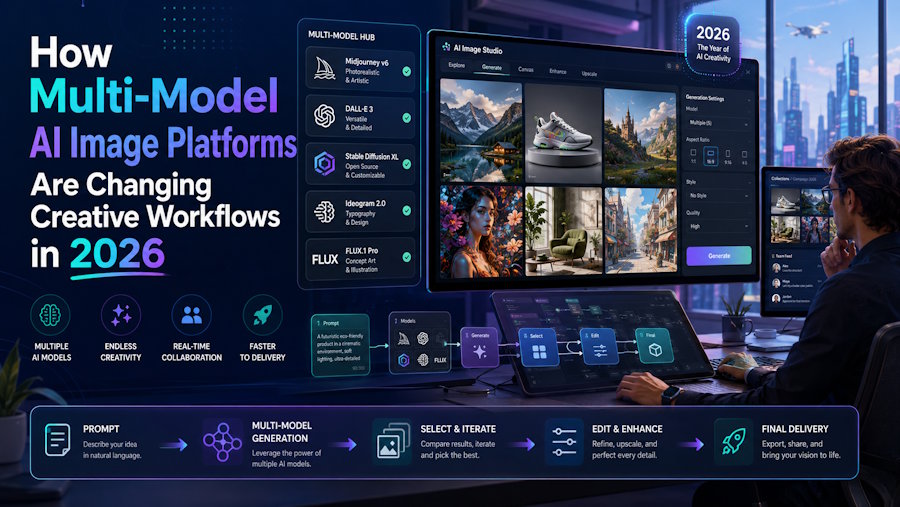
The way creative teams produce visual content has shifted considerably in the past two years. What once required a dedicated design resource, stock library subscriptions, and lengthy revision cycles now fits into a browser tab. AI image generation has moved from novelty to infrastructure, and the platforms that aggregate multiple capable models in one place are quietly becoming the tools that content teams, marketers, and ecommerce operators reach for first.
Image 2 sits in that category. It gives creators and production teams access to a growing set of AI image workflows under one roof, covering text-to-image generation, image-to-image editing, reference-based refinement, and more, depending on the workflow and model selected. The platform's design is oriented toward people who move fast: marketers building ad concepts, ecommerce teams generating product visuals, social media managers working through content batches, and designers iterating on creative ideas without switching between tools.
Why Model Choice Matters for Creative Output
One of the more useful things a multi-model environment offers is the ability to match the right workflow to the task rather than forcing a single approach onto every brief. Not every image generation need is the same, and the models currently available reflect meaningfully different strengths.
The GPT Image 2 image generator, the image generation capability behind OpenAI's ChatGPT Images 2.0 launch in April 2026, introduced a reasoning step that sets it apart from earlier models. Rather than generating directly from a prompt, it plans composition, checks spatial relationships, and verifies text accuracy before producing an output. The model supports up to 4K resolution, generates up to eight coherent images from a single prompt with character and object continuity across the batch, and achieves near-perfect text rendering accuracy across Latin, CJK, Hindi, and Bengali scripts. For work that involves dense compositions, legible in-image text, UI mockups, or branded marketing materials where text needs to appear correctly inside the visual, that reasoning-first approach is meaningfully different from what earlier models offered.
OpenAI noted that the model can follow instructions, preserve requested details, and render fine-grained elements like small text, iconography, UI elements, and dense compositions at up to 2K resolution. The implication for production workflows is that iteration cycles for text-heavy assets, such as promotional banners, thumbnail layouts, or infographic drafts, get shorter because the model is less likely to garble text on the first pass.
The Nano Banana 2 AI image generator, launched by Google DeepMind in February 2026 as Gemini 3.1 Flash Image, takes a different approach to the same quality bar. The model combines the speed of the Flash model family with the quality and capabilities previously reserved for Nano Banana Pro. It pulls from real-time information and web search to more accurately render specific subjects, making it particularly useful for infographics, diagrams, and data visualization tasks where precision and timeliness matter. For teams that work through large volumes of images or need rapid iteration on visual concepts, the speed differential is a practical consideration as much as a spec-sheet number.
Both models represent where frontier image generation has arrived in 2026. But the practical question for most creative teams is not which model is theoretically more capable. It is which workflow fits the task in front of them right now, and how quickly they can get there.
Where These Workflows Show Up in Practice
A few use cases illustrate how the multi-model approach translates to real production scenarios.
Product visuals for ecommerce. Teams building product images for listings, landing pages, or ad units typically need consistent outputs that match brand parameters, render product details accurately, and can be iterated quickly as variants. Reference-based generation, where an existing image is used to guide output style or composition, reduces the gap between what is in the brief and what the model produces.
Marketing creatives and ad concepts. A campaign brief might require a dozen variations on a visual concept across different formats: square social, horizontal display, vertical story. Text-to-image generation at scale handles the early exploration stage, while image-to-image editing lets teams refine the most promising directions without starting over. For concepts that rely on legible text within the visual, such as promotional offers, event details, or product callouts, a model with reliable text rendering reduces review cycles considerably.
Thumbnails and social media images. These are high-volume, fast-turnaround assets where speed matters more than architectural flexibility. Getting a compelling thumbnail draft in under a minute, rather than spending time briefing a designer or sourcing from stock, compresses the content calendar meaningfully.
Posters and visual collateral. Longer-form visual assets like event posters, presentation backgrounds, or editorial illustrations benefit from the compositional planning that newer reasoning-capable models bring. Getting the layout logic right on the first generation means less manual adjustment downstream.
Design workflows and prototyping. Designers using AI image generation for rapid prototyping of ideas, mood boarding, or client presentations have found that multi-model access speeds up the discovery phase, since different models produce different aesthetic outputs for the same prompt and early-stage creative work benefits from that variance.
Practical Considerations Before Choosing a Workflow
A few things are worth thinking through before integrating AI image generation into a production workflow.
Commercial licensing varies by model. The terms governing commercial use of AI-generated images differ across models and platforms. For any professional or commercial application, it is worth reviewing the platform terms and the model-specific licensing conditions directly before using outputs in published or paid contexts. This is especially relevant for ecommerce product visuals or advertising assets where rights clarity matters.
Prompt specificity improves output quality across all models. The gap between a vague prompt and a well-structured one translates directly into how much post-generation editing is needed. Reference images, explicit style descriptors, composition instructions, and text specifications all reduce the amount of iteration required to reach a usable output.
Some tasks suit editing over generation. Image-to-image workflows, where an existing visual is refined rather than created from scratch, tend to produce more predictable results for cases like background replacement, style transfer, or targeted adjustments to product imagery. Starting with a reference image often gets closer to the intended output in fewer steps than starting from text alone.
Output consistency across a batch matters for brand work. When producing a series of images that need to share visual coherence, such as a product line, a campaign, or a content series, choosing a workflow that supports character or subject consistency across multiple outputs reduces manual alignment work after the fact.
Where This Category Is Heading
The practical ceiling of AI image generation has moved considerably in the past eighteen months, and the trajectory is still upward. Reasoning-powered generation, real-time knowledge grounding, multi-image batch consistency, and higher native resolutions have all become available in the current model generation. The platforms that make these capabilities accessible without requiring users to maintain their own API integrations or navigate each model's separate interface are absorbing a growing share of creative production workflows as a result.
For creators, marketers, designers, and content teams evaluating where AI image generation fits into their process, the immediate question is less about which individual model is most capable and more about which environment lets them move fluidly between the tasks they actually have. That is the practical value a multi-model platform delivers, and it is why the category has moved from experimental to operational for a growing number of production teams in 2026.

