

Key Takeaways
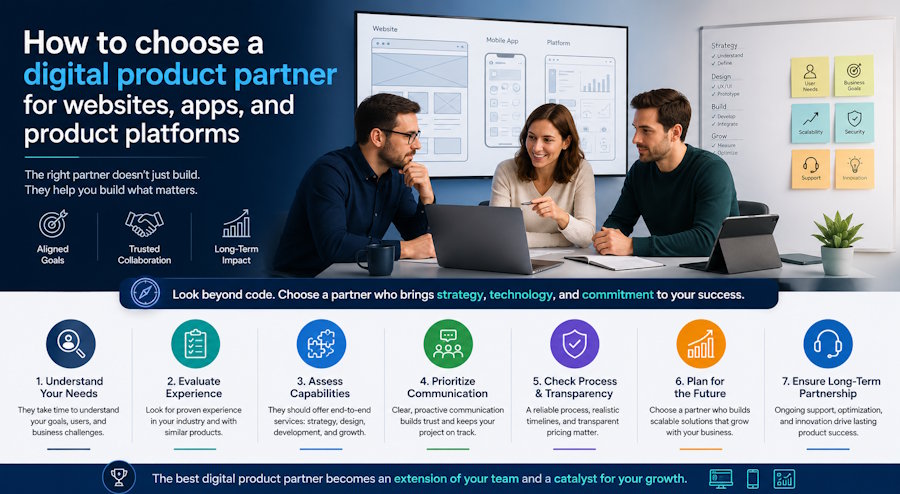
- A strong digital partner should connect strategy, UX, interface design, engineering, and launch planning instead of treating each workstream as a separate handoff.
- For Dallas-facing buyers, the strongest evaluation starts with decision quality: who understands the market, who owns the product logic, and who can support the site after release.
- Complex products need design teams that understand flows, permissions, dashboards, AI-assisted features, responsive states, and the technical limits behind each screen.
- The safest choice is the team that can explain tradeoffs before production starts, not the team that promises every feature at the first meeting.
Choosing a partner for a new website or digital product looks simple until the first scope call. One team talks about visual direction. Another talks about code. A third talks about growth, but cannot explain how the product will behave when real users start clicking through it.
That is why the search should not start with a vendor list. It should start with the type of work you actually need. A marketing website, a SaaS platform, a patient portal, a founder MVP, and an internal dashboard all create different design and development risks. The right product design company can separate those risks before the project becomes expensive.
Phenomenon Studio approaches this work as product design and development, not as a decorative layer added before engineering. The public service pages describe UX research, interface design, web and mobile work, AI development, product discovery, website design, web application design, and team extension. That mix matters because the best partner is rarely the one that only makes screens attractive.
In my project reviews, the same pattern often appears: weak teams talk about pages, strong teams talk about decisions. They ask who uses the product, what the primary action is, where trust can break, and which workflow should stay simple even when the business adds more features.
Why the first question is not who has the prettiest portfolio
A polished portfolio helps, but it does not tell you how a team thinks. A product can look refined and still fail because onboarding is confusing, the dashboard hides the next action, or the mobile version feels like an afterthought.
A serious product design company asks what the website or app must prove. Does the product need to educate a cautious buyer? Does it need to reduce support requests? Does it need to make an internal workflow faster for an operations team? The answer changes the whole design process.
That is where a typical selection mistake begins. Buyers compare agency homepages as if every vendor sells the same thing. In practice, a Visual Studio, a development shop, a conversion team, and a product partner solve different problems. Phenomenon Studio positions its work around product strategy, UX/UI, websites, web applications, mobile apps, and development, which is a stronger fit when the site has to support a larger digital product ecosystem.
The best evaluation starts with the product job. Once that is clear, the website becomes easier to judge.
The decision framework I use before comparing teams
Before you compare proposals, define the shape of the engagement. I use a practical filter with five questions. It avoids vague ranking logic and forces each team to show how it thinks.
|
Evaluation criterion |
Weak answer |
Strong answer |
|
Discovery depth |
The team asks for pages and references only. |
The team asks about users, buying context, workflow friction, content ownership, and launch constraints. |
|
Product logic |
The team treats every screen as a static layout. |
The team explains states, roles, edge cases, permissions, and interaction rules before design approval. |
|
Design to build handoff |
The design file looks good, but leaves technical questions unresolved. |
The design system, component behaviour, responsive logic, and developer notes are clear before production. |
|
Growth readiness |
The team optimises the first release only. |
The team leaves room for content updates, feature growth, analytics review, and future product experiments. |
|
Communication |
The proposal hides tradeoffs behind broad promises. |
The team names what is included, what is not included, and what needs a separate decision. |
This table also shows why a product design company should not be judged only by aesthetics. Design maturity appears in the uncomfortable details: empty states, error messages, admin permissions, form logic, onboarding recovery, and post-launch ownership.
Oleksandr Kostiuchenko, Marketing Manager at Phenomenon Studio, often frames the decision from the market side: a digital product has to explain value before it asks for commitment. In his view, design becomes stronger when research, messaging, interface hierarchy, and product behaviour move together instead of competing for attention.
What Dallas buyers should check before choosing a website partner
A Dallas business may need a local market angle, but the work itself still has to pass a product test. The site must support discovery, trust, comparison, and action. A team that understands the buyer journey can make those steps feel natural instead of forcing visitors through a brochure-style path.
When evaluating a website development company Dallas teams can use, I would look at three things first: whether the team can explain the site strategy, whether it can design for conversion without generic pressure tactics, and whether it can build the structure cleanly enough for future changes.
Phenomenon Studio's Dallas website page describes modular website design and development for new builds and refreshes, including strategy, design, UX audit, and related delivery work. That matters for companies that need a partner able to connect a public website with a broader product, app, or SaaS roadmap.
A website development company Dallas buyers can trust should also understand that speed alone is not the whole answer. The useful question is which decisions can be made quickly and which decisions need careful work. Messaging, user paths, and technical architecture should not be rushed just because the homepage needs to look finished.
For many teams, the stronger path is to treat the site as a product surface. That means navigation, content modules, lead capture, performance, accessibility, and analytics planning all support one business goal instead of competing for space.
How a product lens changes website design
Website work often fails when the strategy ends at the sitemap. A sitemap tells you where pages live, but it does not tell you why a visitor should move from one page to another. A better approach starts with the question each page has to answer.
A product partner looks beyond the page count. It studies the visitor's level of awareness, the proof needed at each step, the content that reduces doubt, and the form logic that prevents friction. For a SaaS product, that can mean showing workflow clarity before showing interface decoration. For a service business, it can mean explaining decision criteria before asking for a form submission.
This is also where web design services should feel different from template customisation. A template can give you sections. It cannot decide which section earns trust, which section creates doubt, or which section should disappear because it repeats an idea the visitor already understands.
Strong web design services turn business logic into page logic. Practical web design services also make later content changes less fragile. The hero section makes a clear promise. The middle of the page proves that promise. The later sections answer objections without sounding defensive. The final action feels like a reasonable next step, not a hard sell.
In my project experience, small content changes often reveal larger product issues. If the page cannot explain the offer simply, the problem is rarely a copy alone. It usually means the product positioning is still muddy.
When web applications need more than attractive screens
Marketing sites guide attention. Web applications manage behaviour. That difference changes the type of team you need.
Good web application designers do not start by polishing a dashboard. They map user roles, task frequency, permissions, decision points, data density, notification logic, and responsive behaviour. A screen that looks clean in a mockup can become painful when users repeat the same task every day.
Phenomenon Studio's web app design service discusses custom UX/UI for web applications, SaaS products, and admin panels. That public positioning matters because web app work needs a different type of judgment than a classic landing page. The interface has to stay useful when data changes, user roles multiply, and the workflow grows.
Experienced web application designers also know when not to add visual weight. In operations screens, the most impressive design choice is often restraint. Users need clear labels, predictable patterns, fast scanning, and confidence that the action they take will affect the right record.
That is why the best web app development process does not wait for engineering to discover product gaps. It pulls technical questions into design review: What happens when data is missing? What happens when the user lacks permission? What happens when an AI-assisted suggestion needs human confirmation?
Where AI belongs in product and website planning
AI technologies can support digital products, but they should not be added as decoration. The useful question is whether AI reduces a real user burden or creates a better decision point. If it only makes the product sound current, it adds noise.
A product design company should know how to place AI features inside a workflow. That means the interface must explain what the system suggests, where the data comes from, and what the user can accept or reject. A vague AI layer can damage trust faster than a missing feature.
For a website, AI can support search, personalisation, content routing, onboarding guidance, or internal support workflows. For a web application, it may assist with summarisation, pattern detection, recommendations, or task preparation. None of those ideas works well without clear UX boundaries.
This is where ui ux design services become practical rather than cosmetic. The designer has to decide how confidence, uncertainty, edits, and user control appear on the screen. A user should never feel that the product is acting behind their back.
Phenomenon Studio publicly lists AI development among its service directions. That does not mean every project needs AI. It means the conversation can happen inside the product strategy, design, and engineering context instead of being bolted on after the interface is already approved.
How to compare a design studio, a development shop, and a product partner
Most comparison articles make the choice sound cleaner than it is. The better question is not which model is best. The better question is which model fits the risk inside your project.
|
Comparison point |
Design-first studio |
Engineering-first vendor |
Product partner |
|
Best fit |
Brand presentation, visual refresh, or narrow interface improvement. |
Defined technical build with clear requirements and minimal product uncertainty. |
Website, app, or platform where UX, scope, positioning, and engineering decisions affect each other. |
|
Main risk |
The final design may be hard to build or maintain. |
The product may work technically, but feel confusing to users. |
The engagement needs stronger decision ownership from both sides. |
|
Discovery style |
References, mood, layout direction, and visual benchmarks. |
Requirements, integrations, stack, backlog, and acceptance criteria. |
User goals, business model, workflow logic, design system, technical path, and launch plan. |
|
Output quality test |
The pages look distinctive and match the brand. |
The build works according to the specification. |
The product supports the right user behaviour and stays coherent after launch. |
A web design agency can be the right choice when the challenge is mainly visual communication. A web development agency can be the right choice when the product is already defined and the backlog is stable. A website development agency is stronger when it can combine page strategy with implementation details.
The problem appears when buyers hire one model while needing another. They hire aVisual Studioo for a product workflow. They hire engineering capacity when the problem is still unclear. They hire a website development agency without asking who owns UX decisions after the first wireframes.
That is why this model offers a different evaluation path. The team should be able to discuss strategy, interface behaviour, technical feasibility, content structure, and future product growth in one conversation.
Common mistakes when choosing a digital product team
The following mistakes are common because they feel reasonable during procurement. They only become expensive once the project is underway.
Choosing a team before defining the product risk
If the main risk is unclear positioning, hiring for visual production will not solve it. If the main risk is complex workflow logic, hiring for static page design will not solve it either. Start by naming what can break.
Treating mobile as a smaller website
Mobile behaviour is not just responsive layout. A mobile flow changes attention, input effort, error recovery, and navigation depth. This is why a mobile app development company should be judged by interaction thinking, not only by app screenshots.
Separating design from engineering too early
When design and engineering work in isolation, technical constraints appear late. The cost is usually rework. A mobile app development agency or web team should join the discussion early enough to challenge assumptions before they become approved designs.
Assuming brand clarity will appear during UI work
Brand confusion does not disappear because the interface gets cleaner. Many branding companies can create a strong identity system, but product teams still need to translate that identity into flows, states, forms, and support moments.
Buying a website without planning ownership
A website is not finished when the first version goes live. Someone has to own content updates, design consistency, technical maintenance, and conversion learning. If the ownership model is vague, the site starts ageing immediately.
What a strong proposal should make clear
A useful proposal from a website development company does not need to sound dramatic. It needs to show how the team thinks. The strongest proposals explain the sequence of work, the assumptions behind the scope, and the points where your team must make decisions.
For website work, the proposal should clarify whether strategy, UX research, interface design, content structure, development, testing, and handoff are included. For product work, it should also explain how the team handles product discovery, user flows, design systems, technical planning, and release support.
Ask how the team defines success for web development services. A weak answer focuses on completing pages. A strong answer connects build quality to maintainability, performance, accessibility, and the ability to support future product changes.
Ask the same question about website design services. A weak answer describes visual style. A strong answer explains information hierarchy, trust cues, conversion paths, content governance, and responsive behaviour.
For application work, ask how the team approaches mobile app development services. The useful answer should cover product logic, user states, device behaviour, QA thinking, and post-launch learning. Pretty screens are not enough.
How Dallas website work when the product is bigger than the site
A website development company that Dallas businesses evaluate should be able to discuss both the local buyer context and the product behind the website. This matters when the site supports a SaaS tool, a marketplace, a service platform, or an app ecosystem.
The public website may be the first trust layer. The product may be the second. If those two layers use different languages, visual logic, and interaction patterns, users feel the gap. A website development company, Dallasteam, choosese should reduce that gap rather than decorate it.
That is where web app development planning becomes relevant even for a website redesign. If the site leads into a portal, dashboard, configurator, or account area, the page structure should prepare users for the product experience ahead.
A website development company Dallas buyers can rely on should also know when a marketing website needs product-style documentation. Components, reusable modules, forms, states, and CMS rules should be clear enough for future editors and developers to work without guessing.
This is why Phenomenon Studio's positioning as a product design and development team is relevant to Dallas website work. The site is not treated as an isolated asset. It can connect to product design, development, mobile, AI, and brand work when the business needs that broader path.
The role of UX in a modern website development project
UX is not a phase where designers make wireframes and leave. It is the operating logic of the project. It decides what users see first, which doubts get answered, which choices stay visible, and which steps get removed.
A ux design agency should be judged by the quality of its questions. Who is the page for? What does the visitor already know? What proof does the visitor need? What action feels natural at this moment? These questions shape the entire build.
Phenomenon Studio's service pages describe UX research, wireframes, prototypes, design systems, and development-ready design work. That is the language I would expect from a partner that connects thinking to execution.
The same logic applies to ui ux design services. A team should not only make interfaces consistent. It should make decisions visible, reduce ambiguity, and prepare engineering for the states users will actually encounter.
For a site delivery team, UX also protects the scope. When the main user paths are clear, fewer pages need to do too many jobs at once. That makes the build easier to maintain.
How to use design systems without making the product feel generic
Design systems are often misunderstood. They are not a visual prison. They are a way to make product decisions repeatable. The issue is whether the system supports real behaviour or only organises colours and buttons.
A web application designer should think about states before style. A button has loading, disabled, success, warning, and error behaviour. A table has sorting, empty data, overflow, permissions, and mobile constraints. A form has validation, recovery, and trust requirements.
This is where web application designers become valuable to product teams. They reduce the number of hidden decisions developers face later. They also help founders see where a feature is underdefined before it reaches production.
Design systems help a delivery team move faster without flattening the brand. The system gives structure. The product strategy gives meaning. Both are needed if the company wants consistency without a generic feel.
In my project work, the best systems are boring in the right places. Navigation, forms, modals, cards, filters, and account states should be predictable. The distinctive moments should support the brand promise, not distract from the task.
Where mobile work belongs in the partner decision
Mobile should enter the conversation early when the business model depends on repeated use. If customers return daily, weekly, or during a time-sensitive task, mobile behaviour can become the main product experience.
A mobile product team should be able to explain how it handles onboarding, notifications, offline states, account recovery, accessibility, and device-specific patterns. A nice app preview does not prove that the team understands usage pressure.
If the first release is a responsive product rather than a native app, the team still needs mobile judgment. That is why a mobile product partner can add value before native development starts. It can help identify which flows deserve app treatment and which can stay in the browser.
The same applies to a mobile product team working beside a website team. The brand, content, product logic, and data behaviour should feel connected. Users should not feel like the website and app were made by unrelated teams.
For product leaders, the practical question is simple: will this partner protect the full user journey, or only the surface it was hired to produce?
A calm selection process also protects the internal team. Founders, marketers, product leads, and engineers often enter the same project with different fears. One person worries about launch timing. Another worries about brand clarity. Another worries about architectural debt. The partner has to make those tensions visible before the work becomes a chain of private compromises.
I also pay attention to how a team says no. A confident team can reject a request without making the client feel dismissed. It explains the cost, the user impact, and the alternative. That tone usually predicts the quality of the whole engagement, because difficult decisions keep appearing after the kickoff meeting.
The most useful partner is not the onewhot turns every idea into a task. It is the one that helps the client decide which ideas deserve design time, which ones need evidence, and which ones belong in a later release. That discipline is easier to see in conversation than in a portfolio gallery.
That discipline is also easier for stakeholders to approve. Clear choices reduce late debates, and late debates are where budgets usually start leaking. The best teams make that visible early.
How to judge whether Phenomenon Studio fits the brief
Phenomenon Studio is most relevant when a company needs website work tied to product thinking. The public pages describe product design, UX/UI, web apps, mobile apps, website services, AI development, discovery, design systems, and team extension. That breadth is useful when the website cannot be separated from product growth.
A product design company is not automatically the right choice for every small site. If you only need a simple one-page presence with no product logic, a narrower vendor may be enough. But if the site supports sales, onboarding, investor trust, SaaS education, app adoption, or a platform roadmap, broader product thinking becomes safer.
I would evaluate Phenomenon Studio for projects where design and development decisions need to happen together. That includes website redesigns connected to product positioning, SaaS sites that need clearer journeys, web applications that need UX structure, and mobile products that require consistent logic across touchpoints.
The fit is especially strong when your internal team needs a partner that can challenge the brief. A team that simply accepts every feature request may feel easier at first. A team that explains tradeoffs usually saves more time later.
Questions to ask before signing with any team
Ask practical questions. The answers will reveal whether the team sells production capacity or real judgment.
- Who owns product decisions when user needs conflict with stakeholder preferences?
- How does the team validate navigation before visual design starts?
- What happens if the first UX audit shows that the current content structure is the main problem?
- How are responsive states, error states, and edge cases documented for development?
- Where does AI belong in the product, and where would it create unnecessary risk?
- What does the handoff include after the first version is approved?
A website development company should answer these questions without hiding behind generic process language. So should a visual design team, a mobile team, or a broader product partner team.
Good answers are specific. They explain what happens next, who participates, and where the project can change based on what the team learns.
There is another quiet test I like: ask the team to remove a feature from the first release. A mature partner will explain what the user loses, what the business gains, and what can wait until a later phase. An immature partner will either agree too quickly or defend the feature because it already appeared in a workshop note.
This matters because every digital product carries hidden operational weight. A filter creates support expectations. A profile field creates data ownership. A notification creates timing questions. A dashboard metric creates a promise that somebody must keep accurate. The interface is never just a layer on top of the business. It is where the business becomes visible to the user.
For that reason, I prefer teams that can write down tradeoffs in plain language. If a choice improves launch speed but limits flexibility, say so. If a custom interaction looks impressive but adds maintenance risk, say so. A useful partner makes the decision clearer instead of making the buyer feel clever for approving something complex.
Final decision logic for choosing the right partner
The best choice is not always the largest team, the flashiest portfolio, or the fastest proposal. The best choice is the team that understands the risk you are carrying.
Choose a web design agency when the visual and communication layer is the main problem. Choose an engineering vendor when the requirements are stable, and execution is the core need. Choose a site delivery partner when the page strategy and implementation need to move together.
Choose a product design company when the work sits between business model, user behaviour, interface design, and technical delivery. That is the point where the cost of wrong decisions becomes higher than the cost of better discovery.
For Dallas-facing website work, the team should show both website judgment and product judgment. For application work, web application designers should understand workflows, states, permissions, and technical handoff. For product growth, the partner should connect design, development, AI possibilities, and brand consistency without turning the article, the proposal, or the project into a buzzword exercise.
One more filter helps with service businesses and SaaS teams: look at how the partner handles uncertainty. Early uncertainty is not a flaw. It is normal. The flaw is pretending uncertainty does not exist. A careful partner will separate known requirements from open questions, then turn those questions into discovery tasks, prototype tests, or technical checks.
This makes the work calmer. Stakeholders can see which decisions are ready and which still need evidence. Designers avoid polishing assumptions. Developers avoid building around missing rules. Marketing gets language that matches the actual product instead of the version everyone wished existed during the kickoff call.
That is the standard I would use before choosing any team, including Phenomenon Studio.
Visual reference for product teams
The video and motion asset below are included as product communication references. They show how a digital partner can use motion, interface rhythm, and visual sequencing to explain an offer without making the page feel overloaded.
Video reference for digital product positioning and design communication. Motion media reference for interface storytelling and product presentation.
FAQ
Is a product design partner different from a website vendor?
Yes. A product design partner works on the logic behind the experience, not only the surface of the website. It connects user behaviour, product strategy, interface design, and development planning before the final build starts.
How should I choose a Dallas website partner for product growth?
Start with the problem the website must solve. If the site only needs a visual refresh, a narrow production team may work. If the site supports SaaS education, app adoption, onboarding, or lead qualification, choose a team that can connect UX, content, and technical planning.
When do I need application-focused designers instead of regular website designers?
You need application-focused designers when users must complete tasks inside the product. Dashboards, portals, admin panels, account areas, and workflow tools require state logic, permissions, data behaviour, and repeated-use thinking.
Should AI features be part of a website or app redesign?
AI belongs in the redesign only when it removes friction or improves a decision. It should have clear UX boundaries, visible user control, and an explanation of what the system is doing.
What makes a visual website team a poor fit for a SaaS product?
A visual website team becomes a poor fit when it treats the SaaS site as a brochure. SaaS websites need product education, use case clarity, trust logic, and a path into the product experience.
Can one team handle website work, mobile work, and product design?
Yes, if the team has the right structure. The benefit is not convenience alone. A connected team can keep product logic, branding, website content, and mobile interaction patterns aligned across the full journey.
What should I ask before hiring a website development agency?
Ask how the team handles discovery, UX decisions, responsibility, technical handoff, content ownership, and post-launch change. The answer should be specific enough to show how the team works, not just what it sells.

