

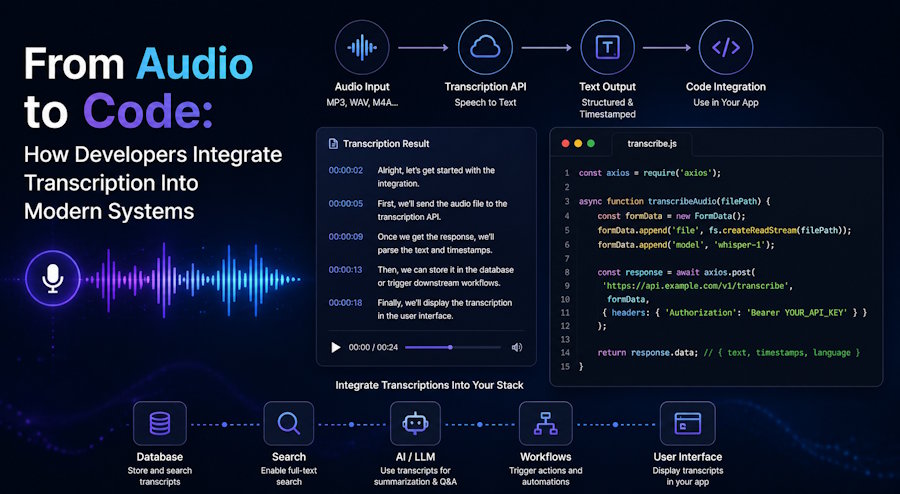
Every developer building a modern application eventually runs into the same problem: audio and video content everywhere, and no clean way to make it searchable, accessible, or usable by the rest of the system. Whether it's a podcast platform, a customer support tool with recorded calls, a video conferencing app, or an internal knowledge base built on recorded meetings, the moment audio enters the pipeline, transcription stops being a nice to have and becomes core infrastructure.
Why transcription is a systems problem, not just a feature
It's tempting to treat transcription as a single API call bolted onto an app, drop an audio file into a speech to text endpoint, get text back, done. But in production systems, transcription touches almost every layer of the stack. It affects storage (raw audio, processed text, timestamps, speaker labels), search (full text indexing of spoken content), accessibility (captions, subtitles, screen reader support), and even compliance (call recordings that need to be reviewable and auditable).
Developers who have shipped transcription features at scale know the real complexity isn't the transcription itself, it's everything downstream: syncing transcript text back to the original timestamp in the audio, handling multiple speakers correctly, dealing with background noise or overlapping speech, and making sure the output format plays nicely with whatever the frontend needs, whether that's a searchable transcript viewer, generated captions, or structured data fed into an analytics pipeline.
Where automated speech to text hits its limits
Speech to text APIs have gotten remarkably good, and for many use cases, like quick internal notes or draft captions, they're more than sufficient. But once accuracy actually matters, legal depositions, medical dictation, multilingual content, heavily accented speech, or audio with significant background noise, automated systems start to show their limits. Misheard words, incorrect speaker attribution, and dropped punctuation might be a minor annoyance in a personal note taking app, but they become a real liability in a system that other people or processes depend on.
This is where a lot of engineering teams end up building a hybrid pipeline: automated transcription for speed and cost efficiency, with a professional transcription layer for content that needs to be accurate, compliant, or publication ready. Rather than trying to fine tune a model to handle every edge case, teams increasingly route high stakes audio to a professional transcription service and reserve the automated pipeline for lower risk content.
Designing systems around human in the loop transcription
For developers architecting these systems, the integration pattern usually looks similar regardless of which transcription approach is used: audio comes in, gets queued, gets processed, and structured text comes out, ideally with timestamps and speaker data intact. The difference with a professional transcription service is what happens in that middle step. Instead of a model doing best effort inference, trained transcribers (sometimes supported by AI tools, but with human review) produce output that's been checked for accuracy, formatting, and context, which matters a lot when the transcript is going to power search, captions, or a permanent record.
Building this into a system well means treating the transcription provider as just another service in the pipeline, with clean input and output contracts, predictable turnaround times, and a way to handle both automated and human reviewed transcripts through the same downstream logic. That way the choice between automated and professional transcription becomes a configuration decision, not an architectural rewrite.
The takeaway for teams shipping audio heavy products
As more products lean on audio and video as primary content types, from podcast apps to communication platforms to internal tools built on recorded meetings, the systems handling that content need to be built with transcription quality in mind from day one, not bolted on as an afterthought. For teams that need transcription output they can actually rely on, whether for compliance, accessibility, or content that's going to be published, pairing an automated pipeline with a professional transcription service is often the difference between a feature that technically works and one that holds up in production.

