

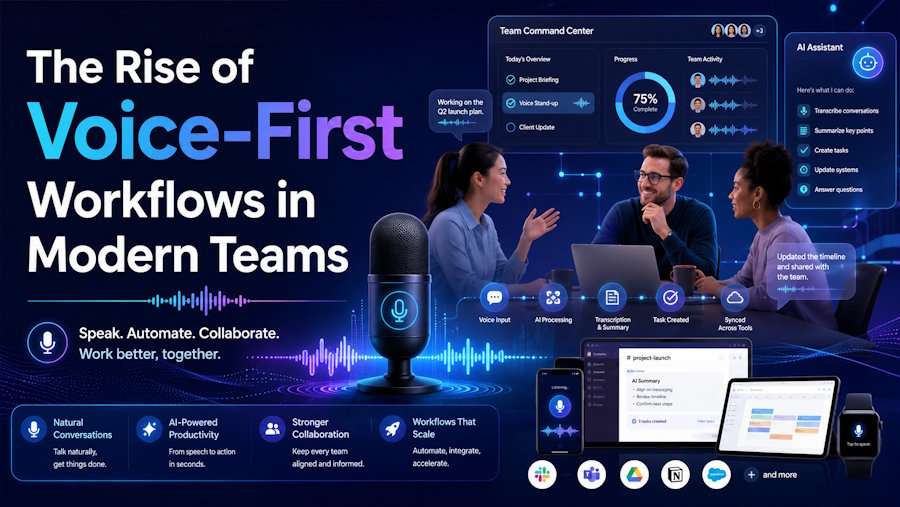
The way people work has changed dramatically over the past few years. Meetings happen across time zones, ideas are captured through voice notes, and important discussions often take place in video calls instead of conference rooms. While these changes have made collaboration more flexible, they have also created a new challenge: valuable information is often trapped inside audio recordings.
This is where voice-first workflows are making a difference. By combining AI-powered speech recognition with intelligent organization, businesses can transform spoken conversations into searchable, actionable knowledge.
Why Voice Is Becoming the Preferred Way to Work
Typing every idea isn't always practical. Whether you're a founder brainstorming product ideas, a sales representative recording customer feedback, or a student reviewing lectures, speaking is often faster and more natural than writing.
Voice notes also reduce friction. Instead of stopping to type every thought, professionals can simply record ideas while walking, traveling, or between meetings. As a result, organizations are generating more audio content than ever before.
However, recorded conversations only become valuable if people can easily revisit and search them later.
The Problem with Audio Files
Audio recordings are difficult to organize manually. Finding a single quote or action item inside a one-hour meeting can take longer than the meeting itself.
Common challenges include:
- Hours spent replaying recordings
- Missing important decisions
- Forgotten action items
- Difficulty sharing specific information with teammates
- Poor documentation for future reference
Without an efficient system, many valuable conversations simply disappear into storage folders and are never used again.
AI Is Changing Audio-Based Workflows
Modern AI transcription technology has transformed the way teams manage spoken information. Instead of manually taking notes, AI can automatically convert speech into structured text within minutes.
Today's transcription platforms can:
- Convert spoken audio into readable text
- Generate meeting summaries
- Highlight key discussion points
- Identify action items
- Make conversations searchable
- Improve collaboration across distributed teams
This allows professionals to focus on the conversation itself rather than worrying about documenting every detail.
Searchable Conversations Improve Team Productivity
One of the biggest advantages of AI transcription is searchability.
Imagine trying to remember when a client requested a specific feature. Instead of replaying multiple recordings, you can simply search the transcript for the relevant keyword.
Searchable transcripts help teams:
- Retrieve information instantly
- Reduce duplicate discussions
- Improve knowledge sharing
- Build an internal library of conversations
- Speed up onboarding for new employees
Over time, these searchable records become an important organizational asset.
Turning Conversations into Action
Raw transcripts are useful, but the real value comes from extracting meaningful insights.
AI-powered workflows can identify:
- Follow-up tasks
- Deadlines
- Customer pain points
- Frequently discussed topics
- Product feedback
- Team decisions
Instead of reading an entire transcript, users can quickly review concise summaries and immediately understand what matters most.
Supporting Remote and Hybrid Teams
Remote work has increased the number of recorded meetings, webinars, interviews, and training sessions.
AI-powered transcription helps remote teams stay aligned by making every conversation accessible, even for people who couldn't attend live.
This improves collaboration because everyone can review the same information without relying solely on handwritten notes.
Choosing the Right Transcription Solution
When evaluating an AI-powered transcription platform, look for features such as:
- High speech recognition accuracy
- Fast processing speed
- Support for multiple audio formats
- Searchable transcripts
- AI-generated summaries
- Secure handling of uploaded files
- Easy export options
If you regularly convert recordings into written documents, using a reliable transcription service can significantly reduce manual work while making your audio content easier to organize and reuse.
Looking Ahead
Voice-first workflows are no longer a niche productivity trend—they are becoming a standard way of working. As AI continues to improve, spoken conversations will become just as searchable, shareable, and useful as written documents.
Organizations that embrace AI transcription today can unlock valuable knowledge hidden inside meetings, interviews, lectures, podcasts, and customer conversations. Instead of letting important discussions disappear into audio files, they can transform spoken information into searchable assets that improve collaboration, decision-making, and long-term productivity.

