

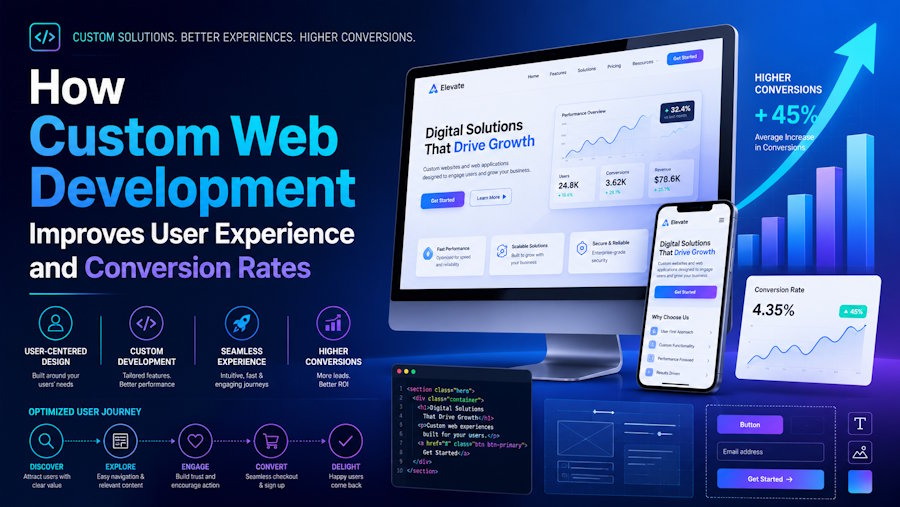
Custom web development improves user experience and conversion rates by giving you full control over speed, navigation, and design, instead of forcing your business into a rigid template.
That control means faster pages, smoother journeys, and fewer reasons for visitors to leave before they take action.
If you're serious about fixing that, partnering with the best web development agency in Bangladesh is where it starts.
Why User Experience Decides Whether Visitors Stay or Leave
It's not about fonts or color palettes. User experience covers everything: load time, menu logic, how easy it is to find what someone needs, and whether the whole thing works on a phone.
Get those wrong and people bounce. Get them right, and people stick around long enough to actually buy.
The problem with templates is they're built for everyone, which means they're built for no one. A custom site gets shaped around your customers' behavior from day one.
That's a different thing entirely.
Fast Load Times Are the First Conversion Tool
People don't wait.
A page that takes three seconds too long to load has already lost a chunk of its visitors, and those visitors don't come back.
Templates carry a lot of dead weight: scripts running in the background, code that exists for features you're not even using.
Custom development cuts all of that out.
Developers build only what the site actually needs. Images get optimized. Page structure gets streamlined.
The result is a site that moves fast and feels sharp. And when a site feels responsive, visitors assume the business behind it runs the same way.
That assumption matters when someone's deciding whether to trust you.
Navigation That Works Like Your Customers Think
Here's a common scenario: someone lands on your website, can't find your pricing in under ten seconds, and leaves. That's not a traffic problem. That's a navigation problem.
Generic templates default to generic menu structures that don't match how your specific customers look for information.
Custom development fixes this at the structural level.
A service business can route visitors straight to a booking page from the homepage. A product-focused site can push people toward filters and checkout without unnecessary detours.
Every click gets designed with one goal in mind, moving the visitor forward. When navigation feels obvious, people don't overthink it. They just keep going.
Personalization Turns a Decent Visit Into a Relevant One
Showing every visitor the exact same page sounds efficient. It's not.
A returning customer doesn't need the same intro as someone who just found you. A mobile user on a lunch break doesn't need the same layout as someone browsing on a desktop at home.
Custom sites can adapt. Returning visitors can see a targeted offer. First-time visitors can get context about what you do. Personalized experiences help visitors find what they need faster. Web Design Toronto can help businesses create tailored websites that engage users and increase conversions.
Mobile users can get a leaner, faster version of the page. None of this is possible with a template.
And every small adjustment like this removes a reason for someone to leave before they convert.
Design That Points People Toward Action
Good design doesn't just look clean. It controls where the eye goes and what someone does next. That same principle applies when starting from Framers templates, where sections such as hero messaging, social proof, pricing, and CTAs can already be structured around moving visitors toward action.
A custom site lets you put calls to action, testimonials, and key proof points exactly where they'll land hardest, not where a template decided they should go.
A landing page can be stripped down to one clear next step.
A service page can walk someone through benefits, then social proof, then a contact form, in the order that actually builds trust. And when your visual style stays consistent- same button style, same type sizes, same spacing logic- the site feels like a professional operation.
That visual steadiness is what keeps someone moving instead of second-guessing.
Mobile Experience Isn't Optional Anymore
Over half of web traffic comes from phones.
A site that works great on desktop but feels cramped on mobile is losing real customers every day. Most template sites treat mobile as an afterthought, and it shows - text that requires zooming, buttons too small to tap, forms that fall apart on a small screen.
Custom development starts with mobile behavior, not desktop.
Layouts adjust properly, buttons are the right size, forms are easy to fill in with your thumbs. If someone can't complete your checkout or contact form on their phone, they won't try twice.
Accessibility Widens the Audience You're Already Missing
Most businesses don't think about accessibility until someone points out it's missing.
But a site that works for people with disabilities, screen reader support, keyboard navigation, proper contrast, and clear labels is also a site that's easier for everyone to use.
Clearer labels. Better structure. More readable text.
These improvements don't just serve people with specific needs. They reduce confusion across the board and make decision-making faster for all visitors.
More people who can use the site comfortably means more people who can take the action you want.
When Your Tools Actually Talk to Each Other
A custom site doesn't just sit on the internet looking nice.
It connects to your CRM, your booking system, your payment gateway, your email automation.
When those connections work properly, leads get routed automatically, bookings trigger follow-up emails, and inventory stays synced without anyone doing it manually.
Visitors feel this even though they never see it. The experience just feels smooth. No dead ends, no broken flows, no dropped inquiries. That kind of seamlessness builds trust without you having to say a word about it.
A Site That Keeps Up As You Grow
Businesses change. New services get added. New markets open up.
With a template, scaling often means starting over. A custom site is built to grow with you, new sections, new features, new audiences, without forcing a full redesign every time something shifts.
That long-term flexibility protects your conversion performance too. A site that stays current keeps working for the business. One that goes stale starts costing you customers quietly, in ways that are hard to trace until the damage is done.
Your website should be an asset, not a liability you keep patching. Custom development is what makes that possible.

