

Building Scalable iOS Apps Using SwiftUI and MVVM
Building a successful iOS application requires much more than creating an attractive user interface. Modern mobile applications are expected to support growing user bases, integrate with third-party services, and receive frequent feature updates without sacrificing performance. As businesses continue investing in digital products, many choose to Hire iPhone Developers who understand how to build scalable architectures that remain reliable as applications evolve. Rather than focusing only on visual design, experienced developers prioritize maintainability, performance, and clean code that supports long-term growth.
SwiftUI and the Model-View-ViewModel (MVVM) architecture have become one of the most effective combinations for achieving these goals. SwiftUI offers a modern declarative framework that simplifies interface development, while MVVM separates presentation from business logic to create applications that are easier to test, update, and expand. Together, they provide a foundation for building iOS apps that remain efficient and manageable even as new features and users are added.
Why Are SwiftUI and MVVM Ideal for Scalable iOS Development?
SwiftUI Simplifies Modern User Interface Development
SwiftUI has changed the way developers create applications for Apple's ecosystem by introducing a declarative approach to interface design. Instead of manually updating every UI element whenever application data changes, developers simply describe how the interface should appear based on the current application state. SwiftUI automatically refreshes the appropriate components whenever the underlying data changes, reducing repetitive code and minimizing opportunities for bugs.
This approach significantly improves development speed while making projects easier to maintain. Features such as Live Preview in Xcode allow developers to visualize interface changes instantly without repeatedly building the application. SwiftUI also promotes reusable UI components, allowing teams to maintain consistency across different screens while reducing duplicated code. As applications become larger, this consistency helps simplify maintenance and accelerates future development.
MVVM Creates a Clear Separation of Responsibilities
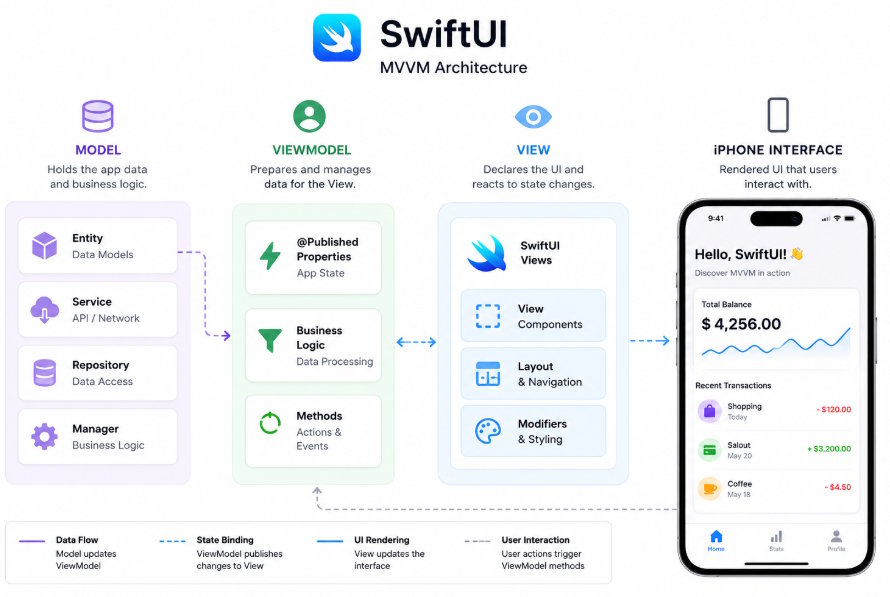
The MVVM architecture divides an application into three primary components: the Model, the View, and the ViewModel. Each layer has a clearly defined responsibility, preventing business logic from becoming mixed with user interface code. The Model manages application data, the View handles presentation, and the ViewModel processes business logic while preparing data for display.
This separation creates a cleaner project structure that becomes increasingly valuable as applications grow. Developers can modify business logic without affecting the user interface, while designers can update screens without introducing unexpected side effects into application functionality. The result is code that remains organized, easier to understand, and much simpler to maintain throughout the application's lifecycle.
How Does MVVM Improve Application Scalability?
Easier Maintenance and Faster Feature Development
Applications rarely remain unchanged after release. Businesses continuously introduce new features, improve existing workflows, and respond to customer feedback. Without a structured architecture, each update increases technical debt and makes future development more difficult.
MVVM addresses this challenge by organizing code into independent layers. Developers can introduce new functionality by updating ViewModels or Models without significantly modifying the interface. This modular approach reduces development time while minimizing the risk of introducing regressions into unrelated features. Teams working on larger projects also benefit because multiple developers can work on separate components simultaneously with fewer code conflicts.
Better Testing and Higher Code Quality
Testing becomes significantly easier when business logic is isolated from the user interface. Rather than testing entire screens, developers can verify ViewModel behavior independently using automated unit tests. This approach helps identify issues earlier in the development process while reducing the number of bugs that reach production.
Improved testing also supports continuous integration and continuous deployment workflows. As development teams release updates more frequently, automated testing ensures new features do not negatively affect existing functionality. Over time, this leads to higher code quality, improved stability, and greater confidence during future refactoring efforts.
What Best Practices Help Build Scalable SwiftUI Applications?
Build Reusable Components and Modular Features
One of the biggest advantages of SwiftUI is its support for reusable components. Buttons, cards, navigation bars, forms, and custom controls can all be designed as independent views that are reused throughout the application. This reduces duplicated code while ensuring visual consistency across multiple screens.
As projects become larger, organizing features into separate modules further improves maintainability. Authentication, user profiles, payments, notifications, messaging, and settings can each exist independently while sharing common services where necessary. A modular architecture makes future expansion much simpler because developers can update individual features without affecting unrelated areas of the application.
Organize Networking and Data Management Properly
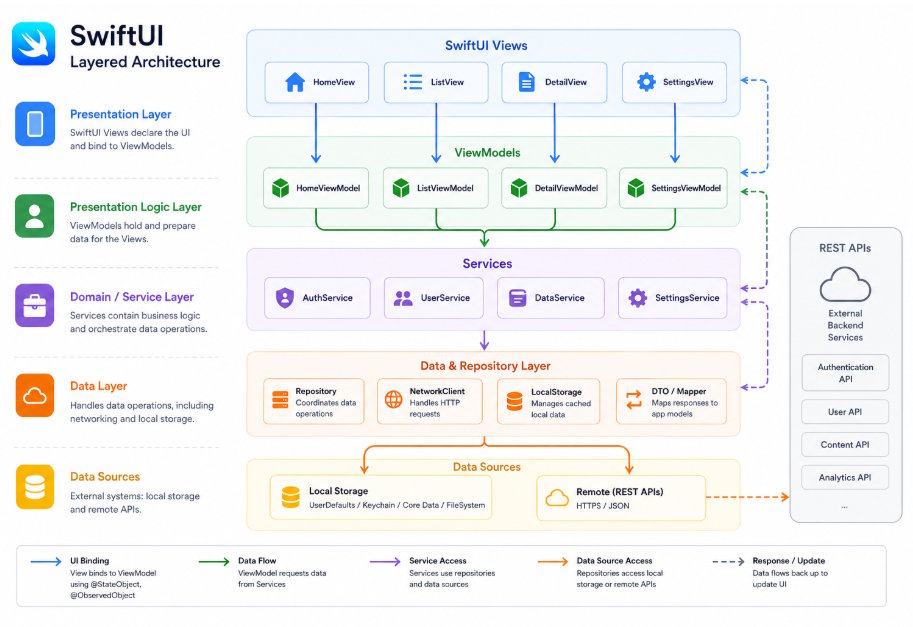
Networking should never be tightly coupled with the user interface. Instead of making API calls directly inside SwiftUI Views, scalable applications isolate networking inside dedicated service layers responsible for authentication, data retrieval, caching, request handling, and error management.
This organization keeps ViewModels focused on application behavior rather than communication details. It also allows developers to replace APIs, introduce offline support, or add new integrations without rewriting interface components. As businesses adopt cloud services and microservice architectures, maintaining this separation becomes increasingly valuable for long-term scalability.
How Can Developers Optimize Performance in SwiftUI?
Manage State Efficiently
Efficient state management plays a major role in application performance. SwiftUI provides several property wrappers, including @State, @Binding, @ObservedObject, @StateObject, and @EnvironmentObject, each designed for different scenarios. Choosing the appropriate property wrapper prevents unnecessary interface updates and keeps data synchronized throughout the application.
Proper state management also improves responsiveness by limiting expensive rendering operations. Instead of refreshing entire screens, SwiftUI updates only the components affected by state changes, helping applications remain smooth even when displaying large amounts of information.
Focus on Long-Term Performance Optimization
Scalable applications require ongoing performance optimization as features continue to expand. Developers should minimize unnecessary computations on the main thread, load data asynchronously, optimize image handling, implement caching strategies, and use lazy containers for large collections. Profiling applications with Xcode Instruments helps identify memory leaks, rendering bottlenecks, and excessive CPU usage before they become noticeable to users.
Organizations planning enterprise-grade applications often Hire Swift App Developers who have experience implementing these optimization techniques alongside modern architectural patterns. Their expertise helps ensure applications remain responsive while supporting increasing numbers of users and increasingly complex functionality.
Conclusion
SwiftUI and MVVM provide a practical and future-ready foundation for building scalable iOS applications. SwiftUI accelerates interface development through its declarative approach, while MVVM promotes a clean separation of concerns that simplifies maintenance, testing, and future enhancements. Together, they enable development teams to create applications that remain organized, responsive, and easier to expand as business requirements evolve.
By adopting reusable components, modular project organization, structured networking, efficient state management, and performance optimization strategies, developers can reduce technical debt while delivering better user experiences. Investing in scalable architecture from the beginning allows applications to accommodate future growth without requiring costly redesigns, making SwiftUI and MVVM an excellent choice for modern iOS development.

