

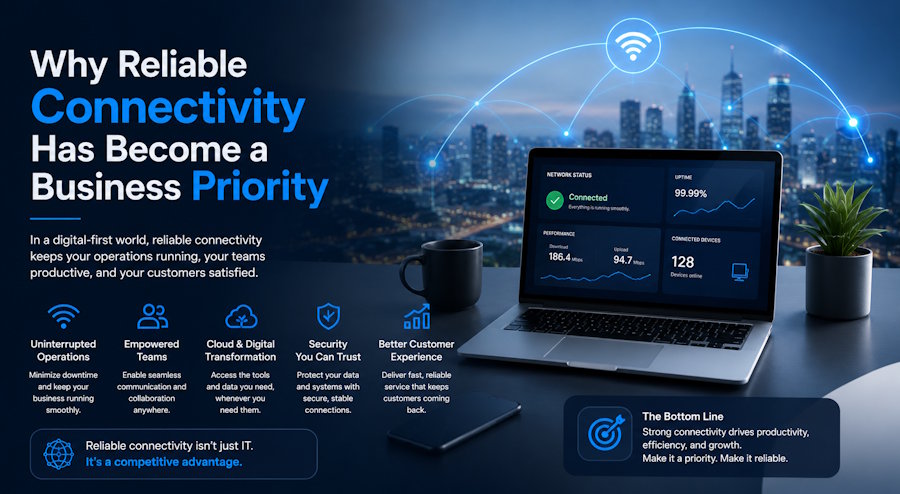
Slow internet used to be an inconvenience. For many organisations, it is now a direct operational risk. Cloud software, video meetings, online payments, customer portals and remote access all depend on a stable connection. Businesses that have outgrown standard broadband are increasingly turning to leased line internet for dedicated bandwidth, consistent speeds and connectivity designed around commercial demands.
What Is a Leased Line?
A leased line is a dedicated internet connection provided exclusively to one organisation. Unlike standard broadband, the bandwidth is not shared with nearby homes or businesses, so performance is far less likely to drop during busy periods.
Leased lines also provide symmetrical speeds. Uploads run at the same speed as downloads, which is useful for businesses that transfer large files, back up data to the cloud, host video calls or run applications across several locations.
The service is usually supported by a formal service level agreement. This sets out expected uptime, response times and repair commitments, giving organisations greater clarity if a fault occurs.
Why Standard Broadband Can Hold Businesses Back
Consumer-style broadband can work well for small teams with light internet use. Problems often appear as the number of users, devices and cloud tools grows.
A busy office may have laptops, mobile phones, printers, security systems, voice services and guest devices all competing for bandwidth. Video calls may freeze, large uploads can slow down other tasks and cloud platforms may become less responsive.
These issues affect more than convenience. Employees lose time, customers may struggle to reach the business and important systems can become harder to use. For retail sites, a poor connection can interrupt payment terminals. In professional services, it can delay file transfers or remote access. In healthcare, unreliable connectivity can disrupt booking systems and access to records.
Consistent Speeds Throughout the Working Day
One of the main reasons businesses choose a leased line is consistency. Advertised broadband speeds often describe the maximum available rather than the performance a business will receive at all times.
With a leased line, the agreed bandwidth is reserved for the organisation. A 500 Mbps service should provide that capacity throughout the day, rather than dropping when local demand increases.
This predictability supports better planning. IT teams can assess whether the connection can handle new software, more users or a larger volume of data without relying on changing broadband performance.
Faster Uploads for Cloud-Based Work
Download speed receives most of the attention when internet services are compared, but upload speed is just as important for many businesses.
Cloud backups, hosted telephone systems, video conferencing and shared project platforms all send data away from the premises. When upload speeds are limited, these services can become slow or unstable.
Symmetrical connectivity gives uploads and downloads equal capacity. This can make a noticeable difference for design studios sharing media files, accountancy firms using hosted software, construction teams transferring plans or companies running daily cloud backups.
It also supports hybrid working. Employees connecting to office-based systems need a dependable flow of data in both directions, and strong upload speeds help remote users access files without unnecessary delays.
Greater Reliability and Clearer Support
Connectivity faults can happen on any service, but the level of support varies.
Business leased lines usually come with agreed response and repair targets. This gives an organisation a clearer route to resolution than a standard broadband package, where support may be limited and repair times less certain.
Many services are monitored by the provider, allowing faults to be identified quickly. Some organisations also add a backup connection using broadband, 4G or 5G, so important systems remain available if the primary circuit fails.
This resilience matters for businesses that depend on online systems. Even a short outage can stop orders, interrupt calls and leave staff unable to access key tools.
Better Support for Multiple Sites
Organisations with several offices, shops, warehouses or clinics often face a different set of connectivity problems. Each site may have a different provider, contract, speed and support process.
Leased lines can form part of a wider network that connects locations securely and gives IT teams more control. Sites can share access to central systems, cloud platforms and voice services while maintaining dependable performance.
A well-planned network can also make expansion simpler. When a new branch opens, its connection can follow the same standards as existing sites, avoiding a patchwork of services that becomes difficult to manage.
Central visibility gives IT teams a clearer view of performance, usage and emerging issues across the network.
Is a Leased Line Worth the Cost?
A leased line usually costs more than standard broadband, so the decision should be based on business impact rather than speed alone.
Organisations should consider the cost of downtime, how often employees experience connection problems and which systems depend on internet access. Expected growth, new sites, cloud adoption and future bandwidth needs should also form part of the review.
For a small office using basic email and web browsing, standard business broadband may remain suitable. For a growing company running cloud software, voice services, video meetings and large data transfers, a dedicated line can provide better long-term value.
The right connection is not always the fastest package available. It is the service that matches the way the organisation works and provides enough capacity for future demand.
Choosing the Right Provider
Businesses should look beyond headline speed when comparing providers. Installation times, service levels, support access, scalability and backup options all matter.
A suitable provider will assess the site, review current usage and explain any construction or access requirements before work begins. The proposal should make clear what is included, how faults are handled and whether the service can be upgraded later.
Businesses reviewing dedicated connectivity can speak with UK Cloud about leased lines, managed networks and wider business internet requirements. Careful planning at the start can lead to a more dependable connection, fewer daily disruptions and a network that supports the organisation as it grows.

