

For decades, spare parts management ran on one principle: make more than you need and store what you don't use. Warehouses filled with low-turnover components, and procurement teams spent considerable resources forecasting demand for parts that might sit on shelves for years before anyone touched them. That model worked well enough when manufacturing options were limited. It no longer makes sense.
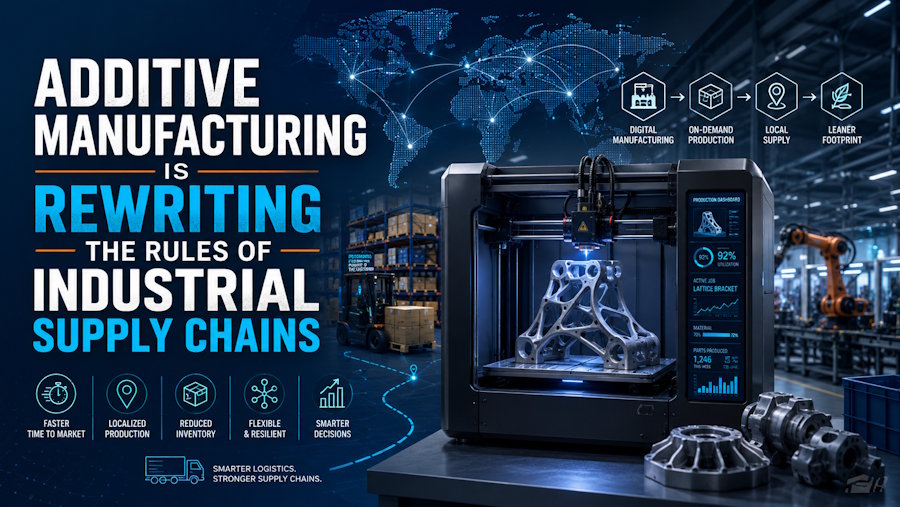
Additive manufacturing has quietly dismantled the core assumptions behind traditional inventory strategy. When a part can be produced in days from a digital file, the logic of physical stockpiling starts to break down. What's emerging in its place is the concept of digital inventory — a library of CAD files that replaces rows of shelved components. When a part is needed, it gets printed. When the design needs to be updated, the file gets revised. There's no obsolete stock, no scrap, and no shipping delay from a supplier three time zones away.
The Real Cost of Legacy Inventory Models
The traditional approach to spare parts was never efficient — it was just the only option available. Manufacturers carried buffer stock because lead times were long and tooling was expensive. A single injection mold for a low-volume bracket could cost tens of thousands of dollars. That made large production runs economically necessary, even when the actual demand didn't justify them.
Carrying costs, storage space, and part obsolescence quietly consumed budgets that looked clean on paper. When product lines were updated or discontinued, physical inventory became a liability. The parts couldn't be repurposed, and the capital tied up in them was simply lost.
On-Demand Production Changes the Equation
Additive manufacturing removes the upfront tooling cost entirely. A geometry that would have required a custom mold can now be produced directly from a digital model. That changes the economics of low-volume and custom production fundamentally. Short runs become viable. One-off replacement parts become practical. Design changes no longer require scrapping existing tooling.
This shift has significant implications for how procurement teams structure their operations. Instead of forecasting and pre-producing, engineers and supply chain
managers can respond to actual demand. The file exists; the part gets made when it's needed. Lead times shrink from week to days, and in some cases, hours.
For sectors where component failure means operational downtime — energy, marine, defense — that responsiveness has measurable value. Parts that once required months of lead time through overseas suppliers can be produced locally, quickly, and to specifications.
Where Certification and Material Science Still Matter
Not every part can or should be printed. Material selection, layer adhesion properties, and certification requirements all shape what's viable for additive production. In regulated environments, the shift to on-demand manufacturing requires documented validation processes, material traceability, and in some cases, third-party testing.
This is where 3D printing for aerospace presents a useful case study. The sector has moved deliberately, not quickly. Printed components used in flight-certified assemblies require extensive qualification data, and the materials used — high-performance thermoplastics like ULTEM, for example — must meet strict mechanical and thermal standards. The aerospace industry's adoption of additive manufacturing has forced rigorous development of both the materials and the qualification frameworks around them. Other sectors have followed that groundwork.
Digital Inventory as a Supply Chain Strategy
The broader transition here is from physical assets to data assets. A company that once needed warehouse square footage to support its maintenance operations can increasingly operate with a hard drive and a capable printer. The part doesn't exist until it's needed. When it is needed, the geometry is already defined, the material is specified, and production can begin without procurement delays.
This isn't a niche application. Industries with aging equipment, complex assemblies, or geographically distributed operations stand to benefit directly. The offshore energy sector, commercial shipping, and large-scale infrastructure maintenance are all areas where on demand additive production can cut costs and response times simultaneously.
What This Means for Procurement Teams
Supply chain professionals who understand additive manufacturing capabilities are already rethinking how they classify and manage components. The distinction between "critical" and "non-critical" spares takes on new meaning when some parts can be printed on demand, and others still require traditional sourcing.
Building a digital inventory requires investment in CAD modeling, file management systems, and printer validation — but that investment replaces a much larger and less flexible one in physical stock. For teams managing aging product lines or operating in remote environments, the math tends to favor the shift quickly.
The warehouse model isn't going away entirely. But for a growing category of parts, the most efficient inventory is the one that doesn't physically exist until it's needed.

