

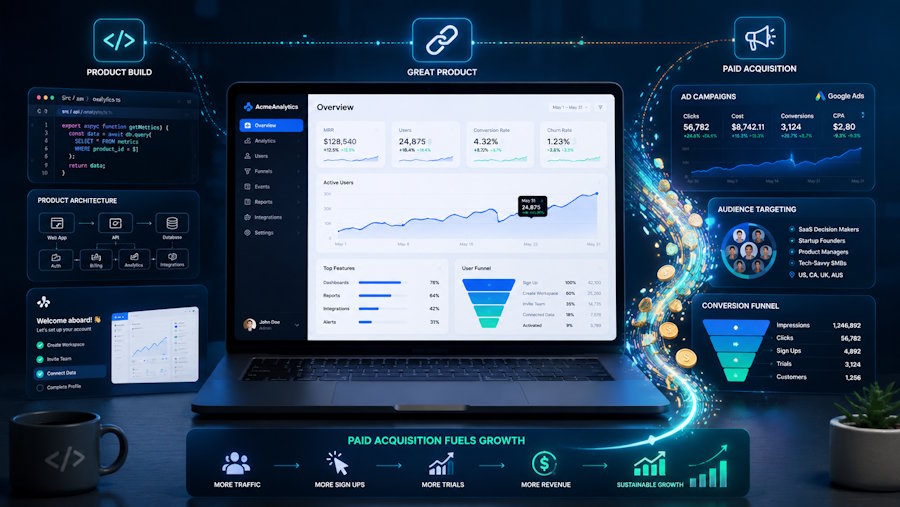
Building a great developer tool or SaaS product is rarely the hard part anymore. Frameworks, cloud infrastructure, and no-code backends have made it possible for a small team, or even a solo founder, to ship something genuinely useful in weeks. What still trips up most technical founders is what happens after launch: getting the product in front of the right people, at the right moment, without burning through runway to do it.
Organic growth, content marketing, and community building all work, but they are slow. For product-led growth SaaS companies with a working product and early traction, paid acquisition is often the fastest way to validate demand and scale trials into paying customers. The catch is that most PPC agencies were built for e-commerce or local service businesses, not SaaS, and that mismatch shows up in wasted spend and confusing reports within the first month.
Why Generic PPC Advice Fails SaaS Companies
A typical paid ads agency optimizes for clicks, impressions, and cost per lead. Those metrics make sense for a business selling a single product with a single price point. They fall apart for SaaS, where a free trial user, a demo request, and a self-serve signup all represent different stages of a funnel with wildly different lifetime values.
A developer tool with a freemium tier might have a handful of features that convert into a $30 a month plan and others that convert into a $300 a month enterprise plan. Treating every click the same way means spending equally on traffic that will never turn into revenue and traffic that will become a long-term customer. Without someone tracking trial-to-paid conversion rates and customer acquisition cost against actual monthly recurring revenue, a campaign can look successful in a dashboard while quietly losing money.
This is the exact gap that a specialized SaaS PPC agency is built to close. Camel Digital works specifically with product-led growth SaaS companies, building campaigns around trials, demos, and paid conversions rather than generic click volume, which matters more for technical products where the buyer's journey rarely ends at a single ad click.
What Actually Matters When Running Ads for a SaaS Product
Search intent over keyword volume. A high-volume keyword is worthless if it attracts people who are just researching a category rather than actively evaluating a purchase. For developer tools and technical SaaS, this means prioritizing comparison searches, competitor terms, and problem-specific queries over broad, top-of-funnel keywords that inflate traffic without moving the needle on trials.
Feature-level economics. Products with multiple pricing tiers or modules need campaigns structured around which features drive the most valuable customers, not just which pages get the most traffic. A campaign that treats a $20 plan the same as a $2,000 enterprise deal will always misallocate budget.
Landing pages built for technical buyers. Developers and technical decision-makers do not respond to generic marketing copy. Landing pages that speak directly to the problem being solved, with clear proof points and minimal friction to start a trial, consistently outperform generic templated pages.
Tracking beyond the click. Trials, activations, and revenue need to be connected back to the campaigns that generated them. Without that loop closed, it is impossible to know whether a campaign is actually contributing to MRR growth or just generating vanity metrics that look good in a slide deck.
Paid Acquisition as Part of a Broader Growth Strategy
Paid ads work best as one part of a growth stack, not a replacement for product quality or content. SEO and organic content compound over years and build durable authority, but they take time to pay off. Paid acquisition can generate qualified trials within the first 30 days, giving a young SaaS company the data it needs to refine its ideal customer profile and messaging much faster than organic channels alone.
This is particularly useful for technical products in categories where the audience is well-defined but competitive, such as dev tools, data platforms, HR tech, or fintech infrastructure. A founder who has already validated product-market fit with early customers can use paid channels to accelerate what is already working, rather than using ads to discover whether the product resonates in the first place.
The tradeoff is that paid acquisition requires ongoing management. Bid strategies, audience targeting, and ad creative all need regular testing and adjustment as a market shifts, which is why many growing SaaS teams choose to bring in a specialized partner rather than manage campaigns in-house alongside product development.
When It Makes Sense to Bring in a Specialist
Not every SaaS company is ready for paid acquisition. It tends to work best once there is a proven product, a working self-serve or demo funnel, and enough budget to generate meaningful data, typically starting somewhere in the low five figures per month in ad spend. Below that threshold, campaigns rarely gather enough volume to optimize properly, and the fastest path to burning cash is running ads before the fundamentals of the funnel are in place.
For teams that meet that bar, working with an agency that understands SaaS-specific metrics like CAC, LTV, and payback period, rather than one applying the same playbook used for a local plumbing business, tends to produce dramatically different outcomes. The difference shows up not in the number of clicks generated, but in how many of those clicks eventually turn into paying customers.
Final Thoughts
Technical founders are often excellent at building product and mediocre at buying attention, which is a completely reasonable division of skills. The mistake is assuming that any PPC agency will do, when SaaS acquisition math is fundamentally different from most other advertising categories. Getting the unit economics right from day one, rather than discovering six months in that the campaigns never should have scaled, is what separates paid acquisition that builds a sustainable growth engine from paid acquisition that just burns budget.

