

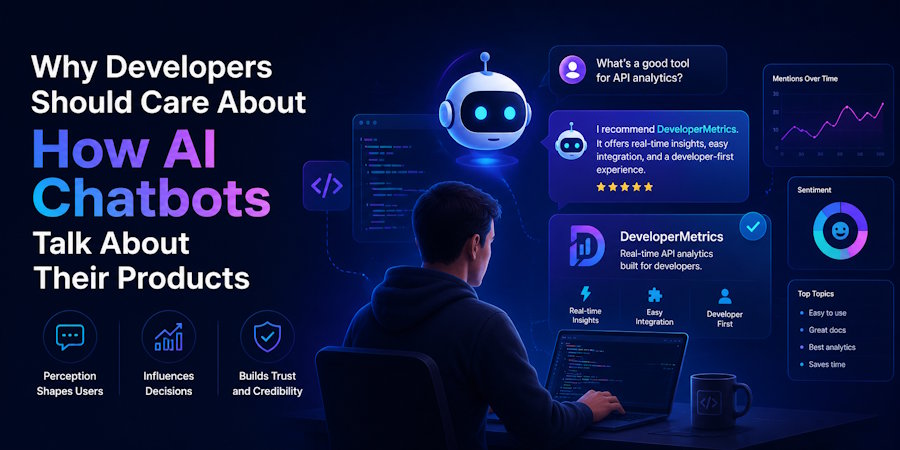
For years, developers building products optimized for one thing: showing up in Google. Keyword research, backlinks, page speed, all of it aimed at ranking on a search results page a human would scroll through. That assumption is starting to crack. A growing share of people researching a tool, library, or SaaS product never touch a traditional search results page at all. They ask ChatGPT, Perplexity, or Gemini directly, and whatever the model says back is the only impression they get.
This shift matters more for developer tools and technical products than almost any other category, because the audience asking these questions is exactly the kind of user who already trusts AI assistants as a default research tool. If a model recommends three API providers or three project management tools and yours isn't one of them, you don't just lose a click, you lose a customer who never even knew you existed.
The Search Results Page Is No Longer the Only Battlefield
Traditional SEO was built around a fairly simple mental model: rank higher, get more clicks, convert some percentage of those clicks into users. That model still works, but it describes a shrinking slice of how people actually find software today. When someone asks an AI assistant "what's the best open source alternative to X" or "which API has the best documentation for Y," the model synthesizes an answer from whatever it has learned and whatever it can retrieve, then presents a short list. There is no pagination, no second page, no long scroll past sponsored results. There are just the brands the model chose to mention, and everyone else.
This creates an entirely new kind of competitive pressure. Two products can have identical search rankings on Google while one gets mentioned constantly by ChatGPT and the other never comes up at all. Without visibility into that gap, a team can spend months optimizing content for traditional search while missing the channel that is quietly becoming just as important.
Why This Is Especially Relevant for Technical Products
Developers researching tools rely heavily on comparison-style queries: "best headless CMS for a Next.js project," "fastest way to add authentication to a React app," "alternatives to Stripe for a marketplace." These are exactly the kinds of prompts AI assistants handle well, and exactly the kinds of prompts where being mentioned or omitted has real commercial consequences.
Unlike a human reading a blog post, an AI model doesn't necessarily explain why it picked the tools it picked. It just presents them as though they're the obvious answer. That opacity makes it hard to know, from the outside, whether your product is even part of the conversation happening inside these tools, let alone whether you're being described accurately.
Treating AI Visibility Like an Observable System
Developers are comfortable with the idea that you cannot improve what you cannot measure, it is the same logic behind logging, monitoring, and analytics in any production system. AI visibility works no differently. Instead of assuming your brand comes up favorably in AI-generated answers, you can actually query the models systematically, track when and how your product gets mentioned, and compare that against competitors mentioned in the same context.
This is the specific problem an ai visibility tracker is built to solve. Instead of manually typing dozens of prompts into ChatGPT and Perplexity to see what comes back, a dedicated tracker runs those queries systematically across models like ChatGPT, Gemini, Perplexity, and Google's AI Overviews, then reports back which brands got mentioned, in what context, and which sources the models pulled from to make that decision.
What You Actually Learn From Tracking AI Mentions
Which prompts you're missing from. A tracker surfaces the exact comparison and recommendation queries where competitors show up and you don't, which is far more actionable than a vague sense that "AI search matters now."
Where the models are getting their information. AI assistants tend to cite specific sources, review sites, documentation, comparison articles, when constructing an answer. Seeing which of your own pages get cited, and which competitor pages get cited instead, points directly at where to invest content effort.
How you're being described, not just whether. Being mentioned isn't automatically good if the context is wrong, outdated, or unflattering. Tracking the actual language models use gives visibility into whether the positioning matches how you'd want to be represented.
Trends over time. Models get updated, training data shifts, and mention patterns move as a result. A one-time check tells you almost nothing; tracking over weeks and months shows whether your visibility is actually improving.
A Practical Starting Point
You don't need a dedicated content strategy overhauled overnight to start engaging with this. The first useful step is simply finding out where you currently stand: which AI models mention your product, for which queries, and how you compare to the two or three competitors you'd expect to be mentioned alongside. That baseline alone often reveals surprising gaps, categories where a competitor with objectively weaker documentation or fewer features still gets recommended more often, simply because their content has better signals for the models to latch onto.
From there, the fix tends to look a lot like good technical writing practice: clear comparison content, honest documentation, and authoritative third-party mentions, the same signals that have always mattered for organic discovery, just now feeding a different kind of consumer.
Closing Thoughts
Developers are usually early adopters of new infrastructure, and AI-driven search is quickly becoming infrastructure in its own right. Ignoring how your product shows up inside ChatGPT or Perplexity because "that's a marketing problem" is a mistake in the same way ignoring server logs would be. The tools to monitor it already exist, and the teams paying attention now will have a real head start over the ones who wait until being invisible in AI search starts showing up as a dip in signups they can't explain.

