

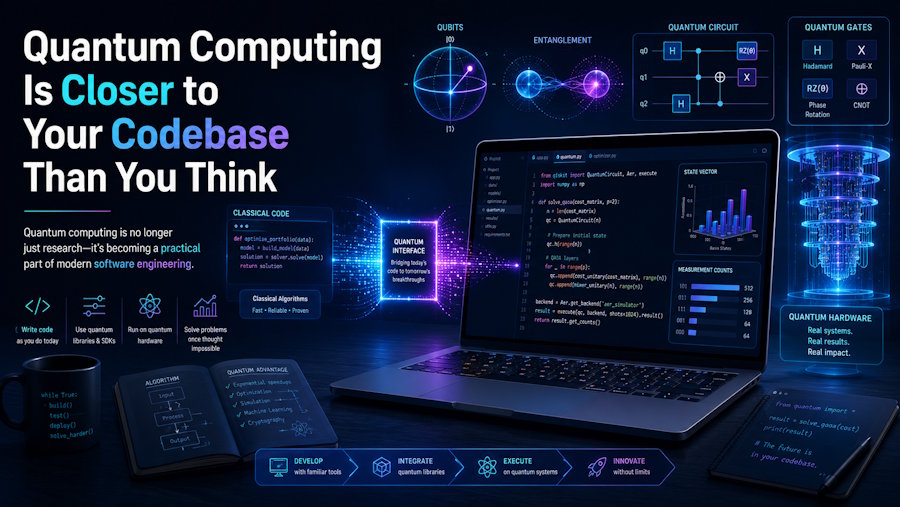
For most developers, quantum computing lives in the same mental category as fusion power: an exciting idea that's always ten years away from being practical. That perception made sense for a long time. Building and maintaining physical quantum hardware requires resources far outside what any individual developer or even most companies can access, so quantum computing stayed locked inside a handful of research labs and hardware vendors.
That barrier has quietly disappeared. Cloud-based quantum platforms now let developers write quantum circuits, run them on real quantum processors, and get results back through an SDK, without owning a single piece of specialized hardware. If you can call an API, you can now experiment with quantum computing the same way you'd experiment with any other cloud service.
Why This Matters for Working Developers, Not Just Researchers
It's easy to assume quantum computing is purely academic, relevant to physicists and PhD researchers rather than the developers building production software. That assumption is becoming outdated. Companies in finance, insurance, pharmaceuticals, and logistics are already running quantum algorithms against real business problems: portfolio optimization, fraud detection, molecular simulation for drug discovery, and large-scale risk modeling.
None of this happens through custom hardware built in-house. It happens through cloud platforms that expose quantum processors as a service, the same way AWS or GCP exposes compute and storage. A developer with a background in Python and some willingness to learn a new SDK can start writing and running quantum circuits within a day, testing algorithms on both simulators and actual quantum processing units.
The Practical Access Problem Quantum Platforms Solve
Access to quantum hardware used to mean one of two things: partnering directly with a hardware vendor like IBM or joining a research program with a long waitlist. Both paths were slow and largely closed to independent developers or smaller engineering teams who just wanted to experiment.
Cloud-based quantum platforms remove that bottleneck by aggregating access to multiple types of quantum processors and simulators behind a single interface. Instead of negotiating separate access to each hardware vendor, a developer can connect to different QPUs and GPU-based emulators through one account and one SDK, switching between simulation and real hardware as a project matures.
This is exactly where a platform like Bluequbit fits into the picture, giving developers, researchers, and enterprise teams a way to develop, test, and run quantum programs against real quantum processors without needing to manage the underlying hardware relationships themselves. What used to require institutional backing now requires an account and a bit of curiosity.
What Working With Quantum Hardware Actually Looks Like Day to Day
Start on a simulator, move to real hardware later. Quantum circuits behave unpredictably enough that testing on a classical simulator first is standard practice. GPU-based emulators let you iterate quickly and debug logic errors before spending time or hardware allocation on an actual QPU run.
Hybrid classical-quantum workflows. Most real-world quantum applications today aren't fully quantum, they're hybrid. A classical optimizer tunes parameters while a quantum processor evaluates a specific subroutine, a pattern common in variational algorithms like QAOA used for optimization problems. Platforms built for this workflow handle the back-and-forth between classical and quantum execution without requiring you to manage the orchestration yourself.
Familiar tooling, unfamiliar hardware. Developers already comfortable with Python don't need to learn an entirely new programming paradigm from scratch. Popular quantum SDKs integrate with familiar libraries, meaning the learning curve is steeper on the conceptual side, understanding qubits, gates, and entanglement, than on the tooling side.
Real fidelity numbers matter. Not all quantum hardware performs the same. Qubit count gets most of the attention, but gate fidelity, how accurately a quantum operation actually executes, determines whether a circuit produces a meaningful result or accumulates too much noise to be useful. Platforms that expose multiple hardware options let you match a workload to the processor best suited for it.
Where This Actually Gets Used Today
Quantum computing's current commercial applications cluster around a few areas where classical computers hit real limitations. Portfolio optimization and risk modeling in finance, where the number of possible combinations grows too large for exhaustive classical search. Molecular simulation in drug discovery, where quantum mechanics governs the underlying chemistry being modeled. Combinatorial optimization problems in logistics and insurance, where finding an optimal solution among an enormous set of possibilities is exactly the kind of problem quantum algorithms are theoretically well suited for.
None of these use cases require a company to build an in-house quantum computing team from scratch. They require a developer or data scientist willing to learn the fundamentals and a platform that handles the messy parts of hardware access, job scheduling, and result retrieval.
Getting Started Without Overcommitting
The lowest-friction way to explore this space is to pick a genuinely interesting algorithm, something like a small QAOA optimization problem or a basic variational quantum eigensolver, and implement it against a simulator first. Once it runs correctly and produces sensible output, running the same circuit against real quantum hardware is usually a matter of changing a target parameter rather than rewriting the logic.
This kind of low-stakes experimentation is exactly how most developers currently working with quantum computing got started. Nobody needs a formal research program to justify curiosity here, just an SDK, a simulator, and enough patience to get comfortable with a genuinely different computing paradigm.
Final Thoughts
Quantum computing is not going to replace classical computing for the vast majority of software problems, and it isn't meant to. What it does offer is a new tool for a specific, narrow class of problems that classical computers handle poorly. Developers who spend a few hours getting familiar with the basics now, while access is cheap and the field is still young, will be in a much better position to recognize when a quantum approach actually makes sense for a problem they're facing later. The hardware access problem that used to make this experimentation impractical has largely been solved. What's left is mostly curiosity and a willingness to learn something new.

