

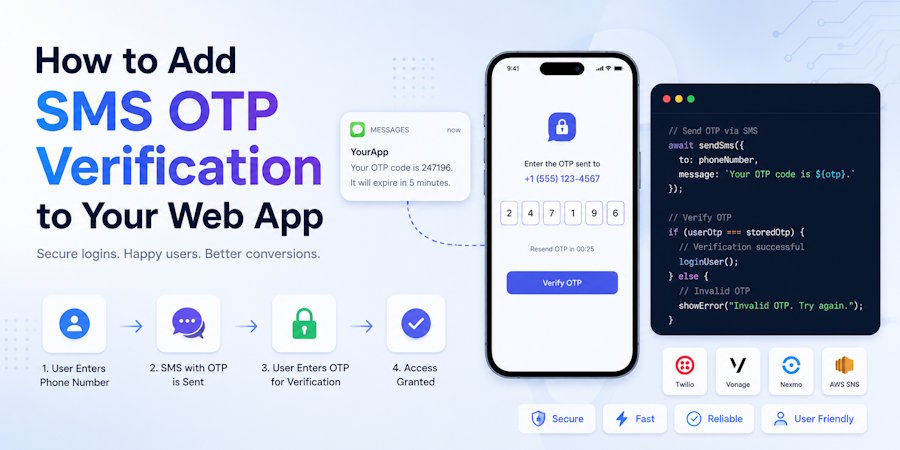
Every login form eventually runs into the same problem: passwords alone aren't enough. Credential stuffing, leaked password databases, and simple brute force attacks mean that a username and password combination is no longer sufficient protection for anything handling money, personal data, or user accounts worth taking over. The most common fix developers reach for is a one-time password sent over SMS, and for good reason. It doesn't require users to install anything, it works on any phone with signal, and most people already understand how it works from years of using it with banks and other services.
That said, building SMS OTP verification correctly is trickier than it looks. What seems like a simple "generate a code, send a text, check the code" flow actually involves rate limiting, delivery reliability across carriers and countries, fraud prevention, and a handful of edge cases that will break a naive implementation the first time it meets real traffic. This guide walks through what actually goes into a solid OTP verification flow and where most implementations go wrong.
Why SMS OTP Still Matters
It's tempting to assume SMS OTP is outdated now that authenticator apps and passkeys exist. In practice, it remains one of the most widely applicable verification methods precisely because it doesn't ask anything of the user beyond having a phone number. Authenticator apps require setup steps many users skip or abandon. Passkeys are excellent but still inconsistently supported across devices and browsers. SMS OTP works everywhere, which is why it remains the default second factor for fintech apps, e-commerce checkouts, and account recovery flows across nearly every industry.
The tradeoff is that SMS delivery is not something you fully control. Carrier routing, international number formatting, and delivery speed vary wildly depending on where your users are located, which is the first place homegrown implementations tend to struggle.
The Basic Flow
At a high level, SMS OTP verification follows three steps: generate a code and send it to the user's phone number, let the user enter that code back into your app, and verify the submitted code matches what was sent before granting access or completing an action.
The part that trips people up isn't the concept, it's everything surrounding it. A production-ready flow needs to handle code expiration, so a code from ten minutes ago can't still be used. It needs rate limiting on both sending and verifying, otherwise a single phone number can be spammed with codes or subjected to brute force guessing against a four to six digit code space. And it needs a fallback plan for when SMS delivery fails, which happens more often than most developers expect once you're serving users across multiple countries and carriers.
Building It Yourself vs Using a Verification API
Rolling your own SMS OTP system means integrating directly with an SMS gateway, handling international number formatting and carrier quirks yourself, building your own rate limiting and abuse detection, and maintaining delivery logs to debug the inevitable cases where a user swears they never got a code. None of this is impossible, but it's a meaningful amount of infrastructure to build and maintain for something that isn't your core product.
This is where a dedicated OTP verification API earns its place. Services like sms otp verification through GetOTP handle the delivery infrastructure, carrier routing, and fraud protection layer so you're integrating an endpoint rather than building a small telecom stack from scratch. You send a request to trigger the OTP, the service handles delivery across its carrier network, and you call a verification endpoint once the user submits the code. The abuse protection, rate limiting, and delivery fallback logic live inside the service rather than becoming something your team has to build and maintain over time.
What to Look for in an OTP Verification Service
International delivery reliability. If your users are global, your OTP provider needs solid routing across regions, not just reliable delivery in your home market. Delivery success rates can vary dramatically by country depending on carrier relationships.
Built-in abuse protection. Rate limiting, SIM-swap detection, and bot traffic filtering should be handled at the infrastructure level. Without this, a single bad actor can trigger thousands of OTP sends and run up your bill or exhaust a target user's patience with spam texts.
Clean, predictable API design. You want clear endpoints for sending and verifying, sensible error responses, and SDKs for your stack if you're not writing raw HTTP requests. A service that's genuinely developer-first will feel like integrating any other well-documented API, not fighting undocumented edge cases.
Delivery logs and observability. When a user says they didn't receive a code, you need to know whether it was actually sent, whether delivery failed, or whether it's a client-side issue. Good logging here saves hours of support back-and-forth.
Usage-based pricing. OTP verification volume tends to scale unevenly with actual user growth, since failed attempts, retries, and abuse traffic all add up. Pricing that charges for successful deliveries rather than flat tiers tends to align better with real usage patterns.
Implementation Tips
A few practical details make a noticeable difference in how smooth the user experience feels. Keep codes short, four to six digits is the sweet spot between security and something a user can reliably type without frustration. Set a reasonable expiration window, typically five to ten minutes, long enough that a slow SMS delivery doesn't lock someone out, short enough that a leaked or intercepted code has a limited window of usefulness.
Always rate limit both the send and verify endpoints separately. Limiting only the verify endpoint still leaves you exposed to send-based abuse, where an attacker triggers repeated OTP sends to harass a user or run up delivery costs. And always give users a clear resend option with a cooldown timer rather than leaving them stuck if a message doesn't arrive within the first minute.
Closing Thoughts
SMS OTP verification is a solved problem in the sense that the pattern is well understood, but implementing it well still requires real infrastructure work around delivery reliability, abuse prevention, and edge case handling. For most teams, that infrastructure isn't worth building in-house when reliable verification APIs already exist and handle the parts that are genuinely hard to get right at scale. Whether you build it yourself or integrate a dedicated service, the goal is the same: give your users a fast, frictionless way to prove they are who they say they are, without turning authentication into the weakest link in your app's security.

