

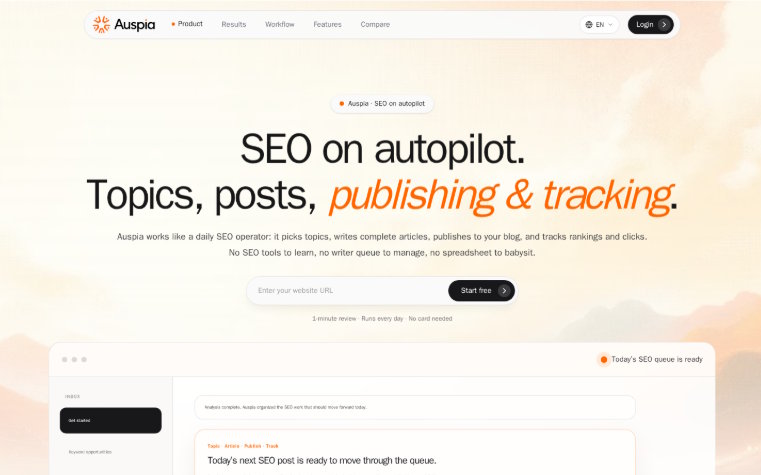
SEO automation uses software to run repetitive search tasks: keyword research, content drafting, publishing, and rank tracking. Most tools automate the analysis, then stop before the work gets done. A newer category, closed-loop operators like Frase and Auspia, also publish content and track results. They close the gap between data and shipped work.
What Can SEO Automation Do Today?
Most SEO automation covers four jobs: finding keywords, drafting content, publishing it, and tracking what ranks. The best tools chain these into one loop. The weakest just speed up a single step and leave the rest to you.
Adoption is already mainstream. In Digitaloft's 2024 survey of e-commerce SEOs, 72.9% used AI tools for research and 43.2% used them for writing. The tasks people trust to automation cluster around volume and repetition.
Tasks safe to Automate First
Start with work that is repetitive and low risk. These jobs are hard to get wrong and easy to check.
- Keyword and topic discovery from search and competitor data
- First drafts and content briefs for human review
- Internal linking suggestions and meta descriptions
- Rank, index, and click tracking with alerts
What Should You Never Fully Automate?
Strategy, brand voice, and anything a reader will judge you on. Automation is good at producing options and bad at deciding which one fits your business. Keep a human on the final call.
Practitioners already draw this line. Aira's State of Technical SEO 2024 report (382 respondents) found 70% were worried about how AI search would affect organic traffic. That caution is healthy, because the expensive mistakes in SEO are strategic, not clerical.
Where Human Judgment Still Wins
Some decisions need context a model does not have. Your positioning, your risk tolerance, and your reader's trust all sit here.
- Deciding which topics match your actual product and buyers
- Setting brand voice and factual accuracy standards
- Reviewing claims, quotes, and statistics before they publish
- Judging when to kill a topic that is not working
Which SEO Tools Just Show You Data?
Semrush, Ahrefs, and Nightwatch are excellent at surfacing data and recommendations; then they hand the work back to you. That handoff is where SEO stalls for small teams.
The distinction is real. Semrush added its Copilot assistant and, in October 2025, an AI Visibility toolkit for tracking brand mentions in ChatGPT and Perplexity. Both surface recommendations. Neither writes and publishes the fix.
Ahrefs is similar. Its AI Content Helper, launched in September 2024, grades how well your draft covers a topic against top-ranking pages. Ryan Law, Ahrefs' director of content marketing, framed it around "comprehensive topic coverage," keeping the writer in control (2024). Useful, but you still write and publish.
The Execution Gap in Plain Terms
The execution gap is the space between knowing what to do and doing it. SEO tools are great in the first part. The second part is where most plans die. That includes execution-heavy work such as Saas link building services, where finding opportunities is only half the job.
This problem is bigger than SEO. Harvard Business Review has reported that 67% of well-formulated strategies fail because of poor execution. SEO lives on the wrong side of that number. A report tells you to publish twelve articles and fix your internal links. It does not write them or ship them.
A newer category tries to close that loop. Closed-loop operators run research, write, publish, and then watch what happens. Frase now runs an agentic workflow that publishes to your CMS and monitors pages for ranking decay. Auspia's AI SEO automation takes a similar operator approach. It turns a site scan into keyword opportunities and content tasks, then ships and tracks them.
How Do the Top SEO Tools Compare?
It comes down to one question: does the tool just analyze, or does it also execute? Analytics platforms give you data and a to-do list. Operators do some of the doing.
|
Tool |
Category |
Automates |
Publishes to CMS |
Tracks and fixes results |
|
Semrush |
Analytics platform |
Research, audits, AI visibility |
No |
Recommends only |
|
Ahrefs |
Research platform |
Backlinks, keywords, content grading |
No |
Recommends only |
|
Surfer SEO |
Content optimization |
Drafting, on-page optimization |
Yes (WordPress) |
Optimizes, no decay loop |
|
Nightwatch |
Rank and AI tracking |
Tracking, audits, briefs |
No |
Tracks, does not fix |
|
SEO.ai |
Content autopilot |
Research, writing, publishing |
Yes (multi-CMS) |
No technical audits |
|
Frase |
Closed-loop operator |
Research, writing, publishing |
Yes |
Yes (Content Guard) |
|
Auspia |
Closed-loop operator |
Scan, keywords, content, publishing |
Yes |
Yes |
Feature details come from each vendor's official pages, 2025–2026. Why does execution matter more now? Ahrefs analyzed 300,000 keywords and found AI Overviews cut the top result's click-through rate by 58% (Ahrefs, December 2025). Shipping and refreshing content fast now beats sitting on a report.
Does Automated SEO Content Hurt Your Rankings?
Not by default. Google judges content by quality and usefulness, not by how it was made. What gets penalized is scaled, low-value content built only to game rankings.
Google made this explicit. Its March 2024 spam policies target "scaled content abuse," meaning mass-produced pages with no added value. Automation that publishes thin content at volume is the risk, not automation itself.
Key Takeaways
- Automate repetitive SEO tasks like research and tracking; keep strategy and brand voice human.
- Most SEO tools show data; only closed-loop operators like Frase and Auspia also publish and track.
- With AI Overviews cutting clicks, fast content refresh now matters more than another dashboard.
Conclusion
SEO automation is not one thing. It is a spectrum from tools that report to systems that execute. If your bottleneck is knowing what to do, a data platform is enough. If your bottleneck is getting it done, pick an operator that publishes and tracks, then keeps a human on strategy and final review. Buy for the gap you have, not the dashboard you think you want.
FAQs
Is SEO automation safe for Google rankings?
Yes, when it produces useful content. Google's March 2024 spam policies target "scaled content abuse," not automation itself. Mass-producing thin pages to game rankings is the risk. Automation that publishes genuinely helpful content, reviewed by a human, stays on the right side of Google's guidelines.
Can AI fully replace an SEO specialist?
No. AI handles keyword research, drafting, and tracking well, but strategy and judgment still need a person. Tools like Semrush surface data; operators like Frase publish it. Neither decides which topics fit your business or when a plan is failing. That call stays human.
What is the difference between SEO tools and SEO operators?
SEO tools like Ahrefs and Nightwatch analyze and recommend, then hand the work back to you. SEO operators like Auspia and Frase also execute: they write, publish to your CMS, and track results. The operator model closes the gap between a report and a shipped page.
How much does SEO automation software cost?
It ranges widely. Phrase starts around $39 per month for a full content lifecycle, while SEO.ai begins near $149 per month for content publishing. Ahrefs charges roughly $99 per month for its Content Kit add-on. Price tracks scope: technical coverage and execution cost more than analysis alone.
Does SEO automation work for small teams?
It can, if the tool matches your gap. Lean teams benefit most from operators that publish and track, because they lack hands to execute. A Semrush-style platform suits teams that already have writers. The Federal Reserve Bank of St. Louis found 20.5% of weekly generative AI users saved four-plus hours a week (2025).

