

Every growing company eventually hits the same wall: the internal team can't keep pace with what the business needs. Maybe the product roadmap has outgrown the current headcount. Maybe a project needs a specialized skill set that doesn't exist in-house. Maybe leadership just needs to move faster than traditional hiring allows.
Whatever the trigger, the same question follows. Should the company bring in outside talent to work alongside its own team, or hand the whole project to an external provider?
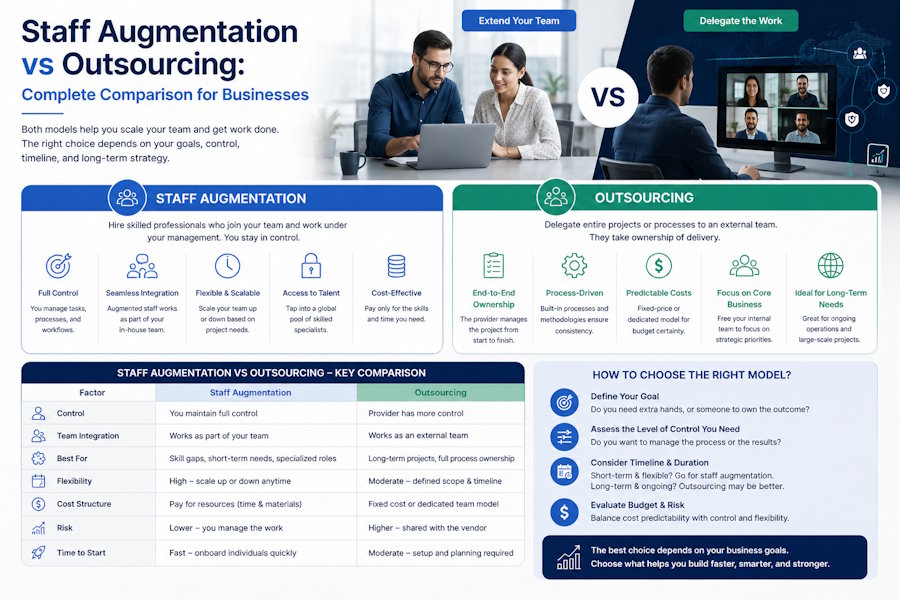
These two paths, staff augmentation and outsourcing, are often used interchangeably. In reality, they're built on very different ideas about who owns the work and how it gets done. Understanding staff augmentation vs outsourcing matters because the choice affects cost, control, communication, and how smoothly a project actually gets delivered.
Staff augmentation is best thought of as an extension of a company's existing team. Instead of running a lengthy recruitment cycle, a business brings in outside professionals who work directly inside its own workflows, tools, and reporting structure. The company keeps full ownership of how the work happens. The augmented talent simply fills a capacity or skills gap.
This is why so many businesses now work with staff augmentation companies rather than expanding headcount permanently. It lets them move fast without giving up day-to-day oversight.
Outsourcing works differently. A business hands over an entire project, function, or process to a third-party vendor, who then manages it independently using their own team, tools, and methodology. The client defines the outcome. The vendor decides how to get there.
That one distinction, who controls the "how," is the root of nearly every other difference between the two models.
Cost Comparison
On paper, outsourcing often looks cheaper. That's genuinely true for repeatable, well-defined work, like payroll processing or routine IT support, where a vendor has already optimized its process across many clients.
Staff augmentation usually costs more per hour, since you're paying directly for a professional's dedicated time.
But that comparison shifts once you factor in management overhead. Outsourced work requires a vendor to interpret a client's goals without daily internal guidance. When requirements are complex or tied closely to a core product, that gap can lead to expensive rounds of revision.
Staff augmentation avoids much of this friction. The professionals work under direct internal supervision from day one, which often lowers the real cost of getting the work right the first time, even if the hourly rate looks higher.
The right way to think about it: outsourcing optimizes for a lower sticker price, while staff augmentation optimizes for fewer surprises down the line. Which one saves more money in practice depends heavily on how well-defined the work actually is.
Control and Project Ownership
This is where the two models diverge most sharply.
With staff augmentation, the hiring business stays the project owner in every real sense. It sets priorities, assigns tasks, reviews work in progress, and can pivot on short notice, because the augmented team is embedded in its own tools and workflows.
This kind of control matters most on core products or proprietary systems, where daily decisions carry real weight.
Outsourcing shifts a meaningful share of that ownership to the vendor. The business defines requirements up front, then steps back and trusts the vendor's own process. That works fine for peripheral or standardized tasks. It's riskier for strategic, fast-moving work, since the client has less visibility and can't easily redirect effort without renegotiating scope.
For businesses building software that customers interact with daily, that loss of visibility can be a real problem. Small decisions, like how an error message reads or how a workflow handles an edge case, add up. Staff augmentation keeps those decisions close to the people who understand the product best.
Communication Differences
Communication follows the same divide.
Augmented professionals join internal stand-ups, use the company's own project management tools, and talk directly with product owners or team leads. Information moves the way it would with any other internal hire: quickly, informally, with little translation loss.
Outsourced engagements typically run through fewer, more formal channels, often a single project manager on the vendor's side, plus scheduled status updates. That works well for stable, clearly scoped projects.
But it can create friction when priorities shift quickly, since every change has to travel through the vendor's process first. Businesses that rely on tight feedback loops tend to find staff augmentation's communication style a much closer match to how they already operate.
Scalability
Both models scale, just in different shapes.
Staff augmentation allows fine-grained adjustments, like adding two backend developers for a three-month sprint, without touching a broader contract at all. This suits businesses with unpredictable workloads especially well.
Outsourcing tends to scale in larger increments, since engagements are usually tied to project or contract boundaries rather than individual roles. A vendor might easily take on an entire new product line, but smaller mid-stream changes are harder, since they often mean renegotiating the agreement itself.
Businesses that expect their needs to shift month to month generally find staff augmentation easier to live with, simply because it doesn't require a new contract every time priorities change.
Security Considerations
Security deserves careful attention under either model, though the risk looks different in each case.
With staff augmentation, external professionals typically work inside the company's own systems, under its own access controls and compliance policies. That gives the business direct, continuous oversight.
Outsourcing often means sensitive data and processes move into the vendor's own environment, which adds variables like the vendor's security practices, subcontractor use, and data handling standards. <cite index="0-0">The World Economic Forum has found that a majority of cyber leaders now consider their organizations' ecosystems too interconnected to fully manage third-party cyber risk</cite>, a good reminder that extending sensitive work beyond direct oversight deserves real scrutiny either way.
Companies handling proprietary code or regulated data often lean toward staff augmentation for exactly this reason.
Best Use Cases for Each Model
Staff augmentation works best when specialized skills need to sit inside an active, evolving project, like extending a core product, covering a temporary skills gap, or supporting a team through rapid growth that doesn't yet justify permanent hires.
Outsourcing works best for well-defined, self-contained work that doesn't need constant internal input, like a one-time website redesign, ongoing helpdesk support, or a clearly scoped audit.
Which Businesses Should Choose Which Approach
Fast-growing companies building core technology, or competing in markets that shift quickly, tend to get more value from staff augmentation. It preserves the control and flexibility that rapid iteration demands.
Larger, more established organizations with stable, well-documented processes, especially for non-core functions, often find outsourcing more efficient. It frees leadership from managing routine work altogether.
Company size, project complexity, and how central the work is to the business's competitive edge are usually the clearest signals pointing toward one model or the other.
Final Verdict
Neither model is inherently better. Each solves a different problem.
Staff augmentation earns its place when control, communication speed, and close alignment with internal teams matter most, especially on strategic or fast-evolving work.
Outsourcing earns its place when a task is well-defined, non-core, and better handled by a specialized team working with minimal oversight.
The businesses that get the most value tend to be the ones that honestly assess how much control they actually need, rather than defaulting to whichever option looks cheaper or more familiar at first glance.

