

Introduction
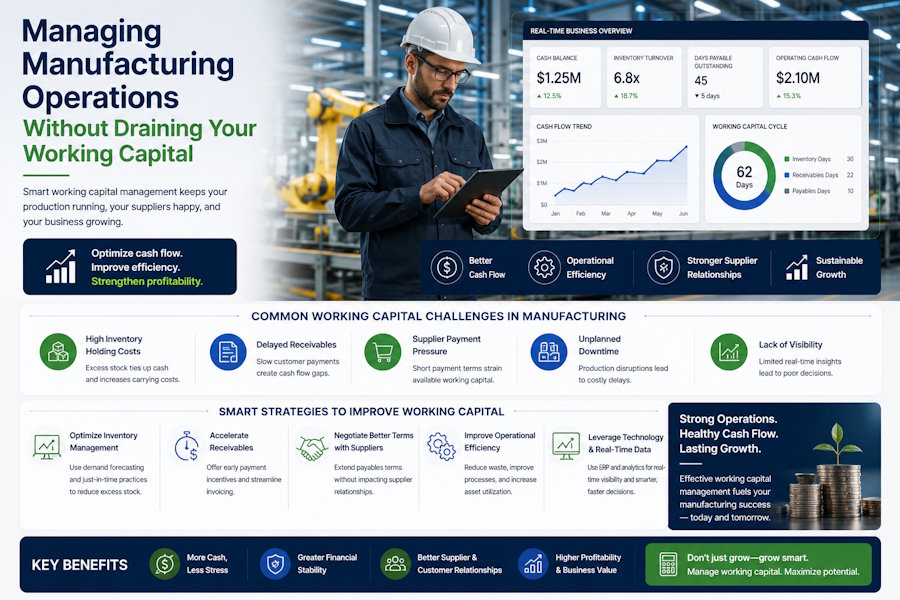
Manufacturing operations exist in a complex financial environment where success requires careful management of cash flow alongside production schedules. You're purchasing raw materials, managing inventory, paying labor, and maintaining equipment while waiting for customers to pay for finished goods. The timeline between spending and revenue can stretch months.
Growing manufacturers often discover that their financial constraints come not from market demand or production capability, but from working capital limitations. The machines run efficiently. The team executes well. The orders exist. But the cash required to fund operations between material purchase and customer payment limits growth.
This working capital challenge is as critical as any operational decision, yet it receives far less attention than production efficiency. Understanding how to manage it separates manufacturers that scale successfully from those operating at maximum capacity due to cash constraints.
Key Takeaways
- Manufacturing working capital gaps are structural realities, not signs of poor financial management.
- Traditional bank lending often misses the actual financing needs of manufacturers with complex payment cycles.
- Raw material purchasing and inventory carrying costs create months-long cash requirements before revenue arrives.
- Modern manufacturing financing solutions align with operational cash flow rather than imposing fixed payment schedules.
- Proper working capital management enables manufacturers to scale to market capacity rather than cash capacity.
The Manufacturing Cash Flow Challenge
Manufacturing differs fundamentally from many businesses because of the time required to convert materials into products and then convert products into revenue. You purchase raw materials today. You process them over weeks or months. You ship finished goods. Your customer pays you 30, 60, or 90 days later.
During that entire period, you've invested cash in materials, labor, and overhead. If you're running multiple production batches, you have cash tied up in each stage. Your bank account reflects financial weakness despite the business being profitable on paper.
This becomes more severe with growth. A manufacturer doubling production doesn't double profit immediately because they double their working capital requirements first. The materials for the expanded production must be purchased before that output generates revenue.
Large inventory balances don't indicate business health or weakness. They indicate you're running your manufacturing operation at scale. The same manufacturer with $500,000 in inventory and $50,000 in cash might be thriving operationally despite appearing financially weak to a traditional banker.
Why Traditional Manufacturing Financing Doesn't Work
Banks evaluate manufacturers using metrics that don't capture operational reality. They look at inventory levels and see risk. They analyze accounts receivable aging and worry about collection. They see cash requirements between material purchase and customer payment and treat it as a problem rather than a normal operational fact.
Traditional lending also moves slowly. A manufacturer needing materials for an urgent order can't wait six weeks for loan approval. Material pricing might shift. Production schedules require decisions now, not next month. A financing structure that takes longer than the cash requirement it's meant to address creates more problems than it solves.
Additionally, banks impose rigid repayment schedules that don't match manufacturing realities. A business with seasonal production, project-based revenue, or cyclical customer demand can't service fixed monthly payments when those months generate no sales. Traditional lenders see payment inconsistency as default risk rather than normal operating variability.
Manufacturing is capital intensive. Banks often demand personal guarantees, home equity, or operating assets as collateral. For smaller manufacturers or those managing multiple facilities, this collateral requirement becomes unrealistic.
How Operational Financing Works for Manufacturing
Modern manufacturing financing approaches the problem differently. Instead of asking "how much collateral do you have," they ask "what is your actual cash flow and when does it arrive?"
A manufacturer with $10 million in annual revenue, $7 million in materials cost, three-month customer payment terms, and one-month supplier payment terms has a real working capital need. The supplier expects payment in 30 days. The customer pays in 90. That 60-day gap times the monthly materials requirement defines the actual financing need.
Unlike traditional loans where you service debt from monthly profit regardless of cash availability, operational financing ties repayment to actual revenue. As products sell and customers pay, the financing is repaid. When business slows, obligations reduce. The solution flexes with your actual business rather than forcing your business to flex around fixed obligations.
Project-based manufacturers benefit especially from this approach. A manufacturer bidding on a large government contract might need to fund three months of materials and labor before receiving even a partial payment. Modern financing enables that project-specific capital without requiring approval for permanent capacity you don't need.
Solutions for Manufacturing Working Capital Needs
Manufacturers managing cash flow challenges have found success with approaches specifically designed for their industry. These include supply chain financing, inventory-based funding, and project-based financing that treat manufacturing's actual cash flow as the repayment mechanism.
Many manufacturers explore solutions like merchant cash advances specifically designed for manufacturing operations. These work fundamentally differently from traditional loans because repayment ties to actual business revenue, not fixed monthly commitments. When you sell more products, you repay faster. When sales slow, obligations reduce automatically.
The key distinction is repayment flexibility matching operational reality. Manufacturing merchant cash advances work because they acknowledge that manufacturing cash flow is lumpy and project-based rather than smoothly distributed monthly revenue.

Scaling Without Cash Constraints
The real impact of proper working capital financing appears in growth capability. A manufacturer managing cash tightly might bid for only the work they can finance internally. With proper financing structure, they can bid for all available work because working capital isn't the limiting factor.
A manufacturer with $5 million in annual capacity but only $1 million in accessible cash might pursue $2 million in revenue while turning away similar volume. With $3-4 million in working capital financing, they pursue $5 million. Same equipment. Same team. Same market. Different financing available.
This isn't about taking on unlimited debt. It's about having sufficient working capital to execute work you can win and that your production capacity supports. Manufacturing teams looking to optimize their operations often benefit from staying current on both technology innovations affecting the industry and the business fundamentals enabling growth. Many manufacturing businesses are much smaller than their market potential because cash timing constrains them more than market demand or capability.
Successful scaling requires matching your working capital capacity to your market opportunity. With proper financing, that matching becomes possible.
FAQ
Q: Why don't traditional banks understand manufacturing financing needs? A: Traditional banks use risk models designed for other industries with faster cash cycles. Manufacturing's months-long conversion from material to revenue doesn't fit their standard underwriting. They see inventory and accounts receivable as risks rather than normal operational facts.
Q: What's the difference between a traditional term loan and manufacturing working capital financing? A: Traditional loans require fixed monthly payments regardless of business performance. Working capital financing ties repayment to actual revenue. When projects complete and customers pay, financing is repaid. The obligation flexes with operational reality rather than forcing operations around fixed payments.
Q: How quickly can manufacturers access working capital financing? A: Many programs fund in 7-14 days. Some expedited processes fund within 48-72 hours. Compare this to traditional bank loans requiring 6-8 weeks, and the advantage becomes clear when you need materials purchased next week.
Q: Is using working capital financing a sign of financial trouble? A: No. Using specialized financing to manage operational cash requirements is a sign of financial sophistication. Growing manufacturers with strong operations commonly use working capital financing to optimize their cash position and scale to market opportunity.
Q: How do I calculate my actual working capital requirement? A: Calculate (monthly materials cost + monthly labor cost + monthly overhead) multiplied by the months between material purchase and customer payment. Add inventory carrying periods. That's your actual need. Financing that matches this number prevents artificial growth constraints.
Q: What happens if customer payments are delayed? A: This is why contract terms and customer quality matter. Strong contracts specify payment terms and enforce them. Many working capital solutions are built to accommodate typical payment delays because they're expected in manufacturing. Ensure your financing terms accommodate realistic payment timelines.
Q: Can I access working capital financing for specific projects? A: Yes. Project-based manufacturers can often access financing for specific contracts rather than permanent capacity. This works especially well for government contracts, custom manufacturing, and large orders requiring upfront investment before customer payment.
Conclusion
Manufacturing operations require sophisticated working capital management because the time between material investment and revenue arrival creates fundamental cash flow challenges. These challenges aren't signs of poor financial health. They're operational realities that proper financing addresses.
Traditional bank financing doesn't work for manufacturing because it doesn't account for operational reality. Modern manufacturing financing solutions understand and accommodate the actual cash flow patterns of the industry. Working capital becomes available when you need it. Repayment happens when customers pay. Obligations flex with your business volume.
Manufacturers that master working capital management scale to market opportunity rather than being constrained by cash timing. They bid work confidently because they can fund it. They expand production without artificial capital constraints. They operate at their actual market potential rather than below it due to cash limitations.
The operational excellence of your manufacturing matters. Your team, equipment, and processes matter. Your working capital financing matters equally because it determines whether your operational capability translates into actual growth.

