

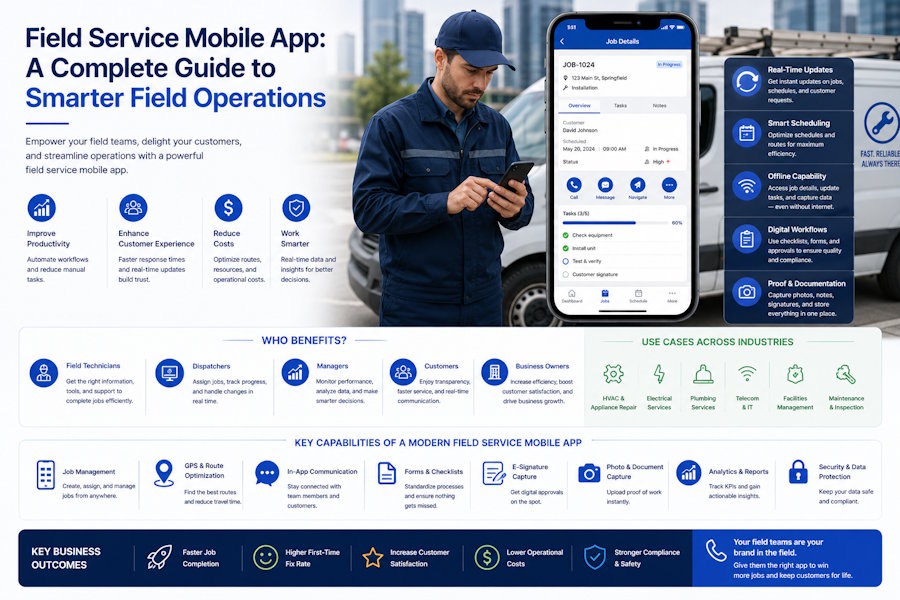
Introduction
Businesses with technicians working across multiple locations need fast communication, organized scheduling, and instant access to job information as part of effective field services. Field services help companies manage mobile workforces efficiently while improving response times and customer satisfaction. Managing these tasks through paper forms, phone calls, or spreadsheets often leads to delays, missed appointments, and unnecessary administrative work. A field service mobile app helps eliminate these challenges by giving field teams the tools they need to work efficiently from anywhere.
A modern field service mobile app connects office staff and technicians through a centralized digital platform. From receiving work orders and updating job statuses to accessing customer information and completing service reports, technicians can manage their daily responsibilities directly from their smartphones or tablets.
As field operations continue to evolve, investing in a field service mobile app enables businesses to improve productivity, streamline workflows, and provide a better customer experience. This guide explores the key features, benefits, best practices, and future trends of using a field service mobile app.
What Is a Field Service Mobile App?
A field service mobile app is a mobile application designed to help technicians perform field tasks efficiently while staying connected with office teams. It provides instant access to schedules, work orders, customer details, service history, and digital documentation from virtually any location.
Instead of relying on paperwork or repeated phone calls, a field service mobile app allows technicians to receive updates in real time, complete reports electronically, and communicate seamlessly with dispatchers and managers.
Why Businesses Need a Field Service Mobile App
Managing field operations involves constant coordination between office staff and technicians. Without the right tools, communication delays and scheduling errors can reduce efficiency. A field service mobile app simplifies these processes by centralizing important information.
Businesses benefit because a field service mobile app helps them:
- Improve technician productivity
- Reduce paperwork
- Increase scheduling accuracy
- Enhance communication
- Improve service documentation
- Provide real-time operational visibility
These advantages help organizations deliver faster, more reliable service while reducing administrative effort.
Key Features of a Field Service Mobile App
Mobile Work Orders
Technicians receive detailed work orders containing customer information, service instructions, equipment history, and job requirements. This ensures they arrive fully prepared for every assignment.
Real-Time Job Updates
A field service mobile app enables technicians to update job progress instantly. Office staff can monitor completed, ongoing, and upcoming assignments without making repeated phone calls.
Mobile Scheduling
Daily schedules remain accessible throughout the workday. If appointments change, technicians receive updated information immediately through the application.
Digital Documentation
Technicians can upload photos, inspection reports, completed forms, and service notes directly from customer locations using the field service mobile app.
Electronic Signature Collection
Digital signatures simplify customer approvals while eliminating paper documents and improving record management.
Benefits of Using a Field Service Mobile App
Increased Workforce Productivity
Technicians spend less time managing paperwork and more time completing service work because all essential information is available from one mobile device.
Better Customer Satisfaction
Timely arrivals, accurate appointment updates, and faster service completion create a more positive customer experience.
Improved Communication
Real-time communication between technicians and office staff reduces misunderstandings while improving operational coordination.
Lower Administrative Costs
Digital documentation reduces printing, manual data entry, and document storage, allowing businesses to operate more efficiently.
Accurate Service Records
Every completed assignment is documented electronically, making customer histories and maintenance records easy to access whenever needed.
Best Practices for Implementing a Field Service Mobile App
Train Technicians Thoroughly
Provide practical training so employees understand how to use every feature efficiently in daily operations.
Maintain Accurate Customer Information
Updated customer records, equipment details, and appointment information improve technician preparation and service quality.
Encourage Real-Time Reporting
Technicians should update job status immediately after arriving, beginning work, and completing each assignment to maintain accurate operational visibility.
Standardize Digital Workflows
Using consistent digital forms and reporting procedures ensures better documentation while simplifying future record management.
Monitor Performance Regularly
Analyze productivity reports, technician activity, and service completion rates to identify opportunities for continuous improvement.
Industries That Benefit from a Field Service Mobile App
Many industries depend on a field service mobile app to improve workforce coordination and operational efficiency.
HVAC Services
Technicians access maintenance schedules, equipment records, and customer histories before each appointment.
Plumbing Operations
Emergency repairs and routine maintenance become easier to organize through mobile scheduling and digital work orders.
Electrical Services
Electricians receive assignments, update job progress, and complete documentation directly from the field.
Facility Maintenance
Maintenance teams coordinate inspections, repairs, and preventive maintenance across multiple buildings while remaining connected with office staff.
Equipment Maintenance
Organizations responsible for servicing machinery use a field service mobile app to document repairs, manage maintenance records, and improve technician productivity.
Common Challenges Solved by a Field Service Mobile App
Businesses often encounter operational issues that affect service quality. A field service mobile app helps solve these common challenges.
Communication Delays
Real-time messaging keeps technicians and office teams connected throughout the workday.
Scheduling Conflicts
Live schedule updates reduce overlapping appointments and improve technician availability.
Paper-Based Processes
Digital work orders eliminate printed documents, reducing administrative effort and improving record accuracy.
Delayed Reporting
Technicians submit reports immediately after completing work, allowing managers to review information without waiting for paperwork.
Limited Operational Visibility
Managers gain real-time insight into technician locations, assignment progress, and completed jobs for better decision-making.
Future Trends in Field Service Mobile App Technology
Technology continues to enhance the capabilities of the field service mobile app. Artificial intelligence, predictive maintenance, cloud computing, and voice-enabled reporting are expected to make field operations even more efficient.
Future applications will likely recommend technician assignments automatically, optimize travel routes based on live conditions, and provide predictive insights that help businesses prevent equipment failures before they occur. These innovations will enable organizations to improve productivity while meeting growing customer expectations.
Conclusion
A field service mobile app has become an essential tool for organizations managing technicians outside the office. By centralizing scheduling, work orders, communication, documentation, and reporting, it simplifies field operations while improving productivity and service quality.
From reducing paperwork and enhancing collaboration to increasing technician efficiency and improving customer satisfaction, a field service mobile app provides long-term operational benefits. Businesses that adopt modern mobile technology can streamline workflows, optimize workforce performance, and build a strong foundation for sustainable growth in an increasingly competitive service environment.

