

Early in my career I believed test automation was a single decision: you either automated or you did not, and more automation was always better. It took a few bruising release cycles to learn that automation is really a portfolio of decisions, and the right allocation changes depending on where a product sits in its release lifecycle. What you automate during an alpha is not what you automate during a beta, and confusing the two wastes effort at both ends.
The distinction sounds academic until you have lived through it. I once watched a team build an elaborate automated suite against an alpha build whose API contract changed weekly. Every sprint, half the suite broke, not because the product had bugs but because the product was still deciding what it wanted to be. The engineers spent more time repairing tests than the tests spent catching anything. Meanwhile, the same team entered beta with almost no regression coverage, because all their automation energy had been spent and thrown away during alpha.
The phases exist for different reasons
It helps to be precise about what each phase is actually for. The classic distinction in alpha vs beta testing is that alpha happens internally against an incomplete product to answer the question of whether the thing works at all, while beta puts a feature-complete build in front of real users to answer whether it works for them. Those are fundamentally different questions, and they reward fundamentally different testing investments.
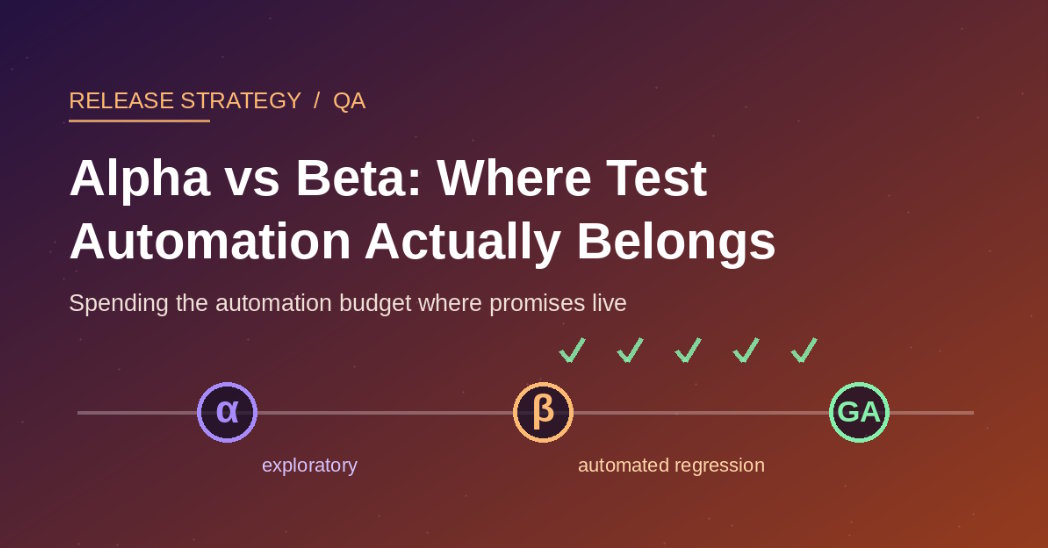
During alpha, the product is unstable by design. Interfaces shift, features appear and vanish, and the most valuable testing is exploratory: humans poking at the system, finding the sharp edges, and feeding observations back to developers while changes are still cheap. Heavy automation against this moving target is mostly wasted motion.
Beta inverts everything. The contract is supposed to be stable now, real users are depending on it, and every regression you ship erodes the trust you invited those users to extend. This is exactly the moment when broad, repeatable, automated coverage pays for itself, because the same checks need to run against every candidate build without consuming a human tester's week.
Where the automation budget actually goes
Alpha: automate the plumbing, not the surface
The automation that survives alpha is the kind aimed below the churning surface. Build pipelines, deployment smoke checks, and tests against whatever core contracts the team has genuinely committed to. If the authentication flow is settled, lock it down with tests. If the reporting endpoints are redesigned every other week, leave them to exploratory sessions and save your suite the whiplash.
Beta: automate the promises
Once a build goes to beta users, every documented behavior becomes a promise, and promises are what automation protects best. This is where investing seriously in api automation testing changes the economics of a release. Recording real interactions from beta traffic and replaying them against each new candidate build catches exactly the class of regression that infuriates early adopters: the thing that worked last week and silently broke this week. Manual testers cannot re-verify an entire API surface every release, and they should not have to.
The teams that handle this transition well treat beta feedback as a test generator. Every bug a beta user reports becomes an automated check before the fix ships, which means the suite grows in exact proportion to the ways the product has actually failed rather than the ways someone imagined it might.
The handoff is the hard part
The genuinely difficult moment is the transition between phases, because it rarely announces itself. Products drift from alpha into beta gradually, one stabilized module at a time, and the automation strategy needs to drift with them. My working rule is to track contract stability per component rather than per product. When an API's schema has survived three consecutive sprints untouched, it graduates: exploratory attention moves elsewhere and automated coverage moves in.
That per-component view dissolves the false binary I started my career with. The question was never whether to automate. It was always which parts of the system have made promises worth protecting, and which parts are still figuring themselves out. Alpha and beta are just the release cycle's way of telling you where that line currently sits. Teams that listen spend their automation budget where it compounds. Teams that do not end up like mine did years ago, with a broken suite for a product that no longer exists and no safety net for the one that does.

