

AI isn't a "someday" project anymore; it's already sitting on most executive agendas. Companies everywhere are looking for ways to work faster, spend less, and make decisions with better information behind them. That push has brought one question to the surface again and again: in the debate of Generative AI vs Agentic AI, which one actually moves the needle for a business?
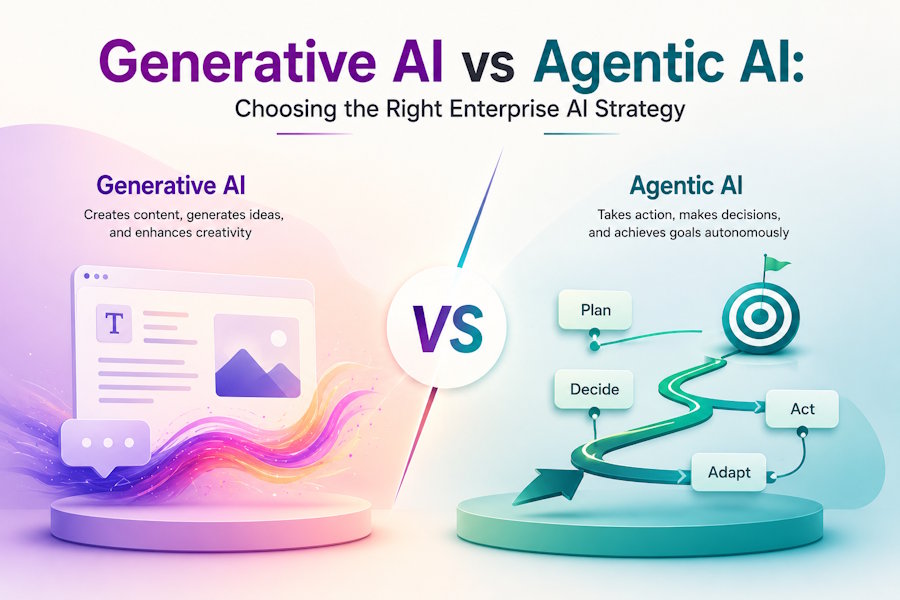
Both fall under the umbrella of enterprise artificial intelligence, but they're built to do very different jobs. Generative AI is the creative half it writes, drafts, and designs. Agentic AI is the operational half; it acts, decides, and gets things done with little or no hand-holding. Knowing where one ends and the other begins is the first step toward an enterprise AI strategy that actually holds up over time.
No matter whether you are at the early stages of trying out artificial intelligence or have already begun using it throughout the organization, the strategy that you adopt at this point is going to define how valuable you can make it.
What Generative AI Actually Does
At its core, generative AI studies patterns in existing data and uses them to produce something new: text, code, images, video, reports, you name it. You give it a prompt, it gives you an output.
Think of the AI assistants, content generators, image tools, and coding copilots that have become part of daily work for a lot of teams. Businesses lean on generative AI mainly to take the grind out of repetitive, creativity-heavy work.
A few places it shows up most often:
- Marketing content creation
- Customer support responses
- Software code generation
- Product documentation
- Internal knowledge management
- Personalized communication
Because it speeds up content production so dramatically, generative AI has quietly become one of the more visible parts of enterprise AI adoption across nearly every industry.
If your business runs on content writing, documentation, and communication, generative AI tends to pay off almost immediately, without forcing you to rebuild how your teams already work. For a deeper technical grounding in how these models work, IBM's overview of generative AI is a solid starting point.
What Is Agentic AI?
Generative AI stops at the output. Agentic AI picks up from there and actually does something with it.
These systems combine reasoning, planning, memory, and the ability to call on other tools to carry a task through to completion mostly on their own. Instead of needing a new instruction for every step, an agentic system looks at the goal, figures out what needs to happen, and starts working through it.
That's why you'll often hear them called AI agents or autonomous AI agents they're built to operate with a level of independence that traditional models were never designed for.
A few examples of what that looks like in practice:
- Customer service process management
- Automated scheduling of meetings
- Invoicing process
- Supply chain management process
- Cybersecurity monitoring
- Testing of software applications
- Business process management
Instead of responding to one request at a time, agentic AI stays on task working continuously toward a business goal until it's done.
Generative AI vs Agentic AI: The Core Differences
Both technologies are built on advanced machine learning, but what they're for is genuinely different.
|
Generative AI |
Agentic AI |
|
Creates new content |
Completes business tasks |
|
Prompt-driven |
Goal-driven |
|
Requires frequent user interaction |
Operates with greater autonomy |
|
Focuses on creativity |
Focuses on execution |
|
Produces outputs |
Produces measurable business outcomes |
|
Limited workflow management |
Supports end-to-end workflow execution |
Where Generative AI Performs Best
Generative AI is at its best whenever people need ideas, drafts, or a head start on communication.
Common enterprise use cases include:
- Drafting business proposals
- Creating product descriptions
- Writing technical documentation
- Generating software code
- Preparing presentations
- Producing marketing campaigns
- Summarizing large reports
A lot of knowledge workers now skip the blank page entirely; they edit an AI-generated first draft instead of starting from scratch, which alone saves hours every week.
That payoff is showing up in the numbers, too. According to McKinsey's State of AI survey, generative AI adoption jumped from 33% of organizations in 2024 to 72% in 2025 a sign that the productivity gains are real enough to keep investment climbing.
Where Agentic AI Creates Greater Business Value
Once a company gets comfortable with AI, the next question usually isn't "what can it write for us?" it's "what can it run for us?" That's where AI workflow automation comes in.
Agentic AI pairs reasoning with execution, which lets organizations automate entire processes that used to need several people or several disconnected tools working in sequence.
Customer Operations
AI agents can take in a customer request, pull the relevant information, draft a response, update the CRM, and hand off anything too complex for a human to take over all without someone babysitting each step.
Finance
Autonomous systems can review invoices, approve payments within set rules, flag anything that looks off, and loop in the finance team only when something needs a human decision.
Human Resources
Agentic AI can screen resumes, prepare onboarding paperwork, coordinate interview scheduling and field routine employee questions throughout the hiring process.
IT Operations
Modern AI agents keep an eye on infrastructure, catch issues early, open support tickets, suggest fixes, and in some cases resolve the problem before anyone notices it happened.
Put together, these capabilities push AI decision-making forward while cutting out a lot of the repetitive manual work that used to eat into people's days.
Can Enterprises Use Both Together?
Yes and honestly, most of the value comes from doing exactly that.
A common misconception is that you have to pick a side. In practice, the strongest enterprise AI strategy rarely picks one over the other; it uses both, each where it's strongest.
Take a product launch as an example.
What generative AI can do is:
- Write marketing copy
- Create product documentation
- Create FAQs
- Write customer emails
Agentic AI can:
- Strategize campaign launches
- Facilitate internal approvals
- Manage project management systems
- Track campaign results
- Initiate follow-up activities
Used together, they cover the whole process not just pieces of it which is exactly why this pairing has become a central theme in AI for business initiatives. It connects the creative side of AI with the execution side.
Factors to Consider Before Choosing
There's no universal answer here; it depends on the specific problem you're trying to solve. A few questions worth sitting with before you commit budget:
Is your team mostly producing information? If people are spending real time on documents, reports, presentations, or code, generative AI is usually the more natural starting point.
Do you want to automate how the business actually runs? If the goal is cutting down manual work across departments, intelligent automation built on agentic AI tends to pay off more over the long run.
Is your data ecosystem actually ready? Agentic AI usually needs to plug into CRMs, ERPs, databases, and internal APIs. It's worth checking whether that infrastructure is in shape before committing to a rollout.
Do you have governance and security sorted out? Both technologies need clear policies around privacy, compliance, and responsible use that isn't optional for either one.
The Future of Enterprise AI
The Generative AI vs Agentic AI conversation is far from settled, and it's likely to keep shifting over the next few years.
Generative AI will keep getting better at helping people create, write, design, summarize. Agentic AI will keep taking on more of the operational load. Neither is really about replacing people; the more realistic outcome is that repetitive work gets absorbed by AI, freeing teams to focus on strategy, innovation, and the relationships that actually need a human touch.
Companies investing in enterprise artificial intelligence now aren't just chasing efficiency, they're getting ready for a future where multiple AI agents work across departments, talk to an AI development service provider, and keep tuning workflows with less and less human input required.
The organizations experimenting today will likely be the ones best positioned when that future arrives.
Choosing the Right AI Strategy
When it comes down to Generative AI vs Agentic AI, the decision should start with what the business actually needs, not with whatever's trending.
While generative AI may be a clear winner if the objective is increased content production and improved day-to-day productivity, the use of agentic AI would make more sense if the aim is better process orchestration and improved decision-making.
For most enterprises, though, the real answer is both folded into one AI roadmap. Generative AI creates the knowledge; agentic AI turns that knowledge into action. With solid planning, real governance, and the right implementation partners offering AI development services, businesses can build an enterprise AI strategy that delivers value now and keeps adapting as the technology moves forward.

