

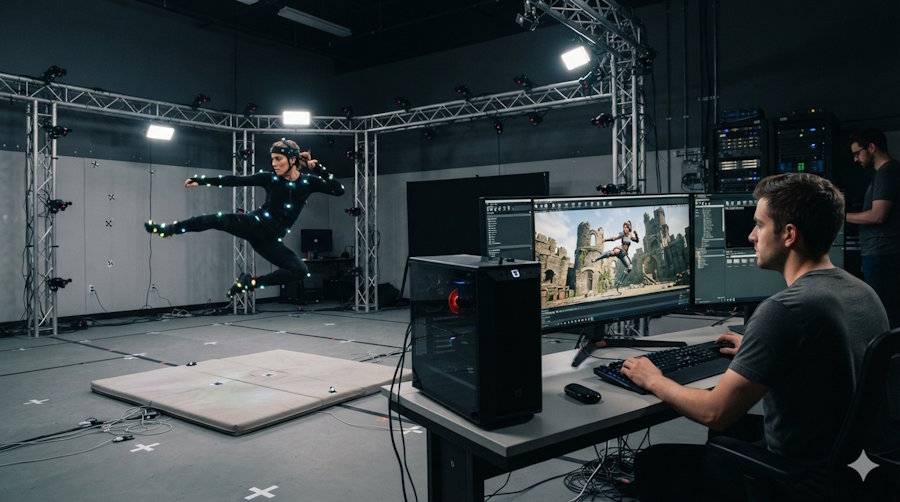
Motion capture has quietly become one of the most powerful tools in modern game development. From Hollywood blockbuster game franchises to indie studios pushing creative boundaries, mocap technology lets developers capture real human movement and translate it directly into their digital characters. The result is more expressive, believable, and compelling animation that players actually feel connected to.
If you're working in game development, visual effects, or interactive media, understanding how motion capture works and where it fits into your pipeline is essential. This guide walks through the fundamentals, practical applications, and what you need to know to evaluate mocap solutions for your own projects.
Key Takeaways
- Motion capture translates real human movement into usable animation data for games and interactive media.
- The process works by tracking physical markers or using markerless systems to record body position and movement.
- Mocap is faster and more authentic than hand-animating complex character interactions.
- Different capture methods suit different needs, budgets, and technical requirements.
- Integration into your game engine requires proper data cleaning, rigging, and performance optimization.
What Is Motion Capture and Why It Matters
Motion capture is fundamentally about recording movement. An actor performs an action in the real world, sensors or cameras track their body's position, and specialized software translates that positional data into animation files your game engine can use.
The appeal is immediate. Instead of an animator spending weeks hand-crafting a walk cycle or combat combo, an actor performs it once, and you have usable animation data in hours. The movement feels natural because it is natural, grounded in actual human biomechanics rather than an animator's educated guess.
This matters more than many realize. Players unconsciously pick up on unnatural movement. Stiff walks, floaty jumps, or awkward transitions between actions pull them out of immersion. Motion capture sidesteps that problem entirely.

The Two Main Capture Methods
There are two dominant approaches to motion capture: marker-based and markerless systems.
Marker-based capture uses optical cameras to track reflective markers placed on an actor's body. The actor wears a special suit dotted with these markers at key joints, and the camera system reconstructs their skeleton position from the marker positions. This method is extremely accurate and has been the industry standard for decades. The tradeoff is cost and setup complexity, both for equipment and the physical space required.
Markerless systems use standard cameras and AI-powered pose estimation to track movement without any physical markers. These systems have improved dramatically in recent years and are becoming increasingly accessible to smaller teams. They're faster to set up and cheaper to operate, though they can sometimes struggle with occlusion (when one body part blocks another from the camera's view) or rapid movements.
Most professional studios use a hybrid approach, leveraging the speed of markerless systems for prototyping and planning, then using marker-based capture for final animation when quality is critical.
Where Motion Capture Excels
Motion capture shines in specific scenarios. Complex character interactions, like realistic hand-to-hand combat or detailed facial expressions, are exponentially faster to produce with mocap than traditional animation. A single fight choreography session can yield dozens of unique attack and defense animations.
Sports games depend heavily on mocap. Basketball, football, soccer, and other athletic games require thousands of small, contextual animations that feel authentic to the sport. Capturing actual athletes performing these movements ensures accuracy that hand animation simply can't match.Narrative-driven games with cinematic cutscenes benefit enormously from motion capture. When a character needs to convey emotion through subtle body language, mocap captures micro-movements that telegraph feeling without relying solely on facial animation.
Why Accuracy Matters in Mocap Data
Not all motion capture systems are created equal. The quality of your source data directly impacts the quality of your final animation. When the captured data is noisy or imprecise, you spend more time cleaning it up in post-processing, which erodes the time savings mocap is supposed to provide.
Look for systems offering motion capture with high accuracy. The precision of the capture directly affects how much data cleanup you'll need to do, how well the animation integrates into your engine, and whether you'll encounter glitches during playback. Systems that consistently deliver clean, precise skeletal data save you hours of manual correction and refinement down the line.
The difference between a system that captures at 95% accuracy versus 99% accuracy might sound small, but across hundreds of animation frames, those small errors compound. You want a solution that captures movement so accurately that your animation pipeline can focus on creative work, not data rescue.

Integrating Mocap Data Into Your Game Engine
Capturing movement is only half the battle. The data needs to flow smoothly into your game engine, which means proper rigging, retargeting, and optimization.
Raw mocap data comes as skeletal animation files, typically in BVH or FBX format. Your character model in the engine needs a matching skeleton structure so the mocap data knows which bones to move. Retargeting adapts the captured data to your specific character's proportions if they differ from the original actor.
our animation workflow guide for a deeper dive into pipeline setup.
Performance matters too. Every animation you import adds to your game's memory footprint and CPU load. Studios optimize mocap data by reducing the number of keyframes where possible, removing unused bones, and strategically using animation blending instead of storing every single variation.
The bigger the animation library, the more critical optimization becomes. A AAA game might have 5,000 mocap animations; an indie project might have 500. Either way, keeping data lean keeps performance high.
Common Challenges and How to Handle Them
Even with excellent capture systems, mocap workflows hit snags. Foot skating, where a character's feet slide across the ground instead of staying planted, is a classic problem. It happens when the captured skeleton position doesn't perfectly match the ground plane in your engine.
Jitter, another common issue, appears as small unwanted vibrations in joints during playback. This usually stems from marker occlusion during capture or calibration drift in the camera system. Most studios run captured data through a smoothing filter to remove jitter before importing into the engine.
Transitions between animations sometimes expose seams. A walk cycle might flow perfectly on its own, but when the engine blends into a run or turn, the transition feels jarring. Solving this requires careful blending parameters in your engine and sometimes re-capturing transition animations specifically.
None of these issues are deal-breakers, but they're real work. Budgeting time for data cleanup and pipeline refinement is essential when planning a mocap-heavy production.
Choosing the Right Solution for Your Project
Scale, budget, and timeline all influence which capture approach makes sense for your team.
If you're running a small indie project with tight resources, a markerless system might be your sweet spot. You can run captures with a couple of cameras and standard recording equipment, and the software does the heavy lifting of pose estimation. The tradeoff is slightly lower accuracy and the learning curve of a new tool.
Larger studios with mocap pipelines already in place tend to stick with marker-based systems. The upfront equipment investment is substantial, but over hundreds of projects, the per-shot cost drops. You also get the accuracy and reliability that high-stakes production demands.
Mid-size studios increasingly use both. They might validate mocap data and prototype shots using markerless systems, then do final captures with a marker-based rig when quality is locked in. This hybrid approach gives you speed and flexibility without sacrificing the final polish.
Looking Forward
Motion capture technology continues to evolve. AI-powered post-processing is getting better at cleaning noisy data automatically. Real-time markerless capture is approaching the accuracy of marker-based systems, which could fundamentally shift how teams prototype animation.
The ceiling for what mocap can do keeps rising, but the basic principle remains the same: capture real movement, clean it, integrate it, iterate. For developers building immersive, character-driven experiences, mocap is no longer optional. It's the expected foundation for animation that feels authentic and looks polished.
Frequently Asked Questions
How long does a typical motion capture session take?
A standard mocap session with a professional capture facility lasts a full day (6-8 hours), capturing anywhere from 20 to 50 animations depending on complexity. Simple actions like walks or idle poses take minutes. Complex sequences like fight choreography or parkour stunts take much longer because they require multiple takes to get right.
Can you use motion capture data from one character model on another?
Yes, through retargeting. The captured skeletal data adapts to fit different character proportions. If your captured actor is 6 feet tall and your game character is 5 feet, retargeting scales and adjusts the data accordingly. Some fine-tuning usually follows, but it's far faster than recapturing.
What if your character has unusual anatomy, like wings or extra limbs?
Standard mocap systems track human skeletons by default. For non-human characters, you'll need custom marker placement or markerless tracking tuned to recognize the extra limbs. Many studios capture human movement, then use IK (inverse kinematics) and animation blending to adapt it to non-human rigs.
Do you need a dedicated mocap studio, or can you DIY it?
DIY markerless capture is absolutely viable on a limited budget. You need cameras (smartphones work), good lighting, and software that does pose estimation. DIY marker-based capture is much harder because it requires a calibrated multi-camera rig and reflective markers that actually track properly. Most teams either use a service bureau or invest in proper equipment.
How much does motion capture cost?
Markerless DIY capture: minimal (you likely have the cameras already). Professional markerless service: $500 to $2,000 per day. Marker-based capture at a professional facility: $2,000 to $5,000+ per day. Long-term ownership of a marker-based studio runs $100,000 to $500,000+ depending on camera count and software licensing.
Can mocap capture facial expressions and hand gestures?
Yes, but it requires additional markers or cameras focused on the face and hands. Full-body capture is standard. Adding a facial rig significantly increases complexity and cost, so many studios mocap body movement and animate faces by hand or with blendshape technology.

