


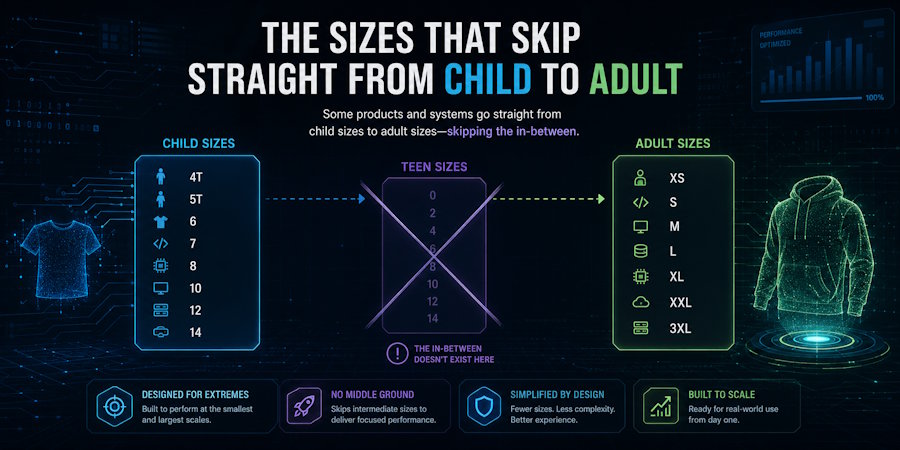
Somewhere between a child's last costume size and the smallest adult option, there exists an awkward gap that many shoppers only discover once they are standing in front of a rack, garment in hand, realizing nothing quite fits. This overlooked middle ground reveals something genuinely interesting about how costume sizing developed in the first place.
Where the Gap Actually Sits
Children's costume sizing typically follows age-based categories, while adult sizing shifts to measurements based on chest, waist, and height. Somewhere between these two systems, usually corresponding to early adolescence, a noticeable gap appears. A child too tall for the largest youth size may still be too narrow for the smallest adult option, leaving very few choices that actually fit comfortably.
This gap exists partly because adolescent bodies vary so dramatically during this period. Two people the same age can differ enormously in height and build, making it genuinely difficult to design a single size category that fits most bodies in this range. Manufacturers instead tend to focus resources on the more predictable extremes of childhood and adulthood, leaving the transitional years underserved by comparison.
Why This Gap Persists Year After Year
Addressing this gap would require costume makers to produce an entirely separate sizing category, one that likely sells in smaller volumes than either children's or adult ranges. From a manufacturing standpoint, this makes the awkward middle less commercially appealing to address, even though the frustration it causes shoppers remains real and consistent every single year.
This is one of the more common frustrations a well-stocked costume shop hears about directly from customers, particularly parents shopping for a child who has recently grown taller than expected. Staff familiar with this pattern often become skilled at suggesting adult small sizes paired with simple adjustments, such as a belt or safety pins, to bridge the gap more comfortably than either category manages on its own.
Practical Ways Around the Gap
Understanding why this sizing gap exists can make navigating it considerably less frustrating. Rather than assuming something is wrong with a particular body for not fitting neatly into either category, it helps to recognize that the gap reflects a genuine limitation in how costumes are manufactured rather than any flaw in the shopper.
A Gap Worth Understanding
Recognizing this sizing pattern in advance can save considerable stress for anyone shopping during this transitional period. Rather than a personal sizing failure, the gap between child and adult categories reflects a structural quirk in how the industry approaches costume manufacturing, one that shoppers can plan around once they know it exists.
Looking Ahead With More Confidence
Families who shop through this stage more than once often develop their own workarounds long before retailers catch up. Some begin buying adult small sizes a year earlier than expected, anticipating a growth spurt rather than reacting to it. Others keep a small collection of adjustable accessories, belts, clips, and pins on hand for exactly this situation each year.
None of these solutions requires special skill, yet knowing they exist in advance transforms a stressful shopping trip into something considerably more manageable.

