

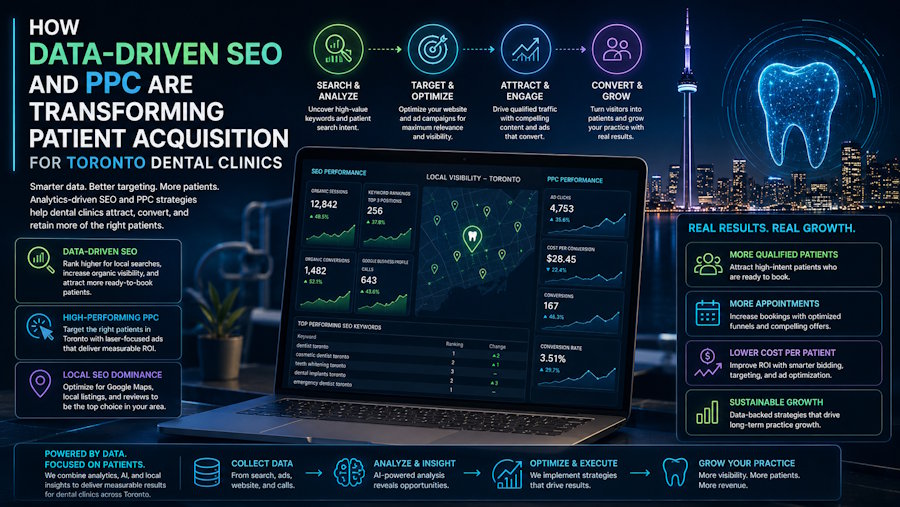
Digital marketing for dental practices has evolved beyond posting before-and-after photos on Instagram and hoping for the best. In 2025, the Toronto dental clinics filling their appointment books consistently are doing so through a disciplined, data-driven approach to online visibility one that combines the long-term compounding power of search engine optimization with the immediate patient flow that precision-managed Google Ads delivers. The gap between practices that have mastered this combination and those that have not is widening every month.
At the core of this shift is the recognition that dental patients search with extraordinary specificity. They are not searching for 'dentist' they are searching for 'Invisalign cost Toronto' or 'emergency tooth extraction Scarborough' or 'dental implants payment plan Markham.' Capturing this demand requires a structured, procedure-level approach to dental SEO Toronto that most generalist agencies are simply not equipped to deliver.
This article breaks down the technical and strategic elements behind high-performing dental digital marketing in Toronto and explains why the practices winning online are treating SEO and PPC as an integrated data system rather than two separate line items.
The Data Behind Dental Search Behaviour in Toronto
Understanding how dental patients actually search is the foundation of any effective digital strategy. Google Search Console and keyword research tools reveal patterns that are consistent across Toronto dental markets and that should directly inform both content strategy and PPC campaign architecture.
The key patterns that emerge from dental search data in the GTA include:
- Procedure-specific searches dominate: The highest-volume, highest-intent dental searches in Toronto are procedure-plus-location combinations 'dental implants Toronto,' 'Invisalign Markham,' 'teeth whitening Scarborough.' Generic terms like 'dentist near me' have high volume but lower conversion rates than procedure-specific queries.
- Cost queries convert exceptionally well: Searches including 'cost,' 'price,' or 'how much' signal a patient who is actively evaluating their options and close to a booking decision. Pages that answer cost questions clearly and position the practice favourably consistently generate high-quality leads.
- Emergency searches are ultra-high intent: 'Emergency dentist Toronto' and related queries come from patients in immediate pain who will call the first practice that answers. Ranking for these terms even at position 3 or 4 generates same-day appointment bookings.
- Mobile dominates local search: More than 70% of local dental searches in Toronto happen on mobile devices. A site that loads slowly or displays poorly on mobile is losing the majority of its potential patient enquiries before they even read a word of content.
These data patterns should directly shape which pages a dental website prioritizes, how those pages are structured, and which keywords a PPC campaign targets first.
Technical SEO for Dental Websites: What Google Actually Measures
Google's ranking algorithm for healthcare content evaluates signals that go far beyond keywords and backlinks. For dental websites in particular, the technical foundation of the site plays an outsized role in ranking potential and it is the layer that most dental practices have never had properly audited.
The technical SEO elements that most directly impact dental website rankings in Toronto include:
- Core Web Vitals: Google's three performance metrics Largest Contentful Paint (LCP), Interaction to Next Paint (INP), and Cumulative Layout Shift (CLS) are direct ranking factors. Most dental websites fail at least one of these, typically LCP due to unoptimized hero images.
- Schema markup: Structured data that explicitly identifies the site as a Dentist organization, marks up services, hours, location, and patient reviews gives Google machine-readable context that improves both rankings and rich result eligibility.
- Crawl architecture: A flat, logical site structure where every important service page is reachable within 2–3 clicks from the homepage ensures Google crawls and indexes all content not just the homepage and a few top-level pages.
- HTTPS and security: Non-negotiable for healthcare sites Google actively flags non-secure dental websites in Chrome, which directly damages patient trust and conversion rates.
- Mobile-first indexing: Google indexes the mobile version of your site first. If your mobile experience is degraded relative to desktop, your rankings reflect the mobile version not the polished desktop view.
A comprehensive technical SEO audit for a dental website typically surfaces 15–30 actionable issues many of which have been silently suppressing rankings for months or years without the practice owner ever knowing.
PPC for Dental Clinics: Building Campaigns That Actually Convert
While SEO builds long-term organic authority, Google Ads delivers immediate top-of-page visibility for the keywords that matter most. For Toronto dental clinics operating in competitive markets, professional PPC management Toronto is the fastest path to a predictable, measurable flow of new patient enquiries but only when campaigns are structured around conversion data rather than impressions and clicks.
The architecture of a high-converting dental PPC campaign in Toronto:
- Procedure-level campaign segmentation: Each high-value service gets its own campaign implants, Invisalign, cosmetic dentistry, emergency care, general dentistry. This allows independent budget control, bid strategies, and performance tracking per procedure rather than averaging across all services.
- Conversion-optimized landing pages: Every ad group drives to a dedicated landing page that exactly matches the search intent not the homepage. An 'Invisalign Toronto' ad that lands on a generic homepage loses 60–70% of its conversion potential immediately.
- Negative keyword architecture: A dental PPC campaign without a comprehensive negative keyword list wastes 20–40% of its budget on irrelevant searches symptom queries, research terms, competitor names, and non-commercial health searches.
- Call tracking integration: Every phone call generated by a PPC ad should be tracked back to the specific keyword, ad group, and campaign that generated it this is the data that drives monthly optimization and budget reallocation.
- AI-powered bidding with human oversight: Google's smart bidding algorithms (Target CPA, Target ROAS) optimize bids in real time across millions of signals but they require experienced human management to set the right goals, interpret the data, and prevent the algorithm from optimizing toward the wrong outcomes.
The Integration Layer: How SEO and PPC Data Should Inform Each Other
The most sophisticated Toronto dental marketing operations treat SEO and PPC not as separate channels but as a unified data ecosystem where insights flow in both directions.
From PPC to SEO:
- PPC conversion data reveals which keywords actually generate booked appointments not just clicks. This intelligence directly informs which organic content pages to prioritize and invest in
- Ad copy A/B test results reveal which value propositions resonate with patients insights that should directly inform the messaging on organic service pages and blog content
From SEO to PPC:
- As organic rankings improve for specific keywords, PPC bids for those terms can be reduced or reallocated lowering blended cost-per-acquisition over time
- High-performing organic content reveals which topics and formats engage dental patients informing which landing pages to build for PPC campaigns
Dental practices running both channels with this level of data integration consistently achieve lower cost-per-new-patient and stronger year-over-year growth than those treating SEO and PPC as separate budget line items managed by separate teams.
Measuring What Matters: The Metrics That Actually Predict Revenue
One of the most common ways dental digital marketing goes wrong is measuring the wrong things. Rankings, impressions, and traffic are leading indicators useful for diagnosing performance but they are not the metrics that determine whether a campaign is actually growing the practice.
The metrics that actually matter for Toronto dental marketing:
- Cost-per-booked-appointment: The total marketing spend divided by the number of new patient appointments generated. This is the number that determines whether a campaign is profitable.
- New patient acquisition rate by channel: Understanding exactly how many new patients each channel (organic search, Google Ads, GBP, referral) generates allows intelligent budget allocation rather than guesswork.
- Patient lifetime value by acquisition source: Patients acquired through different channels often have different average treatment values and retention rates. Knowing this allows the practice to optimize toward the channels that generate the most valuable patients, not just the most patients.
- Organic visibility trend: Month-over-month improvement in Google Search Console impressions and average position for target keywords is the leading indicator of SEO investment paying off before the traffic and conversion data catches up.
Final Thoughts
The Toronto dental practices that will dominate their local markets over the next three to five years are those building integrated, data-driven digital marketing systems today not those still treating their website as a static brochure and their Google Ads account as something to set up and forget.
The technical foundations, data integration, and specialist expertise required to compete at this level are available but only to practices willing to invest in them seriously and consistently. In a market as competitive as Toronto dentistry, that commitment is the dividing line between the practices that are growing and the ones that are wondering why they are not.
About the Author
KM Mahbubur Rashid, M.Pharm, MBA, PG Digital Media (George Brown College) is the Director & CEO of BizStori Canada Inc., an AI-driven marketing automation agency based in Scarborough, Ontario, specializing in healthcare and dental digital marketing across the Greater Toronto Area.

