

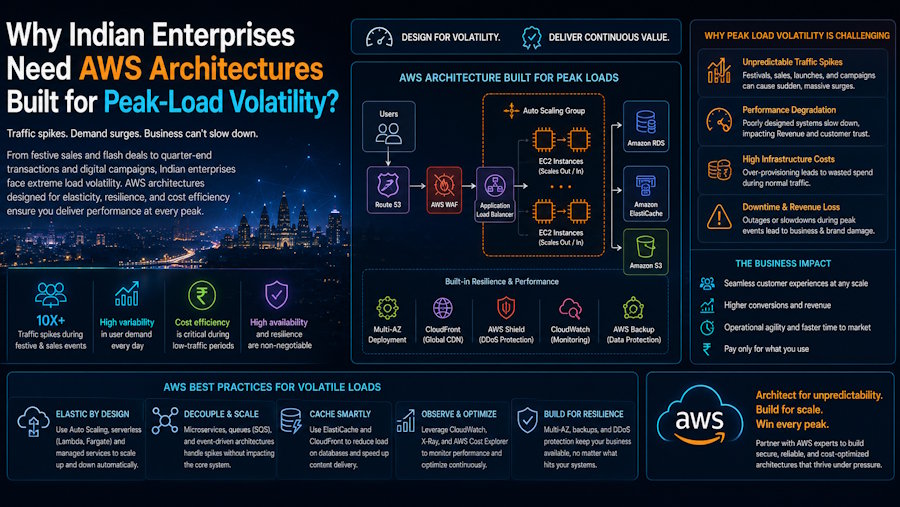
India’s digital demand arrives in compressed bouts, it was noted that UPI processed 22.72 billion transactions in June 2026, roughly 757 million a day. The monthly average hides the engineering problem: rushes around salary dates, festival shopping, ticket releases, tax deadlines, exam results, and public-benefit windows. A system can look healthy all month and fail during the ten minutes that matter commercially.
Applications must absorb uneven arrivals, protect dependencies, preserve transaction integrity, and recover without improvisation. An AWS architecture India review should begin with demand shape and failure propagation, where aws cloud consulting services help enterprises design for volatility, resilience, latency, and scale. Account boundaries belong to governance, billing, security, and ownership decisions.
Account structure does not describe how demand travels
Cloud estates are often arranged by business unit, product, environment, or legal entity. Those divisions support access and financial accountability. They reveal little when a customer taps “Pay,” refreshes results, joins a flash sale, or retries after a mobile interruption.
Demand moves through a transaction path. One request may cross CloudFront, a load balancer, containers or functions, a cache, APIs, a relational database, a payment gateway, and an event queue. Components may sit in separate accounts. Customers experience one service.
This distinction matters for AWS architecture India because Indian volatility is often synchronized. Millions respond together. A push notification, cricket result, inventory release, subsidy deadline, or festive offer can concentrate demand within seconds. Account dashboards may remain green while a shared connection pool, authentication service, inventory lock, or third-party API becomes the choke point.
The design unit is the critical customer journey. Map synchronous dependencies, asynchronous work, state changes, retries, and degraded modes. Then assign account support.
Why Indian traffic patterns punish average-based planning?
Average traffic is useful for cost reporting. It is weak evidence for peak readiness. Four Indian demand patterns expose that gap.
|
Demand source |
Typical burst shape |
Architectural pressure |
|
Festive and flash sales |
Promotion-led surge with inventory contention |
Cache efficiency, admission control, checkout integrity |
|
Digital payments |
Short transaction bursts with retries |
Idempotency, low latency, dependency isolation |
|
Public services |
Deadline or announcement-driven concurrency |
Fair access, queueing, graceful degradation |
|
Mobile-first platforms |
Uneven sessions across networks and devices |
Edge delivery, compact payloads, retry discipline |
User behavior can amplify the surge. Slow responses trigger refreshes. Timeouts trigger payment retries. Unavailable inventory triggers repeated searches. The application’s uncertainty generates a second wave.
A credible peak-load cloud architecture models that loop. It tests retry storms, cache misses, connection exhaustion, hot partitions, queue growth, and third-party slowdown. It separates reads from writes. Catalogue data may be stale. Payment confirmation cannot.
Autoscaling must follow workload signals
AWS Auto Scaling works when metrics reflect saturation and capacity arrives before queues become harmful. CPU alone is weak evidence. A service may show moderate CPU while concurrency, thread pools, memory, database connections, or downstream latency are unsafe. AWS recommends automated resource acquisition and warns against inflexible policies based on manual estimates.
For AWS architecture India, capacity policies should combine several signals:
- Request rate per target for stateless web tiers
- Queue depth and age for background consumers
- Concurrent executions for event-driven functions
- Database connection use and replica lag
- Tail latency, especially p95 and p99
- Business signals such as active checkouts or payment initiations
Scheduled capacity suits known events. An 8:00 p.m. sale should not wait for breached thresholds. Add warm capacity beforehand, then let dynamic policies handle forecast error.
The deeper rule is simple: capacity automation cannot repair synchronous coupling. When ten services must respond before checkout completes, the slowest dependency sets the ceiling.
Caching should protect scarce systems
Caching is often treated as a latency feature. During a surge, it protects scarce systems. CloudFront absorbs repeated delivery of static and cacheable dynamic content near users. ElastiCache reduces repeated database and API reads. AWS recommends explicit time-to-live and invalidation policies, plus retries, backoff, timeouts, and connection pooling.
A strong AWS architecture India separates data by freshness need:
- Product descriptions, media, public schedules, and reference data can use longer TTLs.
- Price, availability, and eligibility data need shorter TTLs or event-led invalidation.
- User-specific state needs carefully scoped keys and privacy controls.
- Payment, booking, and entitlement writes should bypass ambiguous cached state.
Cache misses deserve equal attention. Widespread expiry can send thousands of identical requests to the origin. Use jittered TTLs, request coalescing, stale-while-revalidate patterns, and protected fallback content. The goal is controlled origin demand, not a perfect dashboard.
Database design decides whether the event survives
Application tiers can add capacity quickly. Databases remain sensitive to connection storms, lock contention, hot keys, long transactions, and uneven access. Read replicas help read-heavy traffic. They cannot fix a write bottleneck around one inventory row or serialized payment state.
Database preparation for high traffic cloud workloads should start with transaction classification. Identify which writes require immediate consistency, which reads can accept replica delay, and which updates can be processed later. Use Amazon RDS Proxy or disciplined application pooling to prevent connection floods. Partition keys should distribute demand. Indexes should match event queries, rather than ordinary-day reporting queries.
AWS guidance for traffic spikes points to Aurora Serverless v2 and read-replica automation as options for elastic database capacity. Separate AWS guidance recommends persistent queues with Aurora and RDS Proxy to preserve application data during failover or temporary database unavailability.
For AWS scalability India, the useful question is not “How large can the database become?” Ask, “Which record, connection, lock, or partition fails first when arrivals become concentrated?”
Queueing converts a surge into controlled work
A queue does more than defer processing. It establishes a boundary between customer-facing acceptance and backend completion. Amazon SQS, Amazon Kinesis, and event-driven consumers can absorb uneven arrival rates while workers process at a safe pace.
This pattern suits emails, notifications, invoices, analytics events, loyalty updates, documents, and post-payment tasks. It is unsuitable when users need an immediate, authoritative answer. The architecture must state the distinction.
Every queued workflow needs:
- Idempotency keys to prevent duplicate outcomes
- Visibility timeouts aligned with processing duration
- Dead-letter queues with ownership and replay procedures
- Maximum queue-age objectives
- Backpressure when downstream systems remain impaired
- User status messages that reflect accepted, processing, completed, or failed states
The queue-depth graph is incomplete without age. Ten thousand fresh messages may be acceptable. Five hundred messages waiting twenty minutes may represent a broken service.
Resilience requires designed degradation
Peak readiness is partly the ability to serve less without becoming unavailable. During a surge, recommendations can disappear, search filters can narrow, images can use lower weights, and nonessential personalization can pause. Checkout, payment state, identity, and order confirmation remain protected.
An effective peak-load cloud architecture defines these modes before the incident. Feature flags, circuit breakers, bounded retries, strict timeouts, bulkheads, and load shedding prevent a weak dependency from consuming the whole request path. For limited inventory or public registration, admission control or a virtual waiting room may provide fairer access than unrestricted concurrency. AWS notes that waiting-room patterns are useful when traffic arrives faster than infrastructure can provision or when backend limits cannot move quickly enough.
Multi-Availability Zone design should be the baseline for critical services. Multi-Region design needs a business reason, explicit recovery objectives, data-consistency decisions, and rehearsed traffic switching. AWS provides patterns for cross-Region failover and graceful failback, with observability supporting the failover decision.
Peak testing must reproduce bad behaviour
A load test that sends clean traffic at a steady rate proves little. Real users retry, abandon, refresh, reconnect, and arrive with uneven payloads. External providers slow down. Cache entries expire. A deployment may occur hours before the event.
For AWS architecture India, test scenarios should include:
- A sudden step increase, rather than a gentle ramp.
- Cache cold starts and synchronized expiry.
- Payment or identity provider latency.
- Database failover under active writes.
- Consumer slowdown with continued queue growth.
- One Availability Zone losing capacity.
- Retry storms from clients and internal services.
- Rollback while traffic remains high.
Measure accepted transactions, completed transactions, duplicate outcomes, queue age, error budgets, p99 latency, recovery time, and customer-visible status accuracy. Infrastructure health is only one part of the result.
A practical design standard for peak-load readiness
An AWS architecture India readiness review connects business events to technical limits. These practices create that connection.
- Model demand as arrivals- Record expected requests per second, concurrency, burst duration, read-write mix, and retry assumptions.
- Define service priorities- Protect revenue, payment, identity, and statutory journeys before recommendations or reporting.
- Find the first constraint- Test databases, third parties, locks, partitions, and connection pools before adding compute.
- Move optional work off the request path- Use queues for tasks that can complete after user acknowledgement.
- Pre-position known capacity- Prepare for announced events, then use automation for residual variation.
- Design degraded modes- Decide what can become stale, disappear, queue, or reject safely.
- Run event rehearsals- Include business, application, database, security, network, and support teams.
- Review by journey- Keep account ownership visible, while measuring the complete transaction path.
This is where AWS scalability India becomes an engineering discipline instead of a procurement phrase. The objective is predictable customer outcomes under uneven demand.
Architecture should follow the moment of truth
India’s digital economy creates unusually visible moments of truth. A customer may tolerate a slower recommendation feed. They will remember a debited payment without confirmation, an unavailable exam result, a failed ticket purchase, or a government portal that collapses near a deadline.
The strongest AWS architecture India connects technical controls to those moments. It uses edge delivery to reduce origin pressure, capacity automation tied to saturation, caches with deliberate freshness rules, databases designed around contention, queues that protect completion, and degradation that preserves critical journeys.
Account structure still matters. It supports governance, security, billing, and team autonomy. Peak demand follows a different map. It follows shared dependencies and customer actions. Design for that map first, and high traffic cloud workloads become measurable, testable, and recoverable rather than annual surprises.

