

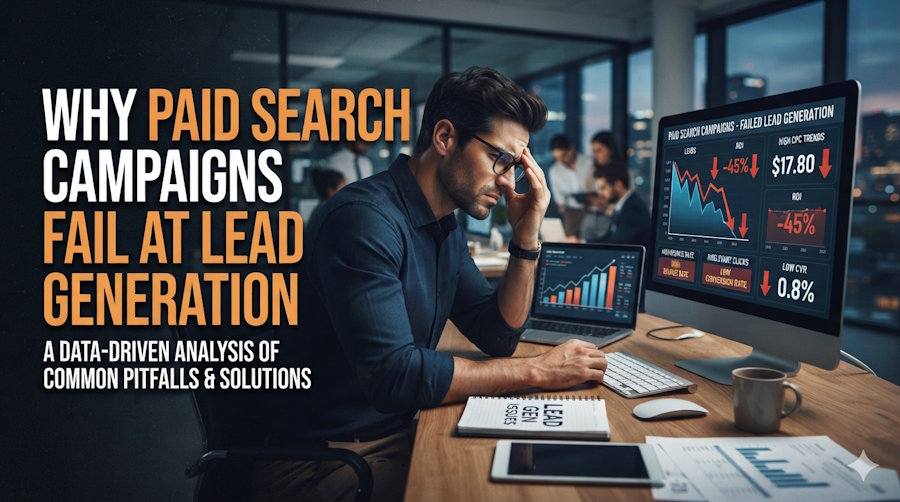
Paid search should be the easiest method of lead acquisition. Someone types exactly what you provide in Google and your ad comes up on top, they click and then they convert. You're not convincing anybody. Most campaigns, however, quietly fall apart somewhere between the keyword list and the contact form. Budgets get spent. Clicks come in. Leads don't. There is a significant difference between the way paid search is supposed to work and how it actually works for most businesses, but it's not random, it's not forever.
In this guide, you'll learn all of the most important reasons paid search fails to generate leads and the steps you can take to improve them. What exactly is the problem and what do you need to do about it?
1. Poor Keyword Targeting
The only rule to remember when it comes to keywords in B2B lead generation is that not all clicks responses are the same.
The person looking for information will be much more likely to click on the link because they are interested in the topic rather than the one who is ready to hire, purchase or sign up. The overwhelming majority of the failing campaigns are targeted at the wrong type.
Consider the following difference between the two queries:
- "how does CRM software work"
- "Best real estate agent CRM software "
They're both in reference to CRM software. The first one is learning though. The second person is going to put the shopping cart away. As a CRM firm looking to get leads you want the second searcher desperately. The first one probably will not purchase anything from you.
It's this separation between those who are simply curious, and those who are ready to act, that is what makes profitable campaigns, and other campaigns that drain money away.
What to fix:
Review the list of keywords you created and ask yourself, "Are people searching this phrase because they want information or because they want to take action?" Trim the ones that are searching for information. Target any keywords that have phrases such as “hire”, “best”, “near me”, “pricing”, “agency”, “quote”, or “service”.
Secondly, religiously use negative keywords. These are the words that you tell Google to ignore when deciding whether or not to display your ad. For premium services: If you're having premium service, add "free" and "cheap" as negatives. If you only work in one city, then do not include nearby areas. Any click that doesn't add value to the deal is a dollar lost.
2. Targeting the Wrong Audience
Your keywords may be correct but your ads can still be viewed by the wrong audience.
You have a B2B software business and you're targeting the keyword "project management tool". The search might be a student working on a homework project, a freelancer working on their own project, or the VP of Operations at a 500-person business wanting to buy a team license. Same keyword. Wildly different people.

For enterprise software, 2 out of 3 of those searchers are squandering your budget.
Google Ads allows you to add filters to your keywords. You can further refine your search by job type, industry, household income, age, location and more. These filters are not used by most campaigns.
What to fix:
Take the time to determine who your actual buyer is. Not who might potentially use your product who actually pays you for it. Use demographic targeting and audience segments in Google Ads to prioritize your spending efforts toward that audience. For B2B, add in LinkedIn-level professional keywords as applicable. If you are local, please place bids only in areas that you can serve. In that way, you get better results in lead nurturing.
3. Weak Brand Message
Usually at the top of Google's search results page, there are three or four paid ads. They are all the best. They all use phrases such as "award-winning," "trusted by thousands," and "contact us today.
Yours will likely contain something similar.
What makes these claims unconvincing is that they don't mean anything to anyone who takes less than five seconds to scan the results. They are all indistinct. Then, when ads overlay, users click on the first one, or on the one with the highest number of stars for reviews, or down to the organic ones in the first place.
Your ad should address one question in the mind of the reader as soon as she opens it: "Why should I click on this one and not the other ads I have seen?
The response must not be general. It needs to be specific. Like: “We've assisted 300 law firms in generating leads in 90 days.” We don't say "we deliver results. Specific words are “free proposal in 24 hours”. “Contact us today” isn't.
What to fix
Go through your existing copy and determine if a total stranger could explain what makes you different from any other business that sells the same product. If they couldn't, rewrite it. You need to start with what you know your customer can't get anywhere else, that's a promise, a result they can't achieve, a process you don't follow, a price point. Be specific about your offer. Be sure your CTA is telling people what they will receive upon clicking.
4. No Clear Marketing Goal
This may seem like a no-brainer, but it's one of the most frequent excuses for campaigns to fall.
If you're asked "what is this campaign supposed to do?," it's likely you'll get one of the following answers: get leads, drive traffic, etc. That's not a goal. That's a wish.
A real goal is: "To have 40 consultation requests per month at a maximum cost of $80 per request. That's the kind of goal to give you the structure of your campaign, what to optimize for, what you're doing well and when you need to make changes.
Otherwise you have campaigns that are running but are going nowhere. It is impossible to discern whether or not they are functioning. It is not possible to make a sensible choice of budget. You make random changes and hope something will get better.
What to fix
Before you invest one single penny, determine for your business what a "lead" is. Does it appear to be a form submission? A phone call? A chat message? A whitepaper download? Choose one main conversion action, and determine a cost-per-lead margin goal, then optimize all of your marketing for that figure. All keywords, bids, landing pages, and ad copy should be aimed at that one goal.
5. Ignoring SEO and AI Search
The world of paid search and the world of SEO were once two entirely different worlds. That's how many businesses ran ads here, blogged there with no relation.That separation is now actively hurting campaigns.
Why? When you continuously appear in Google search results whether in the sponsored ads at the top or the organic ads at the bottom people are more likely to trust you and click on you. Brands which show up in both positions receive more clicks overall than brands that show up in only one. That visibility will also reduce your cost-per-click over time as Google will favour ads which receive high engagement.
Moreover, AI is essentially redefining the way people search. Google's AI Overviews now automatically provide answers to many of the questions on the SERP. Features such as ChatGPT and Perplexity are being used by millions to conduct research prior to entering a query into Google. Whether you spend a fortune on ads or not, if your brand doesn't exist in those AI-generated answers, you don't have content, no authority, and no presence, and a growing part of your target market is invisible
What to fix
Begin considering both SEO and paid search as a single marketing strategy. Create content on the same keywords that your ads are targeting. Create articles, guides and comparison pages that answer the questions your customers actually have. This content is built on a foundation of authority over time, elevates your Google Ads Quality Score (which directly reduces your cost) and puts your brand in front of AI systems that are increasingly determining what people see online. Most importantly, business looking for multi channel presence the principles behind multi channel lead generation for B2B is organic content and paid search working simultaneously.
6. Poor Website Experience
The click has been paid for. Someone clicked. Now what happens?
For most campaigns, the next step is the issue. The visitor ends up on a page that is slow to load, is chock full of information, and provides no clear action. So they leave. That click cost you $5 to $50, and it didn't generate anything.
Cluttered Pages
The saying “Jack of all trades, master of none” applies to a landing page that does too much. Businesses often push paid traffic to the homepage where there are navigation menus, several services, several blog links, company history, social media feeds and six different calls to action all vying for attention.
If a person clicks on your ad, they will tell you what they want. Your page should address the desire right there, eliminate all the distractions, and make it as easy as it can be, for the next step to be taken.
One page. One message. One action.
No Clear Call to Action
If you don't have a Clear Call to Action (CTA), you should have one.
The ‘clean' pages, even if they are relatively clean, hide or weaken the call to action. The submit button is labelled "Submit". There are eight fields to be completed in the form. The CTA is below the fold and in light gray text.
The most crucial part of the page is your call to action. It should describe to people what they are doing, not what they are getting. The answer to "Get My Free Audit” is better than "Submit. “A 20-Minute Strategy Call" is better than "Contact Us.
Even pages that are relatively clean often bury or weaken their call to action. The button says "Submit." The form asks for eight fields. The CTA is below the fold in light gray text.
What to fix
If you are driving paid traffic to your home page, you need to halt that traffic ASAP and create a dedicated landing page for each campaign. Remove navigation area. Focus on one offer. Create a headline that directly carries over the promise in the ad. Place a clear CTA, one that is useful and has a benefit statement that cannot be missed, both top and bottom of the page. Keep the number of form fields to a minimum.
7. Not Budgeting Appropriately
Many pay per click campaigns fail to get off the ground and die a young death due to a certain budget problem: paying enough to run the ads, but not enough to learn.
Google's Smart Bidding system is reliant on real data to optimize your bids for more conversions. In particular, it requires approximately 30 to 50 conversions every month to begin intelligent decision making. When your budget is too small to produce these quantities, the algorithm stays in a constant learning mode, your bills remain high and your outcomes remain unstable.
Many businesses start out a $500 per month campaign, experience poor gains after 4 weeks and decide that PPC is not working for them. In fact, the campaign had a scant amount of time to optimize.
Other companies on the other hand, invest massive amounts of money into campaigns without any structure. There's no sense of priority meaning, money is spread thin across too many keywords and campaigns, and no one receives sufficient spend to perform well. On the other hand companies that have done budget planning for lead campaigns,helps businesses outperform the competitors, not necessarily by being the one with the most budget instead by allocating the spend in the most precise way.
What to fix:
Be realistic about what you can afford in your budget. The numbers of $1,500 to $3,000/month are the minimum needed for most local service businesses to provide meaningful data. In a competitive business-to-business industry, this figure can be $5,000 or higher. If you don't have a budget above these numbers, focus it on fewer, more intent keywords. And do not make significant judgments on a campaign's performance until at least 60-90 days later.
8. Promoting the Wrong Offer
You're being offered the contact info because of your offer. An exchange means you give them something of value and they give you their name, email or phone number.
No conversion, if the offer isn't compelling, despite its greatness in other respects.
The most frequent offer error is requesting too much, too soon. Cold lead generation assumes that your visitor is ready to purchase when they are targeted right to your “Schedule a Demo” or “Talk to Sales” page. Most aren't. They're evaluating options. They want to ‘test' you before they agree to go into a sales conversation.
A lower commitment offer a complimentary audit, a great guide, a pricing calculator, a brief assessment. It reduces the friction to get them in your funnel, qualifies them and nurtures them over time to be able to sell them.
What to fix:
Match your offer to where your searcher is in their decision process. If they are actively comparing solutions, a free consultation or quote is appropriate. If they are still in the early research phase, a genuinely valuable free resource will work better. The goal is to make saying "yes" as easy as possible while building trust through the value you deliver upfront. This is precisely why lead qualification matters so much as the right offer attracts the right leads, and the wrong offer fills your pipeline with contacts who were never going to buy.
9. Focusing Only on Ads
Most paid search agencies will never tell you this, but the ad is just a small part of a successful lead gen campaign.
It's only the click that begins. What the prospect has seen before that click, whether it's your brand before they saw it, your content, a case study has a huge influence on whether they convert or not. What happens after the click of your follow-up email, your sales process, your nurture campaign, etc.
Businesses that focus entirely on ad performance while ignoring everything around it consistently underperform compared to those who build a complete system.
What to fix
Don't only think about the ad. Think about setting up retargeting campaigns that will re-engage many visitors and the ones who will not convert first time. Built an email sequence to follow up the lead. Also create new contents that will target the audience finding genuine usefulness.
Most importantly, combine paid search with outbound channels to create compound returns. Businesses that pair their inbound PPC efforts with dedicated lead generation services create multiple touchpoints in the buyer's journey, dramatically increasing the likelihood that a prospect converts somewhere along the path.
10. No Data Tracking or Analytics
If you don't know which keywords are producing leads, which ads are driving conversions, or what your actual cost per lead is, you cannot improve your campaign. You're flying completely blind.
This sounds obvious. But a shocking number of campaigns run for months with broken or missing conversion tracking. Marketers look at click data and assume it reflects reality. It doesn't. Clicks and leads are completely different things.
Without proper tracking, you might be pouring money into keywords that get lots of clicks but produce zero leads and cutting the ones that were actually working because they had lower click volume.
What to fix
Before launching any campaign, set up conversion tracking for every action that counts as a lead form submissions, phone calls, chat messages, email signups. Understanding how to measure lead quality, not just lead quantity is one of the highest-leverage skills in any lead generation operation.
Use Google Analytics 4 alongside Google Ads to see the full picture. Check your tracking every month because tags break silently when websites get updated. If you run a service business where sales happen offline, look into importing closed deals back into Google Ads so the system can optimize toward actual revenue, not just lead volume.
11. Lack of Content Strategy
Content does something that paid ads cannot: it wins trust before someone is ready to buy.
The first-brand interaction does not lead to conversion for most. They research. They compare. They come back. During that process, content is what allows your brand to rise above the fray and stay in their consideration set and it's also from where AI systems draw answers when they answer user's queries.
Companies that use the process of producing useful content such as practical blog articles, detailed guides, impartial comparison pages and genuine case studies almost always attract better quality leads at much lower cost in the long run. They outperformed businesses that complete paid traffic.
What to fix
When customers trust you to build content that they are actually looking forward to reading. Never try to force keywords and stuff in the content. Do not write for search bots but instead for real specific and useful content answering the questions your users are asking. Specifically any comparison content ("X vs Y”).
This type of content both generates organic traffic and improves your Quality Scores for paid search, not to mention providing you with something great to offer as a lead magnet.
12. Unrealistic Expectations
Last but not the least reason campaigns fail, in fact a mindset problem & tactical nature.
Businesses embark on paid search campaigns in anticipation of immediate results. They make drastic changes when leads don't come flooding in the first two weeks, pause campaigns, slash budgets, rewrite everything and disrupt the very process that with more time would have yielded results.
Paid search is fast, compared with SEO but it also has a ramp up time. It takes time for the Google algorithm to learn. It takes time to gain enough data to make good decisions. Tests on landing pages require sufficient traffic to yield statistically significant results. Two weeks is above all too short for all of this.
What to fix
Manage expectations with your and your team before launching. A 30 to 60 day learning phase for gathering data and optimization. Apply small and granular intentional changes and test each for its impact. Treat the data as intelligence not judgment. Companies that maintain an intentional look to improve the customer experience end up doing orders of magnitude better than those who react emotionally to early results.
How to Fix Failing PPC Campaigns: A Step-by-Step Action Plan
Before making changes, you will need to identify the reasons for a campaign underperformance before doing anything else. Begin by examining the data, settings and overall campaign structure.
Step 1: Audit What You Already Have
Before changing anything, be aware of the actual situation. Export 90 days worth of data and analyse not to see which campaigns, ad groups and keywords are pulling through clicks but leads. Double-check your conversion tracking to ensure it is recording correctly. Look at your Quality Scores. In other words, whilst your keywords focus on what you want to be found for, you should all of the time check your Search Terms Report that presents the actual phrases that trigger your ads.
The audit reveals where the true issues lie. Without it, you're guessing.
Step 2: Study Your Competitors
Hit up Google and type your top ten keywords. Screenshot every ad that appears. Check out the landing page where they're sending traffic. Take note of what they're promoting, how they talk about themselves, and their backdrop.
Next, take SEMRUSH or SpyFu and see what keywords they're bidding on and for how long they've been running those ads. Long-running ads are typically profitable due to the nature that these companies pay for nothing that does not serve their purpose.
This research gives you a glimpse of what the baseline of your market looks like. You want to do something distinctly better.
Step 3: Define Your Ideal Customer Precisely
Define who your ideal customer is in granular detail Not some vague demographic-real profile. What industry are they in? What's their role? When we build a product or service, what challenge are they seeking to address? What have they attempted in the past that proves ineffective? How does success for them look like?
This profile should guide every aspect of your campaign: the keywords that you go after, the words you use in your ads, the sweet offer you are making and what will be on your landing page. Know exactly who you are talking to also determines which outbound channels complement your paid search efforts or many B2B businesses, pairing PPC with B2B appointment setting creates a full-funnel system where inbound interest and outbound outreach reinforce each other.
Step 4: Rebuild Ads Around What Your Customer Actually Cares About
Take the language right out of your customer profile and use it in your ad copy. Use the actual words and phrases that your best customers use when they describe their problem. Use their words back to them.
Create a minimum of three to four different versions of each ad with varying headlines, different offers and angles. Extend them until you see a victor through the data, then kill the losing ones and iterate on what is working.
Step 5: Combine Content and SEO with Your Paid Strategy
List the five questions your target customers ask before they buy. Create genuinely useful, comprehensive content that answers each one. Publish it. Optimize it for search. Use it as a supporting material to any of your landing pages by linking to it.
This content does multiple things at once: it draws in organic traffic, it warms up an audience before they ever click on an ad, it helps your Google Ads Quality Score and feeds into the search results that the AI creates which more people are beginning to rely upon for finding businesses.
Step 6: Track, Test, and Improve Continuously
Establish a recurring cycle for review and optimization. Review your Search Terms Report every week, and add new negative keywords For each two weeks, review ad performance and pause anything that's significantly underperforming. Do an audit of your landing page conversion rate and lead quality monthly. At the quarterly level, consider putting a pause on everything and evaluate if overall strategy is correct: are you pursuing the right customers, are you contemporizing the right offer, and do your budget allocations make sense?
Document every change and the reasoning behind it. This documentation is the data of your decisions for consistency and how these translate to results over time.
Frequently Asked Questions
Why is My PPC Campaign Not Generating Leads?
Poor matching between an ad and the landing page is the reason keyword targeting brings in terrible searchers. The offer is also not interesting enough for the broken conversion and to track the hiding leads. This includes reviewing your tracking and reviewing data from your search team reports to see whether searches set off your ads. If those two things are okay, it's only your landing page or your offer that's probably at fault.
How Fast Can I See Results From PPC?
You'll see clicks almost immediately. You will see your first lead data two-four weeks later. However, when an optimized campaign is consistently achieving its target cost-per-lead it tends to take about 90 days to establish. The first month is learning. Month two is optimization based around what you learned. It is the third month that the compound starts. Abandoned campaigns never get a fair shot within that time frame.
Why Does SEO Matter if I'm Already Running Paid Ads?
You may ask why because SEO and paid ads work together better than either of them alone. Consumers are much more likely to click on your brand when they see it in both the paid and organic results for a given search, which also increases their trust in you. SEO creates assets, content, authority and backlinks that continue working after your ad budget ends. And as the search becomes more powered by AI it is often the brands that have built strong content and authority that will come to top of AI generated answers. Paid ads are not the answer to that visibility.
How is AI Changing Digital Marketing?
In two significant ways. First of all references to AI tools which help you with automating decisions within Smart Biddings, Performance Max, Responsive Search Ads etc. are coming in and it is replacing constant manual management. Which is usually a good thing, but given it only works on clean data. If your conversion tracking is not working properly, AI bidding optimizes toward the wrong thing. The second reason is that AI-based search tools are flipped how buyers investigate buys. ChatGPT or Perplexity is where more and more people are going for suggestions before they even open Google. These systems are even less likely to recommend brands that have not built demonstrable expertise and content authority.
What Are the Best Lead Generation Methods Right Now?
Paid search continues to be one of the highest intent lead generation channels around if someone is searching for a solution, they're in buying mode. However, it is most effective within an ecosystem of SEO content for long-term authority, email nurturing to convert leads who are not ready to buy today and retargeting to compel peoples back who visited but did not convert. LinkedIn Ads can also yield great results for B2B companies with high average deal values. What combination works best for you will depend on your sales cycle, price point, and competitive landscape for your keywords.
Why Does Content Quality Matter for Lead Generation?
This is because the quality of your content is an immediate signal of the quality of your business. Someone who reads a fantastic, useful, specific and well-written article from your business has got more trust than they could have gotten in an ad. When they finally have reached their way to your landing page, that trust makes them much more likely to convert. The funny thing is, poor-quality content ranks less and gets fewer shares while in 2023 it is filtered out of AI search results more and more.
Conclusion
Paid search campaigns fail at lead generation for the same reasons over and over again. Wrong keywords. Wrong audience. Weak offer. Bad landing pages. No tracking. No patience.
Because all of these are rather simple challenges, not complex. But they compound quickly. Generally speaking, three or four of these issues campaigns will under-perform you however big a success of the budget you throw at it!
Not everyone with a big budget wins at paid search lead generation. They are the people who have put in the effort to really know who they are trying to reach, what those people actually want to hear and how a campaign is built. Fix the fundamentals. Track everything. Give it time. The leads will follow.

