

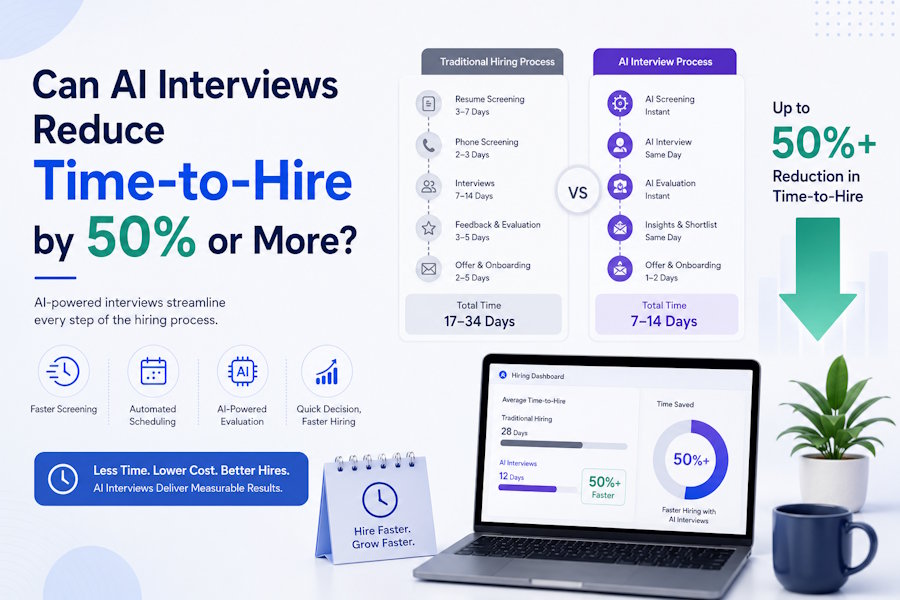
Yes. Enterprise organizations implementing AI interviews report time-to-hire reductions ranging from 31% to 75%, depending on role volume, industry, and the stage of the hiring funnel being automated (SHRM, 2025; Eightfold AI, 2025). For C-suite and HR leaders evaluating whether this level of efficiency gain is realistic for their own organization, the data suggests it is not only achievable but increasingly becoming a competitive baseline rather than an outlier result.
This article examines the data behind these claims, where in the hiring funnel AI interviews create the greatest time savings, and what enterprise leaders should consider before setting internal targets for their own hiring transformation.
The Current State of Enterprise Time-to-Hire
Before evaluating the impact of AI interviews, it is worth establishing the baseline enterprise leaders are working against.
The average hiring process in the United States now takes approximately 42 days from job posting to accepted offer, according to SHRM's 2025 Benchmarking Report. This figure has been trending in the wrong direction. Sixty percent of companies reported longer hiring timelines in 2024, while only 12% managed to shorten them, according to GoodTime's 2026 Hiring Insights Report.
This creates a straightforward business problem for enterprise leaders. Every day a critical role remains open translates into lost productivity, delayed revenue contribution, and in many cases, increased burden on existing teams covering the gap. For organizations hiring at scale across dozens or hundreds of open requisitions simultaneously, even a modest percentage improvement in time-to-hire compounds into significant organizational impact.
Where the 40 to 50 Percent Reduction Comes From
The claim that AI interviews reduce time-to-hire by 50% or more is not a single statistic pulled from one source. It is a pattern that appears consistently across multiple independent studies, each measuring different parts of the hiring funnel.
Resume screening and shortlisting. This is the stage where AI delivers its most measurable and consistent gains. Automated screening reduces initial review time by 71%, while maintaining or improving match accuracy compared to manual review (Workday, 2025). Separately, resume screening time has been reported to drop from an average of 10 days to 2 days when AI tools are introduced (DataRefs, 2026). Candidates can improve their chances of passing this automated screening stage by using an ATS resume checker to identify missing keywords, formatting problems, and other issues before submitting their applications.
Interview scheduling and coordination. Scheduling has historically been one of the most time-consuming administrative burdens in enterprise hiring. AI-powered scheduling and self-service interview tools reduce coordination time by 65% (Careertrainer.ai, 2026), with interview scheduling windows dropping from an average of 5 days to 1 day (DataRefs, 2026).
First-round interview completion. Because AI interviews are not constrained by interviewer calendar availability, they can be completed in parallel across an entire candidate pool. Enterprise deployments have reported roles filled in as little as 1.3 days for high-volume positions, compared to weeks under traditional processes (Eightfold AI, 2025).
Overall time-to-hire. When these stage-level gains are combined, organizations report time-to-hire reductions of 25% to 50% as typical outcomes, with some enterprises reporting reductions as high as 70% to 75% for high-volume roles (Pin, 2026; Impress.ai, 2025).
The pattern across these sources is consistent. The greatest time savings occur not in a single dramatic shift, but in the cumulative removal of friction at every stage of the funnel, from screening through scheduling through evaluation.
What This Looks Like at Enterprise Scale
Numbers in isolation can be difficult to translate into organizational impact. The Unilever Future Leaders programme offers one of the most cited enterprise benchmarks for AI interviewing at scale.
Unilever uses AI-powered video interviews and predictive analytics to process over 250,000 applications annually for approximately 800 hires. The AI system narrows this pool to roughly 350 shortlisted candidates before human review. The measured results include more than 50,000 recruiter hours saved annually, £1 million in associated cost savings, a 16% increase in diversity among new hires, and a 96% candidate completion rate for the AI interview stage.
This case illustrates a point that matters specifically for C-suite decision-makers: time savings from AI interviews are not achieved by removing human judgment from hiring decisions. They are achieved by reserving human time and attention for the candidates who have already been validated as strong matches, rather than spreading that time thin across an entire applicant pool.
Why Talent Acquisition Is Where the Value Concentrates
McKinsey's analysis of generative AI's value potential in HR functions found that talent acquisition and recruiting represent approximately 20% of the total value generative AI can unlock across the entire HR function. This is not an arbitrary allocation. McKinsey based this estimate on where the most manual, repetitive, and time-consuming work actually exists within HR operations, and recruiting consistently ranks among the highest-friction functions.
This finding is significant for enterprise leaders building a business case for AI interviews internally. It reframes the conversation from a narrow recruiting efficiency question into a broader HR value allocation question, one that finance and operations leaders are more likely to engage with when evaluating technology investment priorities.
The Workforce-Level Impact
Beyond time-to-hire as a single metric, the workforce-level data reinforces the same conclusion.
Talent acquisition professionals using generative AI report a 20% reduction in overall workload, equivalent to saving roughly one full workday per week, based on LinkedIn's Future of Recruiting 2025 report, which surveyed 1,271 talent acquisition professionals across 23 countries. A separate 2025 survey of 380 recruiters found that AI-enabled teams complete 66% more candidate screens per week while spending 41% less time on documentation and administrative tasks.
For enterprise organizations, this workload reduction has a compounding effect. Recruiters and hiring managers freed from repetitive screening and scheduling work are able to redirect that time toward higher-value activities such as candidate relationship building, employer branding, and strategic workforce planning, all of which have their own downstream impact on quality of hire and retention.
Setting Realistic Expectations for Your Organization
While the data consistently points toward the 40 to 50 percent range as an achievable and common outcome, enterprise leaders should calibrate expectations based on a few organizational variables.
Hiring volume matters. The parallel processing advantage of AI interviews becomes more pronounced as applicant volume increases. Organizations hiring for high-volume roles, such as customer support, sales development, or entry-level technical positions, tend to see time-to-hire reductions at the higher end of the range.
Role complexity matters. Highly specialized or senior roles that require multiple rounds of technical or executive assessment will still see meaningful time savings in the early screening stages, but the overall percentage reduction is often more moderate, since a portion of the process remains human-led by design.
Integration maturity matters. Organizations that fully integrate AI interviews into their existing applicant tracking systems and hiring workflows, rather than running them as a standalone tool, tend to capture more of the available time savings, since friction at the handoff points between systems can otherwise offset some of the gains.
Adoption curve matters. As with any operational technology, the largest gains typically materialize after the first one to two full hiring cycles, once hiring teams have calibrated interview structure and evaluation criteria within the system.
The Bottom Line for Enterprise Leaders
The evidence across multiple independent industry studies supports the conclusion that AI interviews can reduce time-to-hire by 50% or more, particularly for high-volume enterprise hiring. This is not an isolated claim from a single vendor study. It is a consistent finding across SHRM benchmarking data, McKinsey's HR value analysis, LinkedIn's workforce survey data, and documented enterprise case studies such as Unilever's Future Leaders programme.
For C-suite and HR leaders evaluating this technology, the strategic question is no longer whether AI interviews can meaningfully compress hiring timelines. The data on that point is well established. The more relevant question is how quickly an organization can integrate AI interviews into its existing hiring infrastructure to begin capturing that value, before slower time-to-hire becomes a competitive disadvantage in securing top talent against organizations that have already made the shift.
Sources referenced: SHRM 2025 Benchmarking Report; GoodTime 2026 Hiring Insights Report; Workday, 2025; Eightfold AI, 2025; Pin, 2026; Impress.ai, 2025; DataRefs, 2026; Careertrainer.ai, 2026; McKinsey generative AI in HR analysis; LinkedIn Future of Recruiting 2025 report.

