

There is a question CFOs have started asking engineering leaders in 2026, and it makes a lot of CTOs squirm: "Why does our infrastructure cost more than two engineers?"
For years, the standard answer was that cloud spend is just the cost of doing business. You pay for convenience, you pay for scale you might need someday, and you definitely do not want to manage servers yourself. That answer worked when money was cheap and cloud bills were a rounding error.
It does not work anymore. AI spending is eating IT budgets everywhere, which means every other line item is under a microscope. And when finance looks closely at a typical SaaS company's stack, they find something uncomfortable: a managed database here, a Redis add-on there, a background job service, a monitoring suite, a PaaS platform fee on top, each one reasonable alone, together adding up to thousands per month for an app serving a few thousand users.
This article looks at what the cloud repatriation movement actually saved in practice, how the modern Rails stack quietly removed the need for half those add-ons, and a framework for auditing your own spend. Not everyone should leave the cloud. But everyone should know what they are paying for.
Why Cloud Spend Became a Board-Level Topic
Three things collided to make this a 2026 conversation.
First, AI. Companies are pouring money into AI tooling and compute, and that money has to come from somewhere. Infrastructure budgets that nobody questioned for a decade are suddenly being lined up against AI initiatives with clearer business cases.
Second, the numbers got public. When 37signals, the company behind Basecamp and HEY, documented their exit from the cloud line by line, they turned a vague debate into arithmetic. More on that below.
Third, the tooling caught up. The hard part of leaving a PaaS was never renting a server. It was replicating what the PaaS gave you: easy deploys, zero-downtime updates, SSL, log access, rollbacks. That tooling gap has mostly closed, and much of the closing was done by the Rails community.
The Repatriation Math: What 37signals Actually Saved
The best documented cloud exit in the industry belongs to 37signals, and the numbers are worth knowing even if your company is a fraction of their size.
In 2022 they spent about 3.2 million dollars a year on cloud services. They bought roughly 700,000 dollars of their own hardware, moved their apps out of AWS in 2023, and immediately cut around 2 million dollars per year in cloud costs. The hardware paid for itself in months, not years.
Then came the storage. In 2025 they completed moving 18 petabytes out of Amazon S3 onto their own storage systems and deleted their AWS account entirely. With storage included, the company now projects more than 10 million dollars in total savings over five years. Their team size for operations did not grow.
Now, the honest caveats. 37signals runs mature products with predictable load, they have strong in-house operations skills, and they were spending millions, so the absolute savings are huge. A five-person startup will not save 10 million dollars. But the ratio is what matters: they cut infrastructure costs by more than half without cutting capability. Smaller teams that have done similar moves to bare metal or budget VPS providers routinely report bills dropping by 60 to 90 percent.
How the Modern Rails Stack Removed Half Your Add-ons
Here is where this stops being a finance story and becomes an engineering one. The reason lean teams can even consider this move is that the framework itself changed.
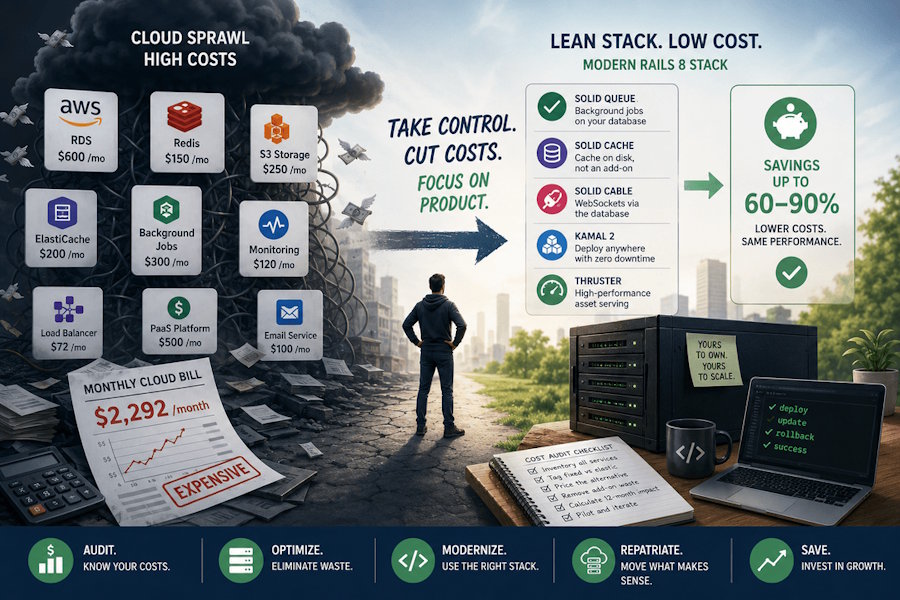
Rails 8, released in late 2024 and refined through 8.1 in 2025, was built around a specific idea: a small team should be able to run production applications without renting a dozen managed services. Look at what the default stack now includes:
- Solid Queue handles background jobs on top of your existing database. Before this, the standard answer was Sidekiq backed by a managed Redis instance. That is one paid service gone.
- Solid Cache uses cheap disk storage on your database for caching instead of a memory-based cache service. Counterintuitively, modern NVMe disks are fast enough that this works well, and you can cache far more data for far less money. Another service gone.
- Solid Cable runs WebSockets through the database too. The separate Redis pub/sub dependency disappears.
- Kamal 2 deploys your app to any server with Docker, whether that is a 10 dollar VPS or your own hardware. It handles zero-downtime deploys, rollbacks, and automatic SSL certificates. This is the piece that replaces the PaaS itself.
- Thruster gives the built-in web server production-grade asset caching and compression without configuring a separate proxy.
Put plainly: a Rails app that needed a PaaS dyno, a managed Postgres, a managed Redis, and a job-runner add-on in 2022 now needs a server and a database. For many small SaaS products, that is the difference between 800 dollars a month and 80.
The savings are real at small scale too. European hosts like Hetzner rent capable dedicated servers for under 50 euros a month, and a single modern server can comfortably run a Rails app serving tens of thousands of users. Teams that want help restructuring an older app onto this leaner stack often work with an experienced Ruby on Rails development company, since upgrading from a Rails 6-era architecture to the Rails 8 defaults touches jobs, caching, and deployment all at once.
When Staying on PaaS Is Still the Right Call
A fair article has to argue the other side, because the cloud exit crowd sometimes oversells it.
Stay on your PaaS if any of these apply:
- You have no one who enjoys operations. Kamal makes servers manageable, not invisible. Someone still owns OS updates, backups, and monitoring. If that someone does not exist, the PaaS fee is cheaper than the outage.
- Your load is genuinely spiky. If traffic multiplies 20x during unpredictable events, elastic cloud capacity is exactly what you are paying for. Ecommerce flash sales and ticketing platforms fit here.
- You are pre-product-market fit. If the product might pivot next quarter, optimizing infrastructure is procrastination. Ship features.
- Compliance does the choosing for you. Some certifications and enterprise customers are simply easier to satisfy on major cloud providers with their audit reports.
The pattern that makes sense for most small SaaS teams in 2026 is not all-or-nothing. It is moving the steady, predictable workloads to cheap fixed-price servers while keeping anything spiky or compliance-heavy on managed platforms.
A Simple Framework to Audit Your Infrastructure Spend
Before changing anything, spend one afternoon on this exercise:
- Print the bill. Every service, every add-on, every seat. Most teams have never seen the complete list in one place.
- Tag each line: fixed or elastic. Does this workload actually vary with traffic, or is it flat? Flat workloads are paying an elasticity premium for nothing.
- Price the boring alternative. For each flat workload, what would it cost on a dedicated server or budget VPS? Include a realistic estimate of the engineering hours to move and maintain it.
- Check for stack-driven waste. If you run Rails, ask specifically: are we paying for Redis and a job-runner service that Solid Queue and Solid Cache would replace for free after an upgrade?
- Calculate the 12-month number. If moving saves less than one month of engineer time per year, skip it. If it saves the equivalent of a salary, you have a business case.
- Pilot with something safe. Move a staging environment or an internal tool first. Your team learns the tooling with zero customer risk.
Teams are often surprised by step 4. The upgrade to a current Rails stack frequently pays for itself through retired add-ons alone, before any server migration happens. The same logic applies beyond Rails: any web development company worth its fee should now be designing new builds around boring, low-cost infrastructure by default rather than assuming a pile of managed services.
Owning Your Costs Is a Competitive Advantage
The last decade trained a generation of developers to believe infrastructure is something you rent by the sliver and never think about. That belief was convenient, and for a while it was even correct. In 2026, with budgets tight and the tooling mature, it has become expensive.
The teams winning right now treat infrastructure cost like they treat code quality: something you own, measure, and deliberately improve. Sometimes that means leaving the cloud. More often it means trimming the add-ons, moving the flat workloads, and knowing exactly why every dollar leaves the building.
Run the audit. Worst case, you confirm your setup is right and finally have the numbers to prove it to your CFO.

