

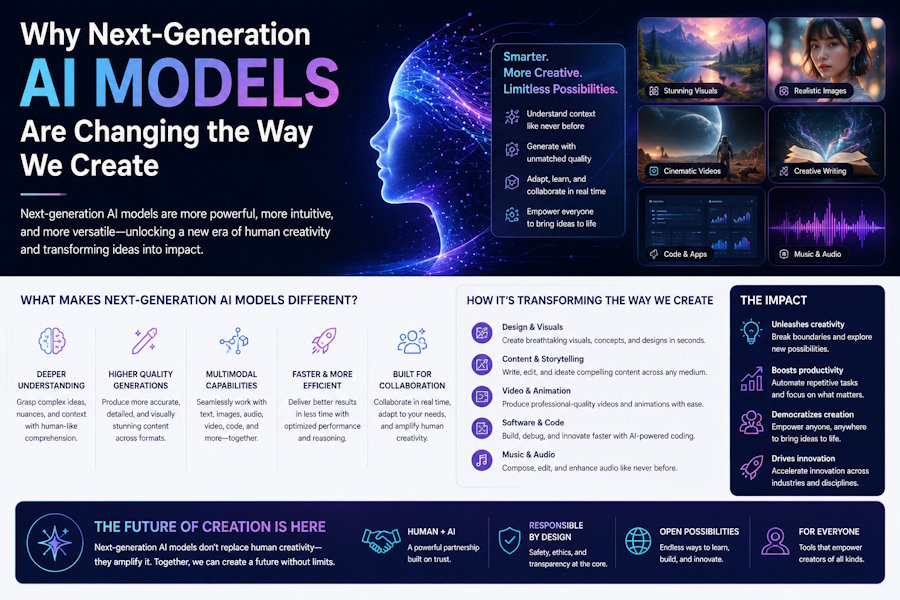
Artificial intelligence is entering a new phase where speed, creativity, and intelligence work together to improve digital workflows. Businesses no longer rely on AI for simple automation alone. Instead, they use advanced AI models to generate ideas, create visual content, assist with research, and support decision-making across multiple departments.
As these technologies become more capable, creators can produce higher-quality work in less time while maintaining greater control over the final result.
AI Is Becoming a Creative Partner
Modern AI tools are designed to collaborate rather than simply automate. Instead of replacing creative professionals, they provide suggestions, generate variations, and help overcome creative blocks.
Writers can quickly organize ideas, marketers can develop campaign concepts, and designers can experiment with multiple visual styles before selecting the strongest direction. This collaborative approach helps teams stay productive without limiting originality.
Smarter Models Are Expanding AI Capabilities
Recent AI models are capable of understanding longer instructions, maintaining context throughout complex tasks, and generating more accurate outputs. These improvements allow businesses to handle increasingly sophisticated projects with greater efficiency.
One example is Hailuo 3, which reflects the industry's movement toward faster reasoning, improved language understanding, and more reliable content generation. Models like these enable professionals to work more efficiently across writing, design, planning, and creative production.
As AI technology continues to mature, users can expect more natural interactions and increasingly personalized experiences.
The Power of Effective Prompting
While AI models continue to improve, the quality of the results still depends heavily on the instructions users provide. Prompt engineering has become an essential skill for creators looking to maximize the potential of modern AI systems.
Many designers now experiment with a gemini ai photo prompt to generate highly detailed images with precise artistic direction. Instead of writing short requests, users include information about mood, lighting, composition, textures, colors, camera perspective, and visual style to achieve more refined results.
A well-crafted prompt often makes the difference between an average image and a professional-quality visual.
AI Is Supporting Faster Business Innovation
Companies across various industries are integrating AI into everyday operations to improve productivity and accelerate innovation. Common applications include:
- Creating marketing content.
- Generating visual concepts.
- Assisting with product development.
- Summarizing large amounts of information.
- Supporting customer communication.
- Automating repetitive administrative tasks.
By reducing manual effort, AI allows employees to spend more time on strategic work and creative problem-solving.
Human Expertise Remains Essential
Despite significant technological advancements, AI is most effective when paired with human expertise. Professionals bring creativity, judgment, industry knowledge, and emotional understanding that AI cannot fully replicate.
The most successful organizations treat AI as a collaborative tool that enhances decision-making rather than replacing human involvement.
Preparing for the Future of AI
Artificial intelligence is expected to become even more capable in the coming years. Improvements in reasoning, multimodal understanding, and personalization will allow AI systems to support increasingly complex workflows across business, education, healthcare, and creative industries.
Organizations that invest in learning how to work effectively with AI today will be better prepared to adapt to future technological advancements.
Conclusion
Artificial intelligence is reshaping how people create, collaborate, and innovate. Advanced models such as MiniMax H3 demonstrate the growing sophistication of modern AI systems, while techniques like using a detailed gemini ai photo prompt highlight the importance of effective human guidance. Together, these advancements are helping businesses and creators unlock new levels of productivity, creativity, and digital innovation.

