

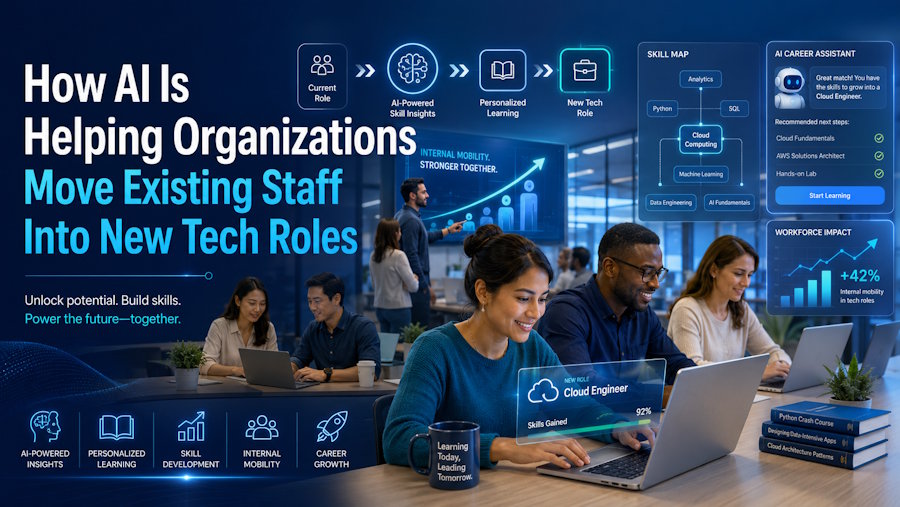
The perfect match for your ultra-niche open cloud architecture position may not be some expensive outside recruit with a spotless IT resume. What if it were a financial analyst sitting three desks away?
Automation, cybersecurity, and artificial intelligence are altering the requirements of the workforce, transforming the global talent landscape like never before. According to the World Economic Forum’s Future of Jobs Report, 39% of workers' skills are expected to become obsolete by 2030.
With this reality, business leaders are not solely turning to outside hiring. 82% of leaders believe AI agents will quickly scale workforce capacity, with AI skilling being one of the top workforce strategies, according to the Microsoft Work Trend Index.
AI is therefore emerging as a potent tool for unearthing latent talent, personalizing learning, and creating clear pathways to emerging technology roles. Learn how this happens in the subsequent sections.
1. AI Is Revealing Tech Skills Employees Already Have
Conventional résumés provide a narrow view into an employee’s abilities. The AI-powered skills intelligence systems today can scan a worker’s experience, projects, and informal training to identify highly valuable, transferable skills far beyond traditional IT departments.
Look at these possible internal transitions:
- Finance analyst transitioning to data analytics with strong visualization of data skills.
- Customer service representative with chatbot experience going into AI ops.
- Project coordinator (with technical background) switching to IT project management.
IBM’s Enterprise Study says intelligent systems can assess current capabilities to find gaps and guide reskilling efforts. Granular visibility allows organizations to move existing staff into new tech roles, aligning individual potential with company needs.
2. AI Is Matching Employees With Emerging Internal Opportunities
The HR conversation is shifting from “Who already has this exact job title?” to “Who has the closest combination of transferable skills?” AI-powered talent marketplaces keep matching employee interests with the needs of available projects or full-time positions.
Skills-based matching finds employees qualified for jobs such as:
- Data analysts and AI operations specialists
- Cloud support analyst and cybersecurity
- Digital product managers, automation experts
By encouraging internal mobility, organizations can reduce lengthy external hiring processes and foster an environment of ongoing development.
3. AI Is Identifying the Exact Skills Employees Need to Make the Move
Moving an employee into a new technology role is more than a change of job title. AI then actively evaluates an employee’s existing skills against the exact competency requirements of a target role.
This leads to a tailored “skills gap” analysis that describes:
- Skills the employee already possesses.
- Transferable skills.
- Technical areas to develop.
- Suggested learning paths
Globally, 63% of employers cite the skills gap as the biggest barrier to transforming their businesses, highlighting the need for targeted blueprints powered by AI to avoid a one-size-fits-all approach to training.
4. AI Is Creating Personalized Reskilling Paths
Once gaps are identified, AI creates customized learning paths based on an employee’s role and personal career goals. An employee who is moving into data governance will get a very different training than an employee who is moving into cloud security.
Organizations are leveraging AI-enabled learning tools, including:
- Customized course recommendations.
- Assessments that adapt to the learner’s pace.
- Instant feedback from AI tutors.
- Run drills to address specific weaknesses.
The industry observations of today reveal that the infusion of AI into core strategies demands highly bespoke reskilling to enable internal career moves through the laser focus on missing competencies.
5. AI Is Helping Employees Gain Experience Before Changing Roles
The theory doesn’t always equip the employee to jump into a brand-new tech role. AI-enabled internal mobility platforms address this need by securely connecting employees to short-term stretch assignments, cross-functional projects, or mentoring opportunities.
A marketing staffer could be involved in a customer data analytics project for a limited time, or an operations specialist could help out with a localized automation rollout. These real-world scenarios help employees develop new skills in low-risk settings, increasing their confidence before jumping into an unfamiliar department.
6. AI Is Changing Which Employees Organizations Consider "Tech Talent"
Generative AI and intuitive low-code platforms have taken traditional technical barriers to new lows. Today, strong domain expertise, complex problem solving, and adaptability are becoming as valuable as pure coding knowledge.
With AI on board, employees can get to the complex, strategic work much sooner in their careers.
This leads to hybrid professionals, for example, HR leaders using advanced people analytics or finance professionals managing automated AI workflows, growing the internal technology talent pool.
7. The Human Decisions AI Cannot Replace in Internal Mobility
AI is good at making suggestions, but it should be an information source, instead of being a dictation source, regarding your career moves. Over-reliance on automated recommendations might result in algorithmic bias or insufficient details on an employee’s ambition.
Managers, HR teams, and mentors still have a key role to play in assessing an employee’s real readiness.
Employees need a clear set of criteria so they know exactly how their skills are measured. We may be able to responsibly unlock talent by bringing together the insight of AI with the compassion of human judgment.
Conclusion
AI revolutionizing the modern workforce is an exciting talent redeployment strategy for organizations.
AI uncovers hidden skills, matches employees to stretch opportunities, identifies competency gaps, and customizes training, all while highlighting transparent internal career paths.
Ultimately, companies that find and unleash the hidden talents that already exist within their walls are best placed to thrive as the future of work unfolds.
Sources
The Future of Jobs Report 2025 | World Economic Forum
IBM: AI Growth Needs Integration, Reskilling and Governance | Technology Magazine

