

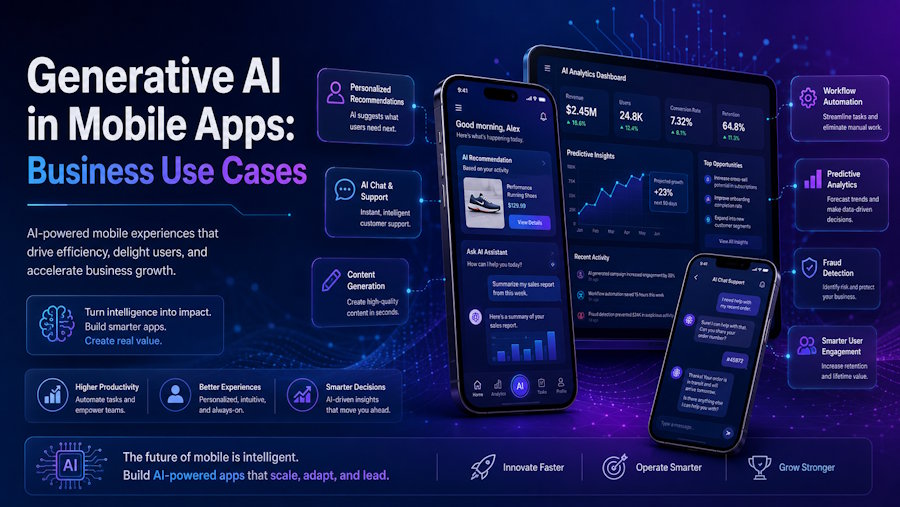
Have you ever used an app that felt like it truly understood you? Maybe it gave you the perfect suggestion, answered your question instantly, or helped you finish a task in seconds. That is Generative AI in your mobile app.
Mobile apps are changing fast. They are no longer just simple tools. They are becoming smart helpers that think, create, and respond as if they’re your real assistant.
Businesses across the world are using generative AI in mobile apps to build better and smarter apps that their customers just love to use and come back again and again.
Let’s briefly understand what generative AI in mobile apps exactly is, why businesses are adding GenAI capabilities to their apps, the business use cases, what’s next and the hidden risks of wrong implementation.
What Is Generative AI in Mobile Apps?
GenAI is a type of artificial intelligence that can create new content instead of simply finding existing information.
Depending on the task, it can generate:
- Text
- Images
- Audio
- Videos
- Product recommendations
- Summaries
- Emails
- Reports
In a mobile app, generative AI works behind the scenes to understand what a user wants and generate a helpful response.
For example:
- A shopping app can suggest products based on your preferences.
- A fitness app can create a personalized workout plan.
- A travel app can build an itinerary for your holiday.
- A healthcare app can explain a medical report in simple language.
Instead of giving every user the same experience, GenAI helps mobile apps adapt to each person's needs.
Why Are Businesses Adding Generative AI to Mobile Apps?
People expect mobile apps to be fast, simple, and personalized. They don't want to spend time searching for information or completing repetitive tasks.
Generative AI helps businesses meet those expectations. But building the right AI-powered product takes more than just a good idea. It’s the right implementation that matters. That's where a Generative AI development company can help.
Let's walk through some of the biggest benefits of Generative AI in mobile apps.
Better customer experiences
AI can answer questions, make recommendations, and provide personalised help, making every interaction feel more relevant.
More engaged users
When an app understands what users need, they're more likely to return and continue using it.
Faster business operations
Many routine tasks, such as writing product descriptions, answering common questions, or creating reports, can be handled by AI. This saves time for employees.
Personalised interactions
Instead of showing the same content to everyone, AI can tailor recommendations, messages, and offers for each user.
Improved decision-making
Generative AI can turn large amounts of data into simple summaries and insights, helping both customers and employees make informed decisions more quickly.
Business Use Cases of Generative AI in Mobile Apps
Generative AI is being used in almost every industry. Here are some of the most valuable business applications.
1. Smarter Customer Support
Nobody likes to wait for a customer support executive to address their problems.
Technology has already brought a big change to customer support. Generative AI is helping businesses provide instant assistance through intelligent virtual assistants. These assistants understand customer questions and respond naturally.
For example, a banking app can help customers:
- Check account information
- Understand recent transactions
- Explain loan options
- Help reset passwords
- Report lost cards
Instead of searching through FAQs or waiting for an agent to respond, users receive answers within a few seconds.
Businesses benefit by reducing support costs while improving customer satisfaction.
2. Personalised Shopping Experiences
The choice of every shopper differs. Providing them with what they like gives them instant satisfaction.
Generative AI helps retail apps understand what customers like and recommend products that match their interests, instead of showing generic stuff to each and every customer.
An AI-powered shopping assistant can:
- Recommend products
- Suggest matching accessories
- Compare similar products
- Explain product features
- Answer buying questions
Imagine opening a clothing app and asking,
"I'm attending a beach wedding next month. Can you suggest an outfit under £200?"
Instead of browsing hundreds of products, the app creates a shortlist that matches your request.
This makes shopping faster and more enjoyable.
3. Content Creation for Marketing
Creating fresh content takes time. Businesses often need product descriptions, promotional messages, push notifications, emails, and social media captions.
Generative AI can create this content in seconds.
For example, an eCommerce business can automatically generate:
- Product descriptions
- Marketing emails
- Push notifications
- App banners
- Promotional offers
Marketing teams can then review and refine the content instead of writing everything from scratch.
4. Healthcare That Speaks Plain Language
Medical information is often difficult to understand.
Generative AI helps healthcare apps explain complex information in a way that patients can easily follow.
It can:
- Summarise medical reports
- Explain test results
- Answer common health questions
- Create appointment summaries
- Share personalised wellness tips
This helps patients better understand their health while reducing routine administrative work for healthcare providers.
5. Personal Finance Made Simple
Managing money isn't easy for everyone.
Generative AI makes financial information easier to understand by turning numbers into simple explanations.
Instead of showing only transactions, a finance app might say:
"You spent more on dining this month than last month. Cutting back by just £50 next month could help you reach your savings goal faster."
AI can also:
- Create monthly spending summaries
- Suggest saving opportunities
- Explain investment terms
- Help users plan budgets
- Answer financial questions
This makes financial apps feel more like personal advisors than digital calculators.
6. Easier Travel Planning
Planning a trip usually means opening several apps, comparing hotels, checking attractions, and creating an itinerary.
Generative AI brings everything together.
A user could simply type:
"Plan a four-day trip to Rome for two people who love history and local food."
The app can generate:
- A day-by-day itinerary
- Hotel suggestions
- Places to visit
- Restaurant recommendations
- Estimated travel costs
This saves users time while helping travel businesses deliver a better experience.
7. Better Learning Experiences
Everyone learns differently, at their own pace.
Generative AI in education apps creates lessons that match each learner's pace and goals.
It can:
- Explain difficult topics
- Create quizzes
- Summarise chapters
- Generate practice questions
- Suggest the next lesson
Instead of following the same learning path, students receive content that fits their progress.
This keeps learners' motivation high and keeps them engaged.
8. Smarter Food Ordering
It’s common to find restaurants based on location.
Generative AI takes this a step further in food delivery apps.
It can:
- Suggest meals based on previous orders
- Recommend dishes that match dietary preferences
- Help users discover new restaurants
- Answer questions about ingredients
- Create meal combinations
Customers don't need to scroll through menus anymore. They receive recommendations that feel personal.
This improves both customer satisfaction and order value.
9. Faster Property Search
Buying or renting a home often involves doing the homework right. One needs to compare hundreds of listings.
Generative AI makes the process much easier.
Users can describe exactly what they're looking for, such as:
"Show me a three-bedroom apartment near good schools with a monthly budget of £1,800."
The app can instantly suggest suitable properties, explain neighbourhood highlights, and answer questions about each listing.
This saves buyers from hectic navigation and delivers business value to real estate agents.
10. Helping Employees Work Faster
Generative AI isn't only useful for customers. Businesses are also adding it to employee apps.
AI can help employees:
- Summarise meetings
- Draft emails
- Create reports
- Search company documents
- Answer internal questions
Instead of spending time on repetitive tasks, employees can focus on work that requires creativity and decision-making.
What's Next for Generative AI in Mobile Apps
Generative AI is still growing.New trends are shaping how GenAI-powered mobile apps function today and how they will evolve in the future. Here are some of the key trends shaping generative AI in mobile apps.
Voice-First Experiences
Even more apps will enable users to talk rather than type to get things done. Users can speak out their questions and get instant responses.
AI Agents
Chatbots are not as intelligent as AI agents. They perform tasks independent of human. For example: an AI agent could book a flight, order food or resolve account issues autonomously without tutorial guidance from the user.
Hyper-Personalisation
Each app gets to know users better over time. That is what makes each screen, message and suggestion seem as though it was crafted specifically for that individual. It feels less like you are using an app, and more like asking for assistance from someone who knows you really well.
Multimodal Interactions
Apps don't just understand text; they also interpret images, voice and video. A user shows a photo and asks a question about it in the same sentence.
On-Device AI
Some AI features will run directly on the phone, not just on the internet. This leads to faster and safer apps with enablement for offline browsing.
These changes will make mobile apps smarter and more helpful. Businesses planning AI-powered apps can explore AI Development Services for AI integration, AI agents, personalization, and scalable application development.
The Hidden Risks of Generative AI and How to Avoid Them
Generative AI can help businesses build smarter mobile apps, but simply adding AI to a mobile app doesn't help. If it's not implemented with the right strategy, it can create problems instead of solving them.
The benefits a business can achieve from generative AI might turn into problems. For example, AI may generate incorrect or misleading responses, provide inconsistent recommendations, or struggle to understand user intent.
Poor integration with existing systems can also lead to a disconnected user experience. On top of that, businesses must protect sensitive user data and comply with industry regulations, especially in sectors like healthcare and finance.
The best way to reduce these risks is to work with an experienced partner who deeply understands mobile app development services and has the right AI strategy. The right partner helps identify where generative AI will create the most business value, integrates it seamlessly into your mobile app, and ensures it is secure, scalable, and aligned with your business goals.
After building it right, continuously monitoring and improving AI performance is also taken care of by your mobile app development partner.
Conclusion
Riding the AI wave, users now expect much more from mobile apps. Mobile apps need to do more than simply perform tasks. They, in fact, need to understand, assist, and deliver meaningful experiences. Generative AI in mobile apps is helping businesses move in that direction by making apps more intelligent, responsive, and user-centric.
Businesses that embrace this shift thoughtfully today will be better prepared to meet changing customer needs and stay competitive in the years ahead.

