

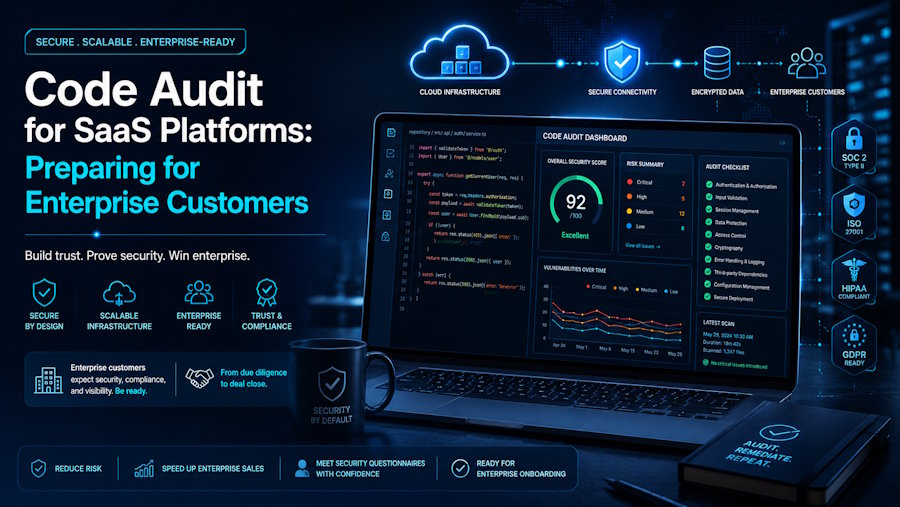
Most SaaS products don't start out with enterprise customers in mind — the early goal is just getting something to market. As the platform grows, features pile on, integrations get bolted in, quick fixes accumulate, and the codebase quietly gets harder to work with.
So, before pitching larger organizations, a lot of companies bring in a code audit company to take a hard look at the application first. An outside audit tends to surface the technical debt, security gaps, and architectural cracks that could otherwise slow things down or create risk down the road.
Why Enterprise Clients Expect More
Early-stage SaaS products are usually designed to validate an idea and reach the market quickly. Speed often takes priority over perfect architecture. While this approach works well during initial growth, enterprise customers introduce new expectations.
Large organizations typically require:
- strong access control and authentication
- high application availability
- detailed logging and monitoring
- predictable performance under heavy workloads
- documented development practices
- secure handling of sensitive information
- long-term maintainability
Even if the product works well today, hidden issues often appear as the customer base grows. Many SaaS companies choose to perform a code audit before approaching enterprise clients instead of discovering these problems during implementation.
What a Code Audit Covers
A code audit goes far beyond checking coding style. Its purpose is to determine whether the application can continue evolving without creating unnecessary technical risks.
Architecture
Architectural decisions have a direct impact on future development. Auditors evaluate whether components are properly separated, dependencies are manageable, and the overall structure supports future scaling.
Common findings include:
- tightly coupled modules
- duplicated business logic
- outdated architectural patterns
- poor separation of responsibilities
- excessive complexity in critical components
Users may never notice these issues directly. Developers usually do. Over time, they make every new feature a little harder to build.
Code Quality
Readable, consistent code is easier to maintain and extend. During the review, specialists evaluate:
- naming consistency
- project organization
- function complexity
- class responsibilities
- error handling
- testability
Poor code quality often results in slower feature delivery and a higher probability of introducing defects during future releases.
Security
Security becomes especially important when enterprise customers process confidential business information through a SaaS platform.
A code audit usually checks for:
- insecure authentication mechanisms
- authorization weaknesses
- improper input validation
- SQL injection risks
- cross-site scripting vulnerabilities
- insecure API implementation
- secrets stored inside repositories
- outdated third-party dependencies
Finding these issues before production incidents is significantly less expensive than responding to security breaches later.
Performance
Applications that serve hundreds of users may struggle when supporting thousands.
Performance analysis often identifies:
- inefficient database queries
- excessive API calls
- memory leaks
- unnecessary data processing
- poor caching strategies
- blocking operations that reduce throughput
Optimizing these areas improves both user experience and infrastructure costs.
Testing Strategy
Enterprise customers expect stable releases. Reliable testing reduces the likelihood of unexpected failures after deployment.
During the review, auditors evaluate:
- unit test coverage
- integration testing
- automated testing pipelines
- regression testing practices
- quality assurance processes
No project has perfect test coverage, and that's normal. The goal is to make sure critical functionality can be verified before every release.
Signs That Your SaaS Product Needs a Code Audit
Some organizations schedule regular technical reviews regardless of project size. Others wait until recurring problems begin affecting development.
The following situations often indicate that an audit would be worthwhile:
- release cycles become increasingly slow
- bug fixing consumes more time than new development
- onboarding new developers takes longer than expected
- system performance degrades as customers grow
- security concerns appear during client assessments
- multiple teams struggle to work on the same codebase
- technical documentation no longer reflects the software
Waiting until these problems become critical usually increases both remediation costs and business risks.
How Technical Debt Affects Enterprise Growth
Technical debt is not always the result of poor engineering. In many startups, it represents deliberate trade-offs made to launch products faster.
Problems arise when temporary solutions remain in production for years.
Examples include:
- duplicated business logic
- outdated frameworks
- hardcoded configuration
- insufficient automated testing
- inconsistent coding standards
- undocumented architecture
- manual deployment processes
Each issue may seem minor on its own. Together, they gradually slow development and make maintenance more expensive.
A structured code audit helps prioritize technical improvements instead of attempting to rewrite large portions of the application without clear business justification.
Preparing for Security and Compliance Reviews
Enterprise procurement processes frequently include technical questionnaires covering software security, operational maturity, and development practices.
Customers may ask about:
- vulnerability management
- dependency updates
- encryption methods
- identity management
- logging practices
- disaster recovery
- backup procedures
- software development lifecycle
If the engineering team struggles to answer these questions, the sales process can become much longer.
Although a code audit is not a compliance certification, it often identifies technical gaps before formal assessments such as SOC 2, ISO 27001, or industry-specific security reviews.
Benefits Beyond Finding Bugs
Many people assume a code audit simply produces a list of bugs. In reality, it helps teams understand which technical problems deserve attention first and which can wait.
Common benefits include:
- lower maintenance costs
- improved developer productivity
- easier onboarding
- better software stability
- reduced operational risks
- increased confidence before major releases
- improved scalability planning
Instead of relying on assumptions, decision-makers receive objective technical information that supports future investments.
Choosing the Right Audit Partner
Not every software consultancy approaches technical assessments in the same way.
An effective audit partner should have experience with:
- cloud-native architectures
- distributed systems
- secure software development
- performance optimization
- DevOps practices
- multiple programming languages
- enterprise software
The final report should be practical. Long lists of generic recommendations rarely help development teams.
Some providers, including DevCom, also combine code audits with broader technology assessments to help organizations plan future improvements.
Turning Audit Results into Action
An audit only creates value if the findings are actually addressed.
Many organizations separate recommendations into three groups:
Immediate priorities
Critical security vulnerabilities, production stability issues, and severe architectural risks.
Short-term improvements
Dependency updates, refactoring, testing improvements, and documentation.
Long-term modernization
Architecture improvements, cloud optimization, or infrastructure modernization that support future growth.
This approach helps teams improve software quality without interrupting ongoing product development.
Conclusion
There's rarely a perfect time to review a codebase. New features always seem more urgent, and technical improvements are easy to postpone.
Still, taking a close look at the application before working with enterprise customers can prevent a lot of problems later. A code audit gives engineering teams useful information for planning future work instead of relying on assumptions. That's often enough to make better technical decisions and avoid expensive rework.

