


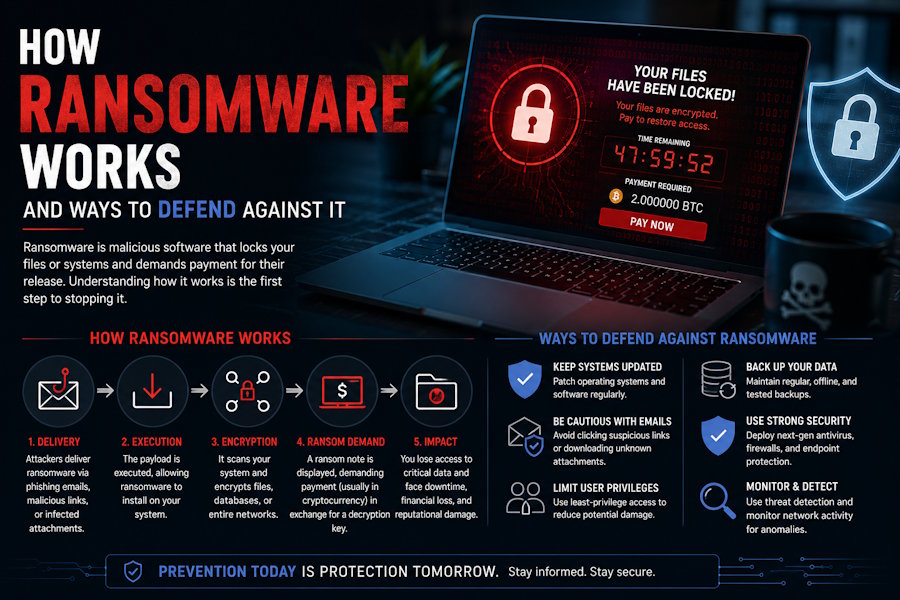
Ransomware has shifted from a more niche IT nuisance to one of the most consistent threats facing modern businesses. Its pervasiveness is due to the fact that it does not require a specific industry or type of organization to attack. It only needs a convincing email, an unpatched system, or a set of stolen credentials. In this article, we will articulate what ransomware is, how it functions, and several key ways to defend against such attacks.
What Is Ransomware?
Ransomware is malicious software specifically designed to block access to systems or data until a ransom is paid. Traditional ransomware was about simple encryption, but modern variants can routinely exfiltrate sensitive data before locking systems down and threaten to leak said information if payment is not made. A third layer is sometimes even added where the perpetrator threatens to notify customers or the press to create a reputational crisis.
Ransomware is also no longer built exclusively by the people who deploy it, complicating the definition a bit. This criminal ecosystem has been professionalized by developers who build and maintain the malware before leasing it to affiliates who handle the actual intrusion. This novel division of labor has lowered the skill barrier for launching a ransomware attack and increased the overall volume of incidents.
The Attack Lifecycle
Ransomware incidents tend to follow a recognizable sequence of events, and understanding this attack lifecycle is the first step to defending your business. The earlier an attack is caught, the less damage it does. However, it is worth noting that the specific tools and techniques used during each incident do vary by group.
Initial Access
Most intrusions start with a single point of access. These can range from a phishing email with a malicious link to a stolen remote desktop credential. It can even be an unpatched, internet-facing vulnerability. Ransomware attackers sometimes purchase already-compromised credentials or footholds from brokers on criminal marketplaces instead of doing the legwork themselves.
Establishing a Foothold
Once initial access is complete, attackers tend to deploy a backdoor or remote access tool. This maintains the persistence of their threat, ensuring that they can return even if the original entry point is discovered and closed.
Lateral Movement and Privilege Escalation
After establishing a foothold, ransomware attackers can move from the initial compromised system toward backup infrastructure, domain controllers, and file servers. They escalate privileges along the way and ultimately convert an isolated incident into an organization-wide issue. This phase involves mapping out the network and identifying targets over days or even weeks.
Data Exfiltration
Before triggering encryption, many ransomware groups slowly and quietly copy sensitive files over to external infrastructure. This step guarantees leverage even if the victim organization has clean backups and can fully restore systems without paying.
Detonation
Encryption tends to be deployed broadly and simultaneously across endpoints, servers, and backups. For this reason, ransomware attackers frequently target these backup systems. Organizations are much more likely to pay if their backups are no longer intact.
Extortion
The final step of the ransomware attack cycle is naturally to begin the extortion of the victim organization. It begins typically with a virtual ransom note that includes a countdown, a payment demand, and a threat to either leak stolen data or increase the price once the deadline passes.
Defending Against Ransomware
Thinking Beyond the Perimeter
The perimeter is still important and should include foundational cybersecurity measures like email filtering, multi-factor authentication, and patch management. Most ransomware attacks are successful because of a known vulnerability that went unpatched or a phishing email that got past a filter. However, organizations still need to think beyond these basic controls.
Segmenting the Network
Flat networks allow ransomware attackers to move from a single compromised endpoint to an entire organization. Network segmentation limits such lateral movement and isolates critical systems. If domain controllers, backup infrastructure, and financial systems are all separated, a single foothold in one segment does not necessarily mean the whole system is at risk.
Back Up Data and Isolation
Backups should be regularly tested and fully isolated from the production network. This can be done through a separate authentication domain, offline storage, or immutable backup solutions. Ransomware attackers tend to hunt for connected backup systems, so it is best to limit that risk at the lateral movement phase. Zmanda's enterprise backup software with immutable, air-gapped storage options makes it much harder for an attacker to reach or encrypt backup copies in the first place.
Internal Penetration Testing
External vulnerability scans and perimeter testing are still important, but internal penetration testing allows you to see how far a ransomware attack could get if they did get initial access. A skilled internal penetration test simulates the lateral movement and privilege escalation phases of a real ransomware attack. They attempt to move from a single compromised workstation toward backup systems, domain admin rights, and sensitive file shares.
The findings of an internal penetration test expose the gaps that perimeter-focused security misses. They find things like weak internal segmentation, unmonitored administrative pathways, and overly permissive account privileges. Addressing such gaps before a ransomware attacker finds them can shift containment from taking weeks to only taking hours.
Building Detection and Response Capability
Detection and response capability are also critical to build, because speed matters more than almost anything once an intrusion begins. Endpoint detection and response (EDR) tools, centralized logging, and a documented incident response plan compress the window between initial access and detonation. Regular testing ensures that the incident response plan holds up under real pressure.
Recognized Security Frameworks
For organizations that handle sensitive data, formal security certifications can provide a structured and independently validated way to demonstrate a rigorous cybersecurity posture. HITRUST certification is one of the most widely recognized frameworks for organizations that need to prove that their security controls meet a comprehensive standard. These kinds of recognized security frameworks are particularly important in sectors where a ransomware incident carries regulatory consequences on top of operational ones.
Final Takeaways
Ransomware defense is not about obtaining a single product or implementing a single policy. It requires a layered strategy that assumes the perimeter will eventually be breached and instead focuses on limiting what happens after that intrusion. Strong backup isolation, network segmentation, a tested incident response plan, internal penetration testing, and recognized security frameworks are critical for defending against such attacks.
Author Bio Information
Author Bio:
Nazy Fouladirad is President and COO of Tevora, a global leading cybersecurity consultancy. She has dedicated her career to creating a more secure business and online environment for organizations across the country and world. She is passionate about serving her community and acts as a board member for a local nonprofit organization.
Headshot

