

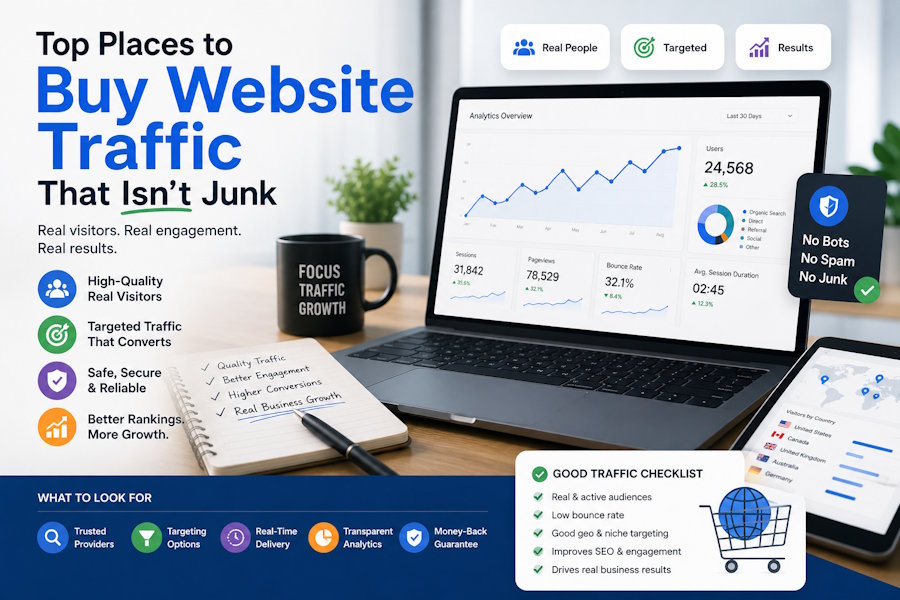
Junk traffic is the worst kind of busy.
It makes your website look active for a minute, then gives you nothing back.
You open your analytics and see visitors coming in. Nice. Finally. The graph has movement. The page is not sitting there like a closed shop on a rainy Tuesday. But then you look closer. Nobody stays. Nobody clicks. Nobody signs up. Nobody reads past the first few seconds!
Just visits.
Empty ones.
That is where website traffic gets tricky. More visitors sounds good until you realise the wrong visitors can make everything harder to understand!
They blur your data. They make good pages look weak. They make bad pages look impossible to diagnose. You start changing headlines, buttons, layouts, offers, all because a wave of useless traffic made your page look like it failed.
Honestly, that can waste so much time.
The better goal is not just traffic.
It is traffic that makes sense.
People who land on your site and behave at least a little like real visitors. They scroll. They read. They click something. Maybe they do not buy today. Maybe they do not fill out the form. That is fine. But they should give you some signal that your website reached someone with a reason to be there.
That is what this guide focuses on.
Places to buy website traffic that is not junk. Not random clicks. Not empty spikes. Not digital dust blowing across your dashboard. Realer, cleaner, more useful traffic that gives your website a fair chance to work!
Why “Not Junk” Matters More Than “More Traffic”
More traffic can feel like progress.
Sometimes it is not.
A website can get thousands of visitors and still learn almost nothing. If those visitors have no interest in your topic, offer, product, or service, their behaviour does not tell you much. They arrive by accident, leave quickly, and make your data look worse than it should.
That is junk traffic.
It is not just low-quality traffic. It is confusing traffic. It gives your analytics a fake pulse. Your pageviews rise, but your real results stay flat. Even worse, your bounce rate, time on page, and conversion data may start looking ugly for reasons that have little to do with your actual website quality.
That can send you down the wrong road.
You might rewrite a page that was already decent. You might blame your offer when the audience was wrong. You might assume your landing page cannot convert when the visitors never cared about the offer in the first place.
I think that is the real danger.
Junk clicks do not just waste your budget!
They mess with your confidence.
Good traffic, or at least better traffic, should help you see your site more clearly. It should help you understand whether your page is useful, whether your message is clear, and whether visitors know what to do next.
That kind of traffic does not have to convert every time. No traffic does. But it should behave like it belongs somewhere near your audience.
That is the standard worth keeping.
Not perfect traffic.
Just traffic that is not nonsense!
SubscriberZ
SubscriberZ feels useful for website owners who want genuine website traffic with a bit more control behind it.
That is important here.
Some traffic providers sell volume like it is the only thing that matters. Big packages. Big numbers. Big promises. But when you are trying to avoid junk clicks, volume is not the first thing to chase. Fit is.
SubscriberZ works best when you already know what page you want to send visitors to and what you want those visitors to do.
Maybe you have a landing page that needs testing.
Maybe you have a blog post that leads into a newsletter.
Maybe your service page needs more visitors so you can see whether people actually understand your offer. SubscriberZ makes more sense in those situations than it does as a random traffic blast across your whole site.
I think its strength is that it feels better suited to focused use.
You pick a page. You give it traffic. You watch what happens. That is much cleaner than sending visitors everywhere and then trying to untangle the mess later. A single page gives you clearer answers!
Do people stay?
Do they scroll?
Do they click the next step?
Do they leave before the main message even appears?
Those answers matter.
SubscriberZ is best used when your page already has structure. A clear headline. A direct opening. A simple layout. A call to action that does not hide halfway down the page like it is shy. When those basics are ready, traffic becomes more useful because visitors have a fair path to follow.
That is what keeps the traffic from feeling like junk.
Not the number itself.
The match between visitor, page, and purpose!
SocialGreg
SocialGreg feels practical.
Not fancy-practical.
Actually practical.
It suits people who want to buy real website traffic without turning the process into a giant puzzle. That can matter a lot if you are a small business owner, blogger, freelancer, creator, or site owner who just wants more real movement around a specific page.
The best way to use SocialGreg is with a clear test in mind.
Not “send me traffic because my site is quiet.”
That is too vague.
A better goal would be, “I want more visitors on this article to see whether people read it.” Or, “I want to test whether this landing page gets form clicks.” Or, “I want to see if my product page holds attention before I spend more on ads.”
That kind of thinking makes SocialGreg more useful.
Because traffic only means something when you know what you are measuring. If visitors come in and leave, you can check whether they were the wrong audience or whether the page needs work.
If they stay but do not click, maybe your call to action is not strong enough. If they click but do not complete the form, maybe the form is asking too much.
That is real learning.
SocialGreg helps create that first layer of movement. It can make a quiet page feel less abandoned. But the page still has to earn attention once the visitor lands.
I like it most for simple, controlled traffic pushes.
One page.
One goal.
One clear thing to watch.
That keeps the traffic useful instead of turning your analytics into a noisy cupboard full of mystery cables!
TrafficHarbor
TrafficHarbor feels like a good option when relevance matters more than raw volume.
And honestly, it usually does.
This platform seems better suited to websites that already understand their audience. If you know who you are trying to reach, traffic becomes easier to judge. You are not just asking whether visitors arrived. You are asking whether the right kind of people arrived!
That changes everything.
A local service page needs visitors who care about that service. A product page needs people who might actually want the product.
A blog post about remote work tools needs readers interested in remote work, productivity, business, or software. If the traffic has no connection to the page, it is junk before it even lands.
TrafficHarbor fits pages with a clear topic.
That is where it feels strongest. It helps send visitors to pages where the audience match matters. And when that match is closer, the data becomes cleaner.
You can actually learn something.
Maybe visitors stay longer than expected. Good sign. Maybe they scroll but do not click. That tells you the content may be useful, but the next step needs work. Maybe they leave instantly. Then either the traffic is still not aligned, or the opening of the page is not doing its job.
I think this kind of traffic is best for people who want answers, not just visits.
Because when the traffic is relevant, visitor behaviour becomes a mirror.
Not a fog machine!
ClickNest
ClickNest feels more careful.
A little softer.
That makes it useful for newer websites or smaller brands that do not want to dump a huge amount of traffic into a site that is still being shaped. Sometimes, a slow and clean test teaches you more than a massive traffic spike.
I know giant numbers feel tempting.
Of course they do.
But if your website is still new, a sudden flood of visitors can make your data harder to understand. You may not know whether people left because the page was weak, the offer was unclear, the audience was wrong, or the traffic was too broad. Everything blends together.
ClickNest seems better for smaller, more manageable traffic flows.
That can help you test without overwhelming the site. It is especially useful if you have recently improved a page and want to see whether the changes helped.
Maybe you rewrote the headline. Maybe you added better internal links. Maybe you simplified your contact form. A controlled traffic push can show whether those updates made the page stronger.
This platform fits people who want to learn in steps.
Not leap blindly.
I think that is underrated. Website growth is often less about one big move and more about small improvements that stack. A little cleaner traffic. A better section. A clearer offer. A stronger call to action.
ClickNest supports that kind of slower growth.
And slow is not bad.
Slow can be smart!
VisitorRoot
VisitorRoot feels grounded.
Like it is built for websites that need a stronger base, not a flashy moment.
That makes it a strong option if your site has content worth reading but not enough visitors yet. A lot of websites are in that place.
The blog posts are there. The service pages are there. The product information is there. But the site still feels too quiet to give you meaningful data.
VisitorRoot can help with that.
It feels especially useful for content-heavy websites. Blogs, guides, learning hubs, comparison pages, and niche resources. These pages need visitors who will actually read, not just click and leave. If people spend time with the content, you can start seeing what holds attention.
That is valuable.
A good content page should lead somewhere. Maybe to another article. Maybe to a service page. Maybe to an email sign-up. Maybe to a product. VisitorRoot makes sense when your site has those paths already built.
If there is nowhere to go, visitors will leave.
Not because they are junk.
Because you gave them no next step.
I think VisitorRoot works best when your internal links are ready. Your related content is placed well. Your pages feel connected. That way, traffic can move through the site instead of landing on one page and stopping there.
That movement is where real website growth starts to show.
Not just visits.
Journeys!
WebPulse
WebPulse feels suited to campaign-style traffic.
That gives it a different role.
Some website traffic needs to show up around a specific moment. A new product launch. A seasonal offer. A refreshed landing page. A limited promotion. A new blog post tied to a trending topic. In those cases, timing matters.
WebPulse fits that kind of use.
It makes sense when your page has a clear reason to receive traffic now. Not someday. Now. The page is ready. The offer is live. The message is current. The visitors have a reason to arrive during this window.
That can help avoid junk traffic because the page has context.
A visitor lands and sees something relevant. A timely offer. A clear topic. A reason to keep reading. If the page is vague or outdated, traffic will not help much. But if the campaign is focused, WebPulse can give it more reach while the moment is still fresh.
I think this platform works best when paired with tracking.
You should know what you want people to do. Click a button. Sign up. Read the article. Visit a product page. Download something. Whatever the action is, track it.
Otherwise, you are just watching visitors arrive and hoping.
Hope is not a traffic strategy.
It is a candle in the wind.
Useful, maybe, but not enough!
How to Spot Traffic That Is Actually Helping
Do not stop at sessions.
That is the first rule.
Visitor count tells you how many people arrived. It does not tell you whether the traffic helped. You need to look deeper. Time on page. Scroll depth. Clicks. Pages per session. Form starts. Add-to-cart actions. Newsletter sign-ups. Contact page visits.
Those are the clues.
Traffic that helps usually leaves some kind of trail. Not every visitor will convert. That is normal. But if nobody does anything, something is wrong. Either the traffic is poorly matched, or the page is not ready.
I think one of the best things you can do is compare traffic sources!
If one provider sends visitors who stay longer and click more, that traffic is probably more useful. If another sends visitors who vanish instantly, that source may not be worth repeating. Simple. Painfully simple, sometimes.
Also, watch patterns over time.
One day of data can be weird. A few tests can tell you more. Send traffic to one page. Study the behaviour. Improve the page. Test again. That is how you turn paid traffic into real learning instead of just another expense.
Good traffic should not only increase numbers.
It should help you make better decisions!
What to Fix Before You Buy Traffic
Before buying traffic, clean the landing page.
Please.
This is the part people skip because it feels boring. But it matters more than the traffic source in many cases. If your page is confusing, slow, ugly, vague, or stuffed with too many ideas, good visitors may still leave.
Start with the headline.
Does it tell people where they are and why they should care?
Then check the opening.
Does it make the page feel relevant within the first few seconds?
Then check the next step.
Is it obvious what visitors should do?
These questions are basic, but basic things carry websites. A page that clearly explains itself will always have a better chance than a page that makes visitors solve a puzzle.
Also check speed.
Slow pages kill good traffic. People do not wait around lovingly while your site loads one image at a time like it is painting a mural.
Check mobile too.
A lot of visitors will arrive on their phones. If your page looks broken there, you are wasting traffic before it even starts.
I think of traffic like sending people to a house viewing.
Clean the house first.
Then open the door!
Conclusion
Buying website traffic that is not junk is really about buying useful attention.
Not just visits.
That is the difference. Junk traffic makes noise. Better traffic gives you signals. It shows you whether people care about your page, whether they understand your offer, whether your content holds them, and whether your next step is clear enough.
That kind of traffic is worth more.
Even if the number is smaller.
Especially if the number is smaller but cleaner!
I think the smartest approach is simple. Choose one page. Know what you want visitors to do. Pick a provider that fits the goal. Start with a modest test. Then watch behaviour, not just volume.
Because real website growth does not come from a graph that jumps for one day.
It comes from learning what makes visitors stay, click, and come back.
So avoid the junk. Keep the page focused. Let the traffic teach you something. Then improve from there.
That is how visits turn into progress!

