

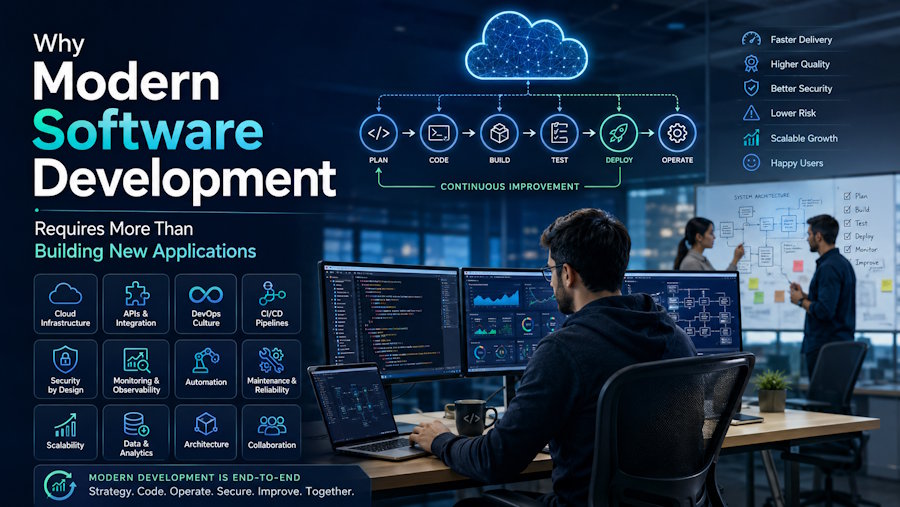
Software development has changed considerably over the past decade. Businesses once viewed application development primarily as a project with a defined beginning and end: identify requirements, build the product, launch it, and move on to maintenance. Today, that approach is increasingly difficult to sustain.
Customers expect software to work across devices, receive frequent improvements, integrate with other platforms, and remain secure as technology changes. At the same time, businesses are under pressure to reduce development costs, respond quickly to market opportunities, and preserve investments in systems that may have been built many years ago.
These pressures have made modern software engineering less about simply creating applications and more about managing an application's entire lifecycle. New products need thoughtful architecture from the beginning, while older systems often require modernization rather than complete replacement. The most effective development strategies therefore connect product engineering, platform compatibility, modernization, and long-term business planning.
The application lifecycle is now a continuous process
A modern application rarely remains unchanged after its initial launch. User expectations evolve, operating systems receive updates, security threats change, and new technologies create opportunities to improve the product.
For businesses, this means development should be treated as a continuous process. Planning, design, development, testing, deployment, monitoring, and improvement are interconnected rather than isolated phases.
This is particularly important for companies building software that needs to serve customers on multiple platforms. A web application may need to work alongside mobile apps, desktop software, cloud services, APIs, and internal business systems. Maintaining consistency across those environments can become complicated if each product is developed independently.
A coordinated approach to full-cycle development of web, mobile, and desktop applications can help businesses manage that complexity. Instead of treating every platform as a separate project, engineering teams can consider the product as one connected ecosystem. Shared business logic, consistent user experiences, common security practices, and coordinated release processes can reduce duplication while making future improvements easier to manage.
Why building everything from scratch is not always the best option
There is an understandable temptation to replace an old application with a completely new system. Legacy software can be difficult to maintain, expensive to integrate, and dependent on technologies that are no longer widely supported.
However, rewriting an entire application is not automatically the most sensible business decision.
Many legacy systems contain years of accumulated business knowledge. They may include workflows, rules, integrations, and data structures that are critical to daily operations but poorly documented. Rebuilding everything introduces the possibility of losing functionality that users rely on.
There is also a financial consideration. A complete rewrite can take months or even years, depending on the size and complexity of the system. During that period, the business still needs to operate its existing application.
This is why modernization often makes more sense than replacement. Businesses looking for a structured approach may consider legacy application modernization services to assess existing systems, prioritize technical risks, and gradually transition critical components to a more maintainable architecture.
Modernization can be a gradual process
Application modernization does not have to mean moving every component to a new technology stack at once. In many cases, the better strategy is incremental.
A business might begin by identifying the application's most problematic components. Perhaps the database is difficult to scale, the user interface is outdated, or an important integration depends on an unsupported technology. Addressing these areas first can deliver measurable improvements without disrupting the entire system.
Modernization can involve several different approaches. Some applications can be rehosted in a modern infrastructure environment with relatively limited changes. Others may benefit from refactoring, where existing code is reorganized to improve maintainability and performance. More complex systems may require parts of the application to be redesigned or replaced with modern services.
The right approach depends on the business objectives, technical constraints, and condition of the existing software.
Companies such as Leobit, for example, work across both software product development and modernization initiatives, illustrating why these two disciplines increasingly overlap. A team that understands how to build new products can also bring useful architectural thinking to the process of improving older systems.
The business case for modernization
Technology decisions are often discussed in technical language, but modernization is ultimately a business decision.
An outdated application can create costs that are not immediately visible on a balance sheet. Developers may spend excessive time maintaining old code instead of delivering new features. Employees may develop manual workarounds for inefficient processes. Customers may abandon a product because its interface or performance no longer meets expectations.
Security can create another hidden cost. Older applications may rely on libraries, frameworks, operating systems, or infrastructure that no longer receive adequate support. Keeping such systems operational without addressing underlying risks can become increasingly difficult.
Modernization can help reduce these problems by creating a more maintainable technical foundation.
However, businesses should not modernize simply because a technology is old. An older system that is stable, secure, inexpensive to maintain, and well aligned with business requirements may not need major changes. The goal should be to improve business outcomes, not to adopt new technology for its own sake.
Architecture matters more as products grow
One of the biggest differences between small applications and mature software products is architectural complexity.
A small product can sometimes be developed quickly with a straightforward architecture. As the number of users, integrations, features, and supported devices increases, the same architecture may eventually become a limitation.
Modern product engineering therefore places considerable emphasis on scalability and maintainability from the early stages of development.
This does not mean every new project needs a complicated architecture. In fact, unnecessary complexity can create its own problems. Instead, teams should make architectural decisions based on expected product growth and actual business requirements.
For example, an application that expects to support multiple client platforms may benefit from clearly separated backend services and APIs. A product expected to process rapidly increasing amounts of data may need an infrastructure strategy that supports horizontal scaling. A business operating in a highly regulated industry may need security and compliance considerations built into the architecture from the start.
Good architecture provides room for change without requiring the business to repeatedly rebuild the entire product.
Cross-platform development creates another challenge
Building for multiple platforms can expand a product's reach, but it also creates additional engineering responsibilities.
Web users may interact with a product through modern browsers, while mobile customers expect responsive applications that work smoothly on different screen sizes and operating systems. Desktop users may require deeper operating-system integration or offline capabilities.
The challenge is maintaining a coherent product experience while respecting the technical characteristics of each platform.
A common mistake is to assume that the same interface should simply be copied everywhere. Good cross-platform engineering instead identifies what should remain consistent and what should be adapted.
Core functionality, branding, data, permissions, and business rules should generally remain aligned. Navigation, interactions, performance strategies, and certain features may need to differ depending on the platform.
This balance is one reason full-lifecycle engineering can be valuable. Teams can consider the product as a whole while still designing experiences appropriate to each environment.
Modern development also changes how teams work
The evolution of software architecture has been accompanied by changes in development practices.
Continuous integration and continuous delivery have made it easier for teams to test and release changes frequently. Automated testing can reduce the risk associated with frequent deployments, while monitoring and observability help teams understand how applications behave after release.
These practices are especially useful for modernization projects.
Rather than making a large number of changes and hoping the system continues to work, development teams can modernize smaller components, test them, deploy them, and evaluate the results. This creates a feedback loop between engineering decisions and real-world performance.
It also makes modernization easier to manage from a business perspective. Stakeholders can see progress through measurable improvements rather than waiting for a multi-year transformation to reach a final launch.
Data should be treated as part of the modernization strategy
Applications are not only made up of source code. Their databases and accumulated data can be among their most valuable assets.
Moving data from a legacy system to a modern architecture can therefore be one of the most sensitive parts of modernization. Businesses need to consider data quality, compatibility, security, access controls, backup procedures, and downtime.
Poorly planned data migration can create operational problems even when the new application itself works correctly.
A practical modernization strategy should therefore address data early. Teams should determine which information needs to be migrated, which data can be archived, how historical records will be accessed, and how data integrity will be validated after migration.
This is another area where gradual transformation can reduce risk. Instead of moving everything simultaneously, businesses may be able to migrate selected datasets or functions in stages.
Security cannot be added at the end
Security has also become a central part of software engineering rather than a final testing step.
Modern applications often depend on numerous third-party libraries, cloud services, APIs, authentication systems, and external integrations. Each dependency can introduce potential risks if it is poorly managed.
For new development, security considerations should influence architecture, authentication, authorization, data handling, and deployment processes from the beginning.
For legacy systems, modernization can provide an opportunity to address accumulated security weaknesses. Updating dependencies, strengthening authentication, implementing better access controls, and improving monitoring can be as important as improving the user interface.
Security modernization can also make future development easier because teams are no longer forced to build new functionality around outdated security mechanisms.
Choosing what to modernize first
Not every component of a large application deserves equal attention. Businesses can prioritize modernization by evaluating several factors.
Technical risk is one consideration. Components that are difficult to maintain or depend on unsupported technology may deserve immediate attention.
Business importance is another. A technically outdated component that directly affects revenue or customer experience may have a stronger case for modernization than a less critical internal tool.
Cost should also be considered. If maintaining a particular system consumes significant engineering resources every year, modernization may provide a meaningful return on investment.
Finally, teams should consider dependencies. Modernizing one component may be difficult if several other parts of the application depend heavily on it. Mapping these relationships before development begins can prevent expensive surprises later.
The goal is sustainable software
The best software development strategy is not necessarily the one that uses the newest technology. It is the one that allows a business to evolve without constantly fighting its technology.
For new products, that means building a foundation that can support future platforms, integrations, security requirements, and changing customer expectations. For established products, it means identifying where modernization can reduce technical debt and create new opportunities without unnecessarily disrupting operations.
Ultimately, modern software engineering is about creating systems that can change.
Whether a company is launching a new digital product, expanding from web into mobile and desktop environments, or gradually replacing a decades-old application, the same principle applies: technology should support the business's ability to move forward.
A thoughtful combination of full-cycle development, sound architecture, incremental modernization, and continuous improvement gives organizations a more sustainable path. Instead of treating software as a one-time project, businesses can treat it as an evolving product—one that becomes more capable, secure, and valuable as the organization grows.

