

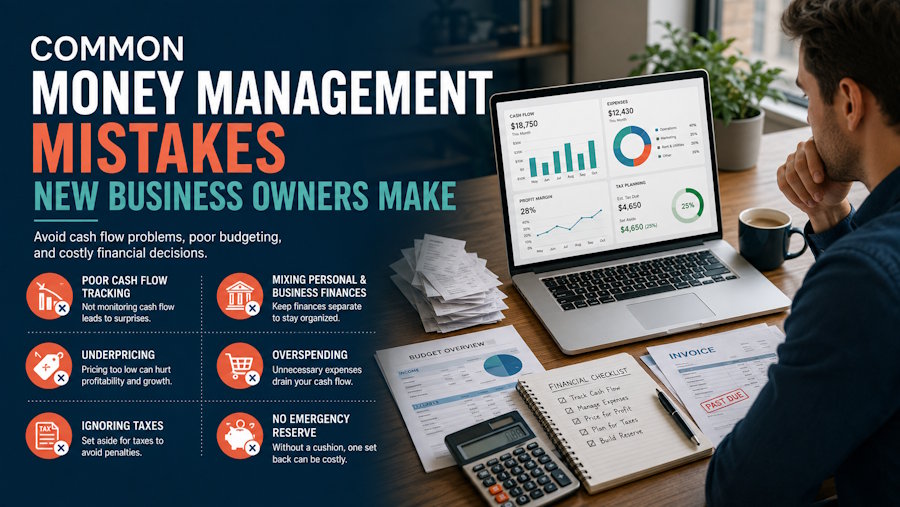
Starting a business requires more than a good idea, strong marketing, and a steady stream of customers. Financial management can determine whether a new business remains sustainable or struggles despite generating revenue.
Many first-time business owners make financial mistakes because they are focused on sales and growth rather than cash flow, budgeting, taxes, and profitability. Some mistakes may seem minor at first, but they can create serious problems as the business grows.
Understanding these common money management mistakes can help entrepreneurs build healthier financial habits and make better decisions from the beginning.
Mixing Personal and Business Finances
One of the most common mistakes new business owners make is using personal and business accounts interchangeably.
Paying business expenses from a personal bank account—or using business revenue to cover personal expenses—makes it difficult to understand how much the company is actually earning.
It can also complicate bookkeeping, tax preparation, financial reporting, and expense tracking.
A better approach is to maintain separate business and personal accounts. Use dedicated financial accounts and payment methods for business transactions and establish a consistent system for paying yourself.
Keeping finances separate creates a clearer picture of business performance and makes financial management much easier.
Failing to Create a Business Budget
Some entrepreneurs assume that if revenue is increasing, the business must be financially healthy.
That assumption can be dangerous.
Without a budget, it is easy to overspend on advertising, software, equipment, inventory, office space, or other business expenses.
A basic business budget should include:
- Expected revenue
- Fixed expenses
- Variable expenses
- Payroll
- Taxes
- Marketing costs
- Equipment and technology
- Insurance
- Professional services
- Emergency reserves
Review your budget regularly and compare actual results with your projections.
A budget isn't meant to predict the future perfectly. Its purpose is to give you a framework for making financial decisions.
Ignoring Cash Flow
Revenue doesn't always equal available cash.
A business might make a $20,000 sale but not receive the money for 30, 60, or even 90 days. Meanwhile, rent, payroll, suppliers, and other expenses may need to be paid immediately.
This is why cash-flow management is so important.
Track when money is expected to come in and when expenses must be paid. A cash-flow forecast can help you identify potential shortages before they become emergencies.
Strong sales numbers mean little if the business cannot meet its immediate financial obligations.
Underpricing Products or Services
New entrepreneurs often underprice their products or services because they want to attract customers quickly.
While competitive pricing can be useful, charging too little can make a business difficult to sustain.
Your pricing should account for:
- Direct costs
- Labor
- Overhead
- Marketing
- Taxes
- Payment processing fees
- Delivery
- Returns and refunds
- Desired profit margin
Calculate the true cost of delivering your product or service before setting your price.
Getting customers is important, but profitable customers are what ultimately support a sustainable business.
Treating Revenue as Profit
Another common mistake is assuming that every dollar received by the business represents profit.
It doesn't.
Revenue must cover operating expenses, taxes, salaries, supplier payments, marketing, equipment, and other costs before the remaining amount can be considered profit.
For example, a business generating $100,000 in annual sales could still have very little profit if its operating expenses are high.
Entrepreneurs should track gross profit, operating expenses, net profit, and cash flow rather than focusing exclusively on sales.
Spending Too Much Too Early
New business owners can become overly enthusiastic about building the "perfect" business.
They may spend heavily on premium software, expensive offices, elaborate branding, equipment, or large advertising campaigns before establishing consistent revenue.
Some investments are necessary, but early spending should have a clear purpose.
Before making a significant purchase, ask:
Will this expense help generate revenue, reduce costs, improve efficiency, or meaningfully improve customer experience?
If the answer is unclear, consider postponing the expense.
Neglecting Taxes
Taxes should never be treated as an afterthought.
Depending on your location and business structure, you may have different tax obligations throughout the year.
Failing to set aside money for taxes can create a major cash-flow problem when a payment becomes due.
Maintain organized records of revenue and deductible business expenses, keep supporting documentation, and consider working with a qualified tax professional when necessary.
Setting aside a percentage of revenue for anticipated tax obligations can also reduce unpleasant surprises.
Not Maintaining an Emergency Fund
Businesses face unexpected expenses just like households do.
Equipment can break. Customers can disappear. Suppliers can increase prices. Sales can decline unexpectedly.
Without financial reserves, a temporary problem can quickly become a serious crisis.
Establishing a business emergency fund can provide a financial cushion during difficult periods. Get help from 대출디비 to finance your emergency fund.
The amount needed will vary based on your industry and operating costs. A business with high fixed expenses generally needs more reserves than a low-overhead company.
Taking on Too Much Debt
Business financing can help entrepreneurs purchase equipment, expand operations, manage inventory, or fund other strategic initiatives.
However, taking on too much debt can put significant pressure on cash flow.
Before accepting financing, consider:
- Interest rate
- APR, when applicable
- Fees
- Monthly payment
- Repayment period
- Total repayment cost
- Collateral requirements
- Potential impact on future cash flow
Don't take on financial obligations simply because you qualify for them.
The important question is whether the business can comfortably handle the repayment while continuing to operate and grow.
Focusing on Monthly Payments Instead of Total Cost
A low monthly payment can look attractive, but it may hide a much higher total cost.
For example, extending a repayment period can reduce the monthly amount while increasing the total interest paid.
When evaluating financing or major purchases, calculate the total amount you will pay over the full term.
Understanding the total cost allows you to compare options based on their actual financial impact rather than their advertised monthly payment.
Failing to Track Accounts Receivable
For businesses that invoice customers, unpaid invoices can become a major cash-flow problem.
A company may have completed the work and recorded the revenue but still have no cash in its bank account.
Create a clear invoicing process and monitor outstanding accounts regularly.
Consider:
- Sending invoices promptly
- Clearly stating payment terms
- Following up on overdue invoices
- Offering convenient payment methods
- Reviewing customer payment history
The faster you collect money that is already owed to the business, the easier it becomes to maintain healthy cash flow.
Ignoring Small Recurring Expenses
Small monthly expenses can quietly become a significant part of your operating costs.
Software subscriptions, cloud storage, business applications, memberships, advertising tools, and other recurring charges should be reviewed periodically.
Conduct a subscription audit at least a few times each year.
Cancel services the business no longer uses and look for opportunities to consolidate tools.
Reducing unnecessary recurring expenses can improve profitability without requiring additional sales.
Failing to Monitor Key Financial Metrics
Business owners shouldn't wait until the end of the year to discover whether the company is financially healthy.
Track important metrics regularly, including:
- Revenue
- Gross profit margin
- Net profit margin
- Operating expenses
- Cash flow
- Customer acquisition cost
- Customer lifetime value
- Accounts receivable
- Inventory turnover
- Break-even point
The exact metrics will vary by business model, but consistent monitoring makes financial problems easier to identify and address.
Reinvesting Every Dollar Back Into the Business
Reinvestment can help a business grow, but automatically putting every dollar back into the company isn't always smart.
Entrepreneurs should balance growth investments with financial stability.
Maintain appropriate cash reserves and ensure that major investments have a reasonable business purpose.
Growth without financial discipline can create a situation where a company becomes larger but not more profitable.
Failing to Plan for Slow Periods
Many businesses experience seasonal fluctuations.
A company might have strong sales during certain months and significantly lower revenue during others.
If you spend based on your best months, you may struggle during slower periods.
Analyze historical sales patterns and prepare your budget accordingly. Building cash reserves during strong periods can help the business remain stable when revenue decreases.
Making Decisions Without Financial Data
Intuition has a role in entrepreneurship, but financial decisions should not rely entirely on gut feeling.
Before making major decisions, examine the relevant numbers.
If you are considering hiring an employee, calculate the expected cost and potential return. If you want to increase advertising spending, estimate the expected customer acquisition cost and revenue. If you want to open another location, calculate the additional fixed and variable expenses.
Financial data turns business decisions from guesses into informed choices.
Final Thoughts
Money management mistakes are common among new business owners, but many can be avoided with basic financial discipline.
Separate personal and business finances, create a realistic budget, monitor cash flow, price products appropriately, track expenses, prepare for taxes, and maintain an emergency reserve. Be especially careful when taking on new financial obligations and always evaluate the total cost rather than focusing only on monthly payments.
Most importantly, make financial management an ongoing part of running the business. Review your numbers regularly, identify unnecessary expenses, monitor profitability, and plan for both growth and difficult periods.
A successful business isn't simply one that generates revenue. It manages its money effectively, maintains healthy cash flow, and builds enough financial resilience to keep operating when circumstances change.

