

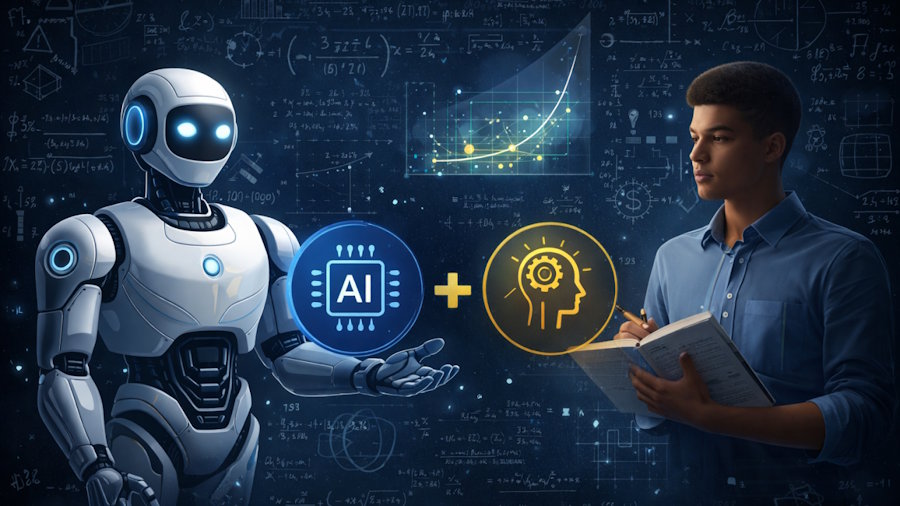
Math has a reputation problem. Ask any classroom of teenagers, and most will admit they find it boring, confusing, or just plain hard. Yet the subject shapes college admissions, career paths, and everyday decisions like budgeting or cooking. That's exactly why the question of how AI is reshaping math education matters so much right now.
Why Traditional Math Learning Often Falls Short
A single teacher usually manages twenty, thirty, sometimes forty students at once. There's no way to give each person individual attention in every single class. Some kids fall behind in silence because they're too embarrassed to raise their hand.
Textbooks don't help much either. They move at one fixed pace, regardless of who's struggling and who's already bored. This one-size-fits-all approach leaves gaps that tend to widen over time.
What Makes AI Different From Regular Study Apps
Old-school math apps just present problems and check answers. AI software does something more interesting: it watches how a student thinks. It notices patterns in mistakes, hesitations, and the types of questions someone tends to skip.
Over time, the system builds something close to a mental map of that student's strengths and weak spots. That map keeps updating. No two students end up with identical lesson plans, even if they started the same unit on the same day.
Personalized Learning Paths That Adapt in Real Time
Imagine two students working through fractions. One breezes through quickly, so the software pushes harder problems within minutes. The other struggles with denominators, so the system slows down, offers a short video, then retries with easier numbers.
This kind of real-time adjustment used to require a private tutor. Now it happens automatically, at scale, for a fraction of the cost. Some platforms report that adaptive practice can cut the time needed to master a skill by nearly 30%, according to recent classroom studies.
Instant Feedback Changes How Students Practice
Waiting a week for a graded test to come back kills momentum. Nobody remembers why they got question twelve wrong after seven days have passed. AI tools flip this completely by scoring work the moment it's submitted.
That immediacy matters more than people expect. A wrong answer, corrected on the spot, teaches faster than the same mistake explained days later.
Building Confidence Through Small Wins
Confidence and math performance are tightly linked, and research backs this up. Students who feel anxious about math tend to avoid practicing it, which only deepens their anxiety.
AI-driven platforms often use small, achievable challenges to build momentum. Short streaks, gentle progress bars, and low-stakes quizzes replace the fear of a big red F. Even the simple ability to launch a math Chrome extension and see the answer to a problem helps build this confidence. This Chrome extension features a screenshot and website scanner, and provides step-by-step solutions to any problem. Little by little, students start believing they can actually do it.
Data-Driven Insights for Teachers and Parents
Teachers don't lose control just because software is involved; if anything, they gain visibility. Dashboards show which topics an entire class is struggling with, sometimes before the teacher would have noticed on their own. That data turns guesswork into planning.
Parents benefit too, especially those who never quite mastered algebra themselves. A simple weekly summary can show whether a child is improving, stuck, or quietly falling behind. Nobody has to wait for a report card to find out.
The Numbers Behind AI in Education
Adoption has moved fast. Surveys from the past two years suggest that over 60% of secondary schools in developed countries now use some form of adaptive learning software in math classes. That's a sharp jump from single-digit percentages just a decade ago.
Outcomes are catching up too. Several independent studies have linked consistent use of AI-based math tools to test score improvements ranging from 10% to 20%, particularly among students who started below grade level. Small gains, multiplied across millions of students, add up to something significant.
Common Concerns About Relying on AI
Not everyone is convinced, and that skepticism is fair. Critics worry that constant reliance on software could weaken a student's ability to sit with a hard problem and struggle productively. Struggle, after all, is often where real learning happens.
There's also the screen-time question, which many parents raise reasonably. Good platforms try to address this by encouraging offline practice, printable worksheets, and breaks between sessions — technology as a supplement, not a replacement for pencil and paper.
Final Thoughts
AI won't replace teachers, and it probably shouldn't try to. What it does well is fill in the gaps: personalizing pace, catching errors instantly, and surfacing patterns no single classroom observation could reveal on its own.
For students who've always felt like math class moved too fast or too slow, that shift matters. Software helps learn in a way textbooks never quite managed, meeting each learner exactly where they are. The results, at least so far, suggest this isn't just a passing trend but a genuine upgrade in how math gets taught.

