

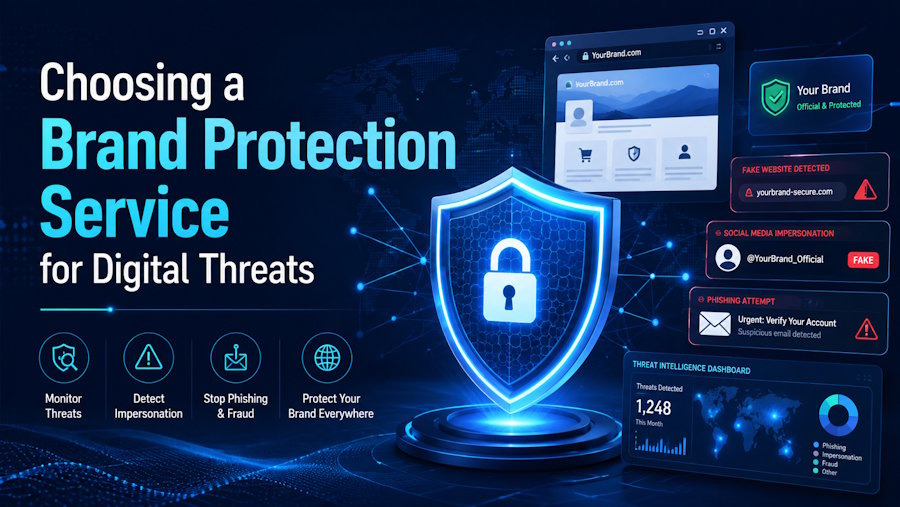
Brands today face a growing array of digital threats that extend far beyond their own websites and social media accounts. Counterfeit product listings, impersonation domains, fake mobile apps, and phishing pages built to mimic legitimate businesses have become routine challenges for security and marketing teams alike. As these threats multiply across channels, many organizations are turning to dedicated services designed to monitor, detect, and respond to brand abuse before it causes lasting damage.
Choosing the right partner for this work, however, isn't straightforward. Vendors vary widely in coverage, detection methods, and response capabilities. Understanding what separates a genuinely effective service from a superficial one requires looking past marketing claims and evaluating the underlying technology, process, and track record.
Why Brand Impersonation Has Become Harder to Contain
A decade ago, brand protection largely meant monitoring trademark registration infringement in traditional retail channels. Today, the scope has expanded dramatically. Attackers can spin up a convincing fake website in minutes, list counterfeit goods on major marketplaces within hours, and launch coordinated phishing campaigns across email and social platforms simultaneously.
This speed creates a fundamental mismatch: threats appear faster than most manual review processes can catch them. Security researchers have repeatedly noted that automated, machine-generated attacks including domain spoofing and app store impersonation now outpace the capacity of human analysts working alone. This shift is precisely why technology-driven detection has become a baseline requirement rather than an optional upgrade.
Core Capabilities to Look for in a Provider
When evaluating options, it helps to focus on a few foundational capabilities rather than getting distracted by feature lists. The most effective platforms typically combine broad monitoring with fast, verified takedown processes. Some of the capabilities worth prioritizing include:
- Continuous scanning across domains, social media, mobile app stores, and marketplaces
- Machine learning models that can identify visual and structural similarities to a brand's legitimate assets
- Automated evidence collection to support faster takedown requests
- Direct relationships with registrars, hosting providers, and platform trust and safety teams
- Clear reporting dashboards that show threat volume, response time, and resolution status
Organizations comparing the best brand protection services should look beyond the number of alerts a platform generates and evaluate how effectively it detects relevant threats, covers the channels most important to the business, and supports timely enforcement. A high volume of low-confidence alerts can create unnecessary workload rather than improve protection.
Evaluating Detection Accuracy and False Positive Rates
One of the most overlooked aspects of vendor selection is how a service handles accuracy. A tool that flags every remotely similar domain or listing as a threat creates alert fatigue, forcing analysts to sift through noise to find genuine risks. Conversely, a system tuned too conservatively may miss subtle impersonation attempts that use slight visual or structural variations.
The leading digital brand protection providers tend to strike a careful balance here, using layered detection methods combining automated pattern matching with contextual signals like domain age, hosting behavior, and content similarity to reduce false positives while still catching sophisticated attempts. Asking a prospective vendor for sample data on detection accuracy and average time-to-takedown can reveal a lot about how mature their technology actually is.
Assessing Takedown Speed and Global Reach
Detection alone doesn't stop a threat—it only identifies it. The real test of a brand protection service lies in how quickly and reliably it can get malicious content removed. Takedown timelines vary significantly depending on the type of threat, the hosting jurisdiction, and the platform involved. A phishing site hosted on a cooperative registrar might come down within hours, while one hosted in a jurisdiction with limited enforcement cooperation could take days or longer.
Because threats originate globally, a provider's relationships with international registrars, domain authorities, and major platforms directly affect how consistently they can act. Businesses with a global customer base should ask specifically about regional takedown performance rather than assuming a vendor's average response time applies everywhere equally.
Weighing Cost Against Operational Fit
Pricing models for brand protection services vary considerably, ranging from per-incident billing to flat annual subscriptions covering unlimited monitoring. Neither approach is inherently better—the right fit depends on an organization's threat volume, internal resources, and risk tolerance. A company with a small security team may benefit from a service that includes hands-on takedown management, while a larger organization with dedicated analysts might prefer a platform-heavy model that gives their team direct control over investigation and response.
It's also worth considering how well a service integrates with existing security workflows, such as SIEM platforms or ticketing systems. Poor integration can create friction that undermines even the most accurate detection technology, since alerts that don't reach the right team in a timely, actionable format lose much of their value regardless of how they were generated.
Final Analysis
Selecting a brand protection service ultimately comes down to matching technical capability with real operational need. Detection accuracy, takedown speed, and global reach form the backbone of any credible offering, but they only matter if the service fits smoothly into an organization's existing security and response processes. Rather than choosing based on the longest feature list, businesses are better served by evaluating how a vendor performs against their specific threat profile, industry, and geographic footprint.
As digital impersonation tactics continue to evolve, the organizations that fare best will be those that treat brand protection as an ongoing operational discipline—regularly reassessing vendor performance, adjusting monitoring scope, and staying informed about emerging attack patterns rather than treating the initial vendor selection as a one-time decision.

