

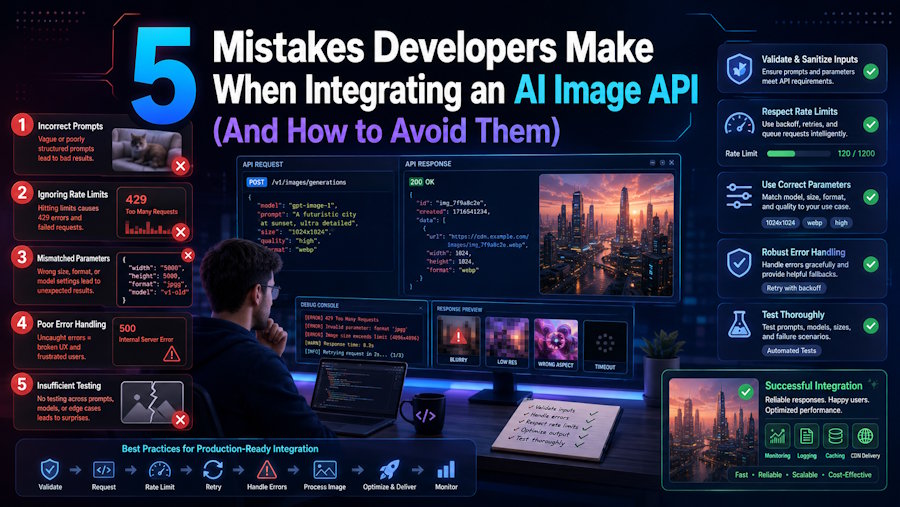
Integrating an AI image API sounds simple on paper: send a prompt, get an image back. In practice, a lot of developers run into the same avoidable problems, usually because they skip a step that seems optional early on but turns into a real issue once the feature is live.
This is especially true with capable models like Nano Banana Pro, built on the gemini 3 pro image API. The model itself handles detailed prompts well, but that doesn't mean the integration around it will automatically go smoothly. Here are five mistakes worth avoiding, based on patterns that show up again and again.
Mistake 1: Skipping Prompt Testing Before Building
The most common mistake is writing integration code before actually testing how the model responds to your prompts. Developers often assume a prompt will produce a certain result, wire it into the app, and only discover during QA that the output doesn't match expectations.
The fix: test prompts in a playground or sandbox environment first. This costs nothing in development time compared to debugging a live feature, and it tells you immediately whether your prompt structure actually works before any code depends on it.
Mistake 2: Underestimating Real Usage Volume
It's easy to plan a feature around development-stage usage — a handful of test requests, maybe a few dozen during QA. Real usage almost always ends up higher, sometimes dramatically so, once actual users start interacting with the feature regularly.
The fix: estimate usage based on realistic user behavior, not development testing. If a feature lets users regenerate images multiple times per session, multiply accordingly. Underestimating this is one of the most common reasons teams get surprised by their API bill.
Mistake 3: Not Setting Usage Limits
Related to the point above, many teams launch AI image generation features with no cap on how often a user can trigger a request. This works fine until someone (intentionally or not) generates images in a loop, or a small group of heavy users drives cost far beyond what was budgeted.
The fix: build in reasonable limits from day one, whether that's per session, per day, or tied to a subscription tier. It's much easier to loosen a limit later than to retroactively add one after cost has already become a problem.
Mistake 4: Ignoring Prompt Structure Consistency
Inconsistent prompt formatting across different parts of an app leads to inconsistent output quality, which is confusing for users and hard to debug. One part of the app might generate great results while another produces something noticeably worse, simply because the prompts weren't built the same way.
The fix: standardize prompt templates across your app. Treat prompt structure like you'd treat any other reusable code — documented, consistent, and version-controlled where possible.
Mistake 5: Paying Full Direct Pricing Without Comparing Options
This is the mistake that costs the most money long-term, and it's also the easiest to avoid. Many developers default to whatever provider they find first, without comparing pricing across access points for the same model. Direct API access often comes at a premium, and that premium compounds quickly at any real scale.
The fix: compare pricing before committing to a provider, not after your feature is already live and dependent on one specific integration.
Where This Applies to Nano Banana Pro Specifically
Nano Banana Pro, running on the gemini 3 pro image API, is a strong model for exactly the kind of detailed, production-grade use cases where these mistakes tend to show up — product photography, marketing content, and user-facing generation features. The model quality isn't usually the problem. The integration decisions around it are.
This is why it's worth looking at You.bot before locking in your integration approach. It offers full API access to the model along with an interactive playground, which directly addresses mistake #1 by letting you test prompts before writing any code.
It also addresses mistake #5. You.bot offers access at rates up to 71% cheaper than standard direct pricing, which means the cost side of the equation is already in better shape before you even start building.
Final Thoughts
Most integration problems with AI image APIs aren't caused by the model itself — they come from skipping testing, underestimating usage, or not comparing pricing options early enough. These are all avoidable with a bit of planning before writing production code.
If you're about to integrate Nano Banana Pro into a project, testing it through You.bot's playground first solves several of these issues at once: you get to validate your prompts, estimate output quality, and lock in lower pricing before committing to anything.

