

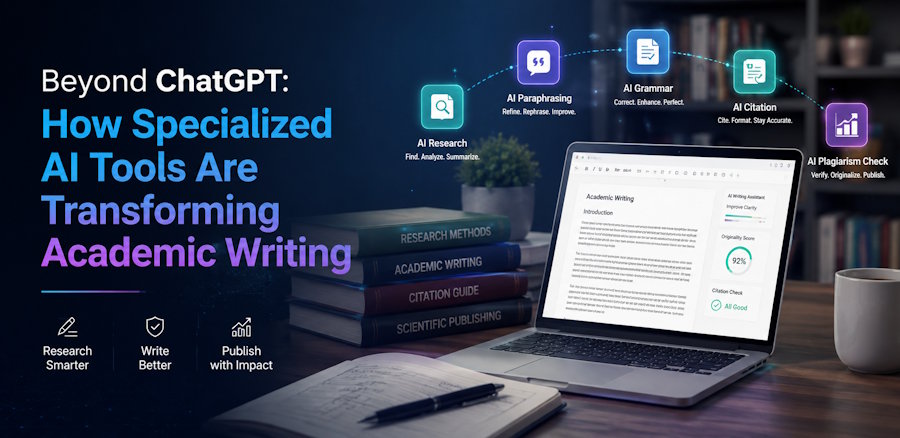
Do you recall the time when ChatGPT was just released, and it seemed to have the answer to virtually every writing challenge? Need an outline? Ask it. Can't come up with a thesis tonight? Ask it. Missed the point about MLA format for a source by three authors? Ask it. For a fleeting moment, it seemed that one chat bot was able to address all the questions that a student might have.
When you actually put it to use for real academic work, the cracks appear in no time. General purpose AI is designed to be widely applied. Not useful for any particular work. It will write a paragraph without problems. But it doesn't really get what a literature review is supposed to do. You can include a citation. You may cite a source without much trouble, and yes, it can "summarize" a source correctly, it can just as easily "mangle" it. That is essentially why a new generation of AI models has begun to fill in that void where chatbots at large have hit their performance ceiling.
Why General-Purpose AI Falls Short in Academic Work
Academic writing operates on a set of rules that casual writing never comes in contact with. Citations must be precise, with all commas included. All arguments must be based on concrete evidence, not on gut feelings. Each field has its own etiquette, its own style, its lexicon, that you may not necessarily recognize as an outsider. A model developed from marketing copy and forum posts and any other information that could be pulled from the net was never really designed to be so accurate. It shows.
Then there's the integrity aspect, which is actually the greater challenge for the majority of students. Universities have improved significantly at detecting AI-generated content and those who put all of their eggs into a single basket by relying on a universal "chatbot" often end up with bland writing. Repetitive. Unusually disjointed in their communication and debate of an issue. Grammatically it's fine. It's also structurally OK. But it's lacking the texture of a real person's thought process, the little stutters, the exact words you pick after you've tried three times as opposed to the first word a model spits out.
But this doesn't mean there's no room for AI in academic writing. This is the process by which the tools must be created to suit the task at hand. Did not attach it later with bolts.
The Case for Purpose-Built Academic AI
Platforms built specifically around research and writing tend to handle problems that generic chatbots were never designed for in the first place. Put them side by side and it's not subtle:
- Citation accuracy — trained to format references correctly across APA, MLA, Chicago, whatever the assignment calls for, instead of guessing based on a thin prompt. Even something as specific as switching between in-text citation rules and a full reference list follows the same logic, which is where a dedicated APA formatting tool tends to save more time than manually double-checking every entry.
- Source-aware writing — works directly from uploaded research rather than generating text from a vague instruction, so the output actually stays grounded in what the source says.
- Built-in originality checks — plagiarism or originality scoring up front, so a student catches accidental overlap before a professor does, not after.
- Discipline-specific tone — a biology lab report and a philosophy essay need pretty different registers, and platforms built for this are finally starting to notice the difference.
This is one spot where eduwriter.ai has really carved out its own lane. Instead of trying to be a jack-of-all-trades chatbot, it's built around the actual mechanics of academic work. Turning research into structured writing. Keeping citations consistent. Helping shape an argument without flattening a student's own voice along the way. That's really the difference between something built for research writing and a chatbot that just happens to be capable of it when you prompt it well enough.
Handling the Research Overload Problem
Don't overlook the fact that one of the most underrated aspects of academic writing is not writing, but rather writing honorably. The amount of reading that you need to do before you can write your first sentence. One literature review could require you to read 20, 30 papers, 20+ pages each, to glean the few points that would be relevant to your project.
For students, AI has made the most tangible dent as of yet, probably in this format. You can read through a lengthier journal article much more quickly with this technology than you would by hand and spend the time that you saved on thinking about the meaning. Being able to quickly to summarize long, jargon-heavy papers changes the shape of the whole workflow. What was once an afternoon is now something that takes twenty minutes, where you'll be able to compare arguments with each other, see what hasn't been discussed yet, and work out where your project fits in all of that.
That is more important than it would seem. It is a skill, in its own right, to do a good job of summarizing. It isn't just about cutting a paragraph, it's about determining which statements are the ones that are truly important and which statements are filler. Even diligent human readers get confused when they are rushing through a pile of PDFs at 2 a.m. However, when it comes to summarizing, AI can help without taking the place of that judgment call. It just makes you get to the judgment call quicker.
The Academic Integrity Question
When talking about AI in education, one question keeps coming up: When does help become cheating? Again there is no universal answer. There are many changes in policies from place to place and from professor to professor within the same department.
A distinction between the roles of AI as a research accelerant and AI as a substitute for real thinking appears to be taking a shape of a middle ground. It's like using a calculator in a math class to organize sources, verify the formatting of citations, or quickly skim through a dense paper. It accelerates the mechanical aspect but does not do the thinking. Creating an entire essay with one prompt and handing it in as your own is something completely different, and most integrity policies are becoming very clear about where to draw the line now.
Those students who are seen to benefit more from these platforms in the longer term use them as a 'rough draft' or a research tool, rather than as a final product. The argument, the reading of the evidence, the prose itself, that must still be written by the student. AI simply removes some of the mechanical mumbo-jumbo to give the real thinking the attention it deserves. Not less.
Where This Is Heading
A few trends look likely to keep shaping this over the next few years:
- Tighter integration with reference managers, so citation tracking happens while a paper is being researched instead of scrambled together right before the deadline.
- Better AI-detection pressure, pushing writing platforms toward assistance and structure rather than just cranking out full-text generation.
- Discipline-specific models, trained on the actual conventions of individual fields, law, medicine, the humanities, instead of one generic "academic" style thrown at everything.
- Originality safeguards built into the process itself, rather than tacked on as a separate check right at the end.
The pattern underneath all of this is pretty clear once you step back. Academic AI is drifting away from being a general assistant and toward being one specialized piece of a bigger research workflow, closer to reference management software than to something you just chat with. That's a meaningful shift, because it treats writing support as one part of a larger process rather than a shortcut around it entirely.
The Bottom Line
ChatGPT demonstrated to the world how AI can help with writing, but it wasn't designed with academic work firmly in mind. The tools that have the greatest impact on the way students and researchers write are the ones focused on accuracy of citations, fidelity to sources, and the very specific pressures of academic integrity. That's not just a luxury for a student trying to clear a mountain of research and keep his or her own thinking sharp. It's rapidly becoming the difference between AI that is genuinely useful and AI that is just adding more noise to an already noisy process.

