

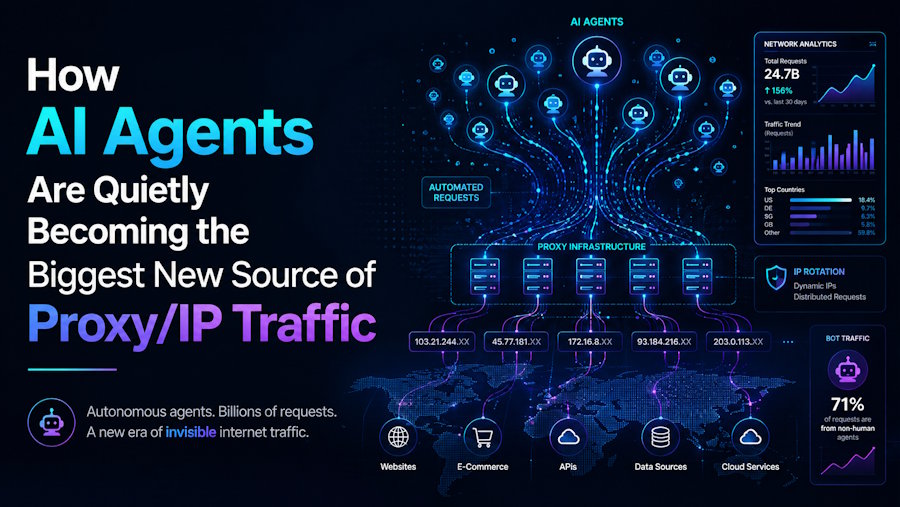
For most of the internet's history, "traffic" meant people. That assumption is gone. Automated activity now makes up more than half of all web traffic, and a growing share of it isn't search crawlers anymore; it's AI agents booking, comparing, and researching on someone's behalf. That shift is quietly changing what proxy and IP infrastructure needs to serve.
AI agents are becoming browsers not just chatbots
- A chatbot answers a question. An agent acts on one. The distinction matters more than it sounds.
- A simple API call fetches data once and disconnects, no session, no identity to maintain. A traditional scraper repeats that pattern at scale, often from datacenter IPs nobody bothers to disguise.
- Browser automation tools like Playwright render real pages and execute scripts, but usually follow a fixed path.
- An autonomous browsing agent is different again; it opens a session, decides what to click next, fills forms, and may return to the same site minutes or hours later expecting to still be logged in.
- Each layer looks more like a person, and each layer raises the cost of getting the network layer wrong.
- For businesses moving beyond fixed automation workflows, custom AI agent development enables these agents to handle more complex, multi-step tasks while adapting their actions to changing conditions.
Why agent traffic changes the proxy equation
A script that breaks mid-run just retries. An agent that loses its session mid-task may silently continue with the wrong identity, location, cart, or login. That makes IP reputation, geographic accuracy, and session persistence functional requirements, not nice-to-haves.
Datacenter IPs get flagged fast by anti-bot systems tuned for exactly this kind of automated pattern; residential and mobile IPs read as ordinary users. Teams building agent-driven browsing or research pipelines increasingly treat proxy infrastructure as part of that reliability stack, worth a look at CyberYozh's proxy infrastructure if session stability is where your agent keeps failing.
Where proxies fit into the agentic web
- A few examples show why this matters. A shopping agent comparing prices across regions needs to exit from the country it's pricing for, since many sites geo-gate pricing.
- A research agent pulling from dozens of sources across a session needs a consistent identity so it isn't rate-limited or challenged mid-task. A booking agent filling out a multi-step form needs the same IP for the full flow, or the session can break.
- A monitoring agent checking a page repeatedly over hours needs rotation between runs but stability within each one. In every case, the proxy layer isn't circumventing anything—it's making the agent's connection behave like a normal user's.
What good agent proxy infrastructure needs
- Session persistence that lasts as long as the task, not just the request
- Accurate geo-targeting, down to country or city, for location-sensitive tasks
- A mix of residential and mobile IPs for trust-sensitive targets
- API-driven control so agents can request or rotate sessions programmatically
- Predictable routing, since debugging a multi-step agent failure is harder than debugging a script
Where CyberYozh fits
- This is an infrastructure question before a vendor question, but it's worth naming what exists.
- CyberYozh runs a residential network of 50M+ IPs across 195+ countries, with rotating and 24-hour long-lived sticky sessions, geo-targeting down to the city level, and API access for programmatic control—the pieces an agent workflow actually touches.
- Its proxies already support agent-oriented use through integrations like Afina's antidetect browser, which routes AI-agent workflows over MCP through isolated, stable sessions.
- Teams evaluating agent infrastructure can explore CyberYozh's proxy options to see which session type fits.
What comes next for agent traffic
- Agent traffic won't stay a niche category. As more everyday tasks get delegated—price checks, form-filling, scheduling—the web will keep treating that traffic as automated first, human-adjacent second, because it is.
- Sites will keep tightening detection; agent frameworks will keep needing infrastructure that makes a session look, and stay, coherent. Proxy and IP management won't be an edge case in agent architecture. It'll be part of the stack.
FAQs
Do all AI agents need proxies?
No. A simple agent hitting one API endpoint usually doesn't. Proxies matter once an agent browses real pages, needs a specific location, or must maintain a session across multiple steps, situations where datacenter IPs or inconsistent identities cause blocks or broken tasks.
What's the difference between a proxy and an MCP server?
An MCP server connects an AI agent to external tools and data sources; it doesn't provide network identity. A proxy controls the IP, location, and session behind a connection. Some MCP tools manage a proxy, but the two solve different layers of the same workflow.
Why do agents need sticky sessions instead of rotating IPs?
Multi-step tasks, logins, forms, and checkouts can break if the IP changes mid-task, since many sites treat that as suspicious or invalidate the session outright. Sticky sessions hold one IP for the task's duration; rotation happens between tasks, not within them.

