

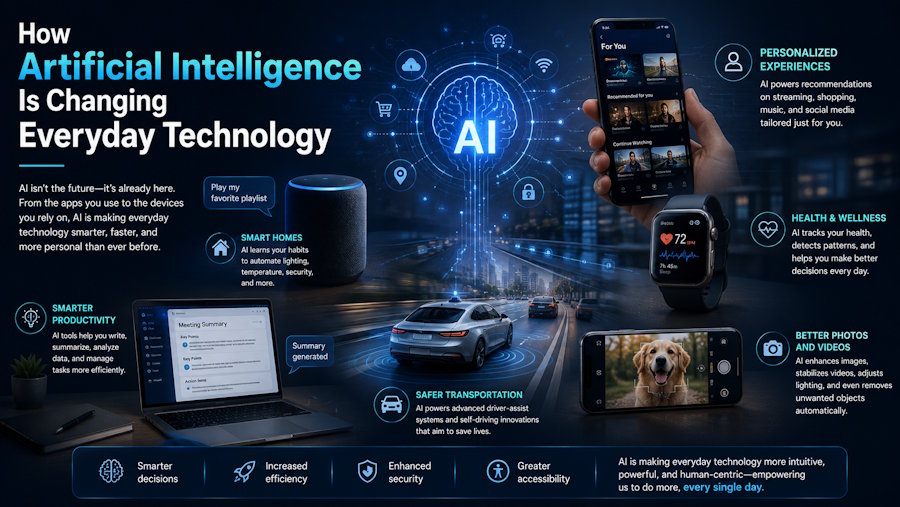
The most interesting thing about artificial intelligence today may be how little attention it demands. A phone camera can improve a photo before you press save, a search engine can understand a question without matching every word, and an app can predict what you are likely to need next.
Small businesses can also get everyday tasks handled more efficiently with AI automation, from customer support and data entry to marketing and routine administrative work.
None of these experiences necessarily looks like “AI” from the outside. They simply feel like software getting better at understanding what people are trying to do.
That quiet shift is changing everyday technology. AI is moving from being a standalone feature that users deliberately seek out to becoming part of the tools they already use from smartphones and search engines to creative software and online communication.
What Artificial Intelligence Actually Does
At a basic level, artificial intelligence refers to technologies designed to perform tasks that normally require some form of human intelligence. These tasks can include understanding language, identifying patterns, interpreting images, generating content, and making predictions.
According to NogenTech, artificial intelligence covers technologies that allow software and machines to handle tasks associated with human intelligence. The important point is that modern AI does not necessarily work like a human brain. Instead, many AI systems are trained to recognize patterns in large amounts of data and produce useful results based on those patterns.
This approach has made AI practical enough to become part of everyday software.
Search Is Becoming More Contextual
Search engines are one of the clearest examples of AI becoming part of ordinary internet use.
Older search systems relied heavily on matching words in a query with words found on a webpage. Modern search technology can consider context, relationships between concepts, user intent, and the meaning behind a question.
For example, someone searching for ways to improve a slow laptop may not use the exact technical terminology found in an article. AI-powered systems can still interpret the intent and identify information that may answer the underlying question.
This is also why content creators increasingly need to focus on genuinely answering users rather than simply repeating keywords.
Smartphones Are Using AI in Small Ways
AI has also become deeply integrated into smartphones.
Camera applications can identify scenes, improve exposure, detect faces, reduce image noise, and enhance photographs. Keyboard applications can predict the next word or suggest corrections. Voice assistants can interpret spoken commands and convert speech into text.
Many of these features do not feel particularly futuristic because they have become normal. That is one of the clearest signs of AI’s influence: useful technology can become almost invisible once people get used to it.
Recommendations Are Driven by Patterns
Streaming platforms, shopping websites, social networks, and news applications all use recommendation systems to some degree.
These systems can examine signals such as previous interactions, viewing habits, searches, purchases, or similar users’ behavior. They then estimate what content or products might be relevant.
The result is a more personalized experience. Instead of presenting exactly the same information to everyone, a service can adjust what it displays based on patterns in user activity.
However, personalization also creates an important responsibility. Users should understand that recommendations are generated by algorithms and may influence what information they see.
AI Is Changing Software Development
Artificial intelligence is also becoming a practical tool for developers.
Modern AI assistants can help explain unfamiliar code, suggest implementations, identify potential bugs, generate test cases, and assist with documentation. These tools do not eliminate the need for programming knowledge, but they can reduce the amount of repetitive work involved in software development.
A developer can spend less time searching through documentation for a simple solution and more time reviewing whether the suggested solution is appropriate for the project.
That distinction is important. AI-generated code still needs human review because a solution that looks correct can contain security, performance, compatibility, or logic problems.
Accessibility Is Another Important Area
One of the less visible but potentially valuable applications of AI is accessibility.
Speech recognition can make it easier to interact with devices without typing. Text-to-speech systems can convert written material into spoken language. Image recognition can help describe visual information, while language-processing systems can assist with translation and communication.
These technologies can make digital products easier to use for people with different needs and preferences.
AI Is Also Changing How Content Is Created
Writing, image generation, video editing, transcription, and other creative tasks are increasingly supported by AI tools including AI logo makers that help users quickly create unique logos without advanced design skills.
For individuals and businesses, this can speed up brainstorming and production. A writer might use AI to organize ideas before developing the final article. Someone working on a longer project could start with scattered ideas, notes, and research, then use an AI book writer to turn them into a structure, suggest chapter directions, or develop an early draft. The writer can then refine the material to match their own ideas and voice.
But faster production does not automatically mean better content.
Human judgment remains important for accuracy, originality, context, and usefulness. Publishing large amounts of automatically generated material without meaningful review can create poor experiences for readers.
What Comes Next?
AI is likely to become less noticeable as it becomes more deeply integrated into everyday software.
Instead of always appearing as a separate chatbot or AI feature, it may operate quietly inside search tools, productivity applications, operating systems, cameras, browsers, and business software.
The most useful developments will probably be those that solve practical problems without making technology unnecessarily complicated.
At the same time, questions around privacy, accuracy, security, transparency, and responsible use will become increasingly important. The technology may become more capable, but users and developers will still need to decide where it should and should not be used.
Final Thoughts
Artificial intelligence is already changing everyday technology in ways that are easy to overlook. From search and smartphones to recommendations, accessibility tools, software development, and content creation, AI is becoming part of the infrastructure behind many familiar digital experiences.
The biggest change may not be the arrival of one revolutionary AI product. Instead, it is the gradual integration of intelligent features into the tools people already use. As these systems continue to improve, understanding how they work and where their limitations lie will become increasingly useful for anyone who relies on modern technology.

