

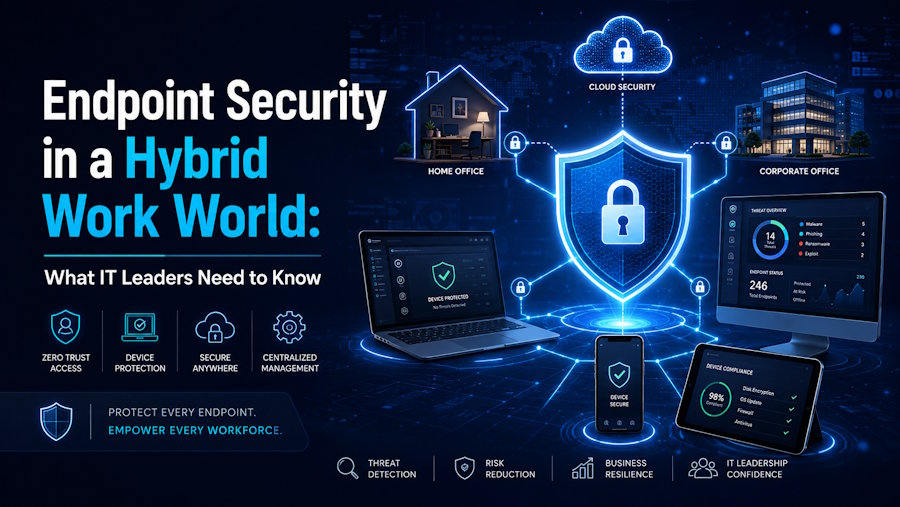
The shift to hybrid work has permanently changed the attack surface for most organizations. Employees now move between home networks, coffee shops, corporate offices, and client sites — often within the same week. Each of those transitions introduces a new variable for security teams to account for, and the endpoints those employees carry with them represent one of the most consequential and underprotected layers in modern IT infrastructure.
When a device connects to a corporate application from a residential network, it bypasses many of the perimeter controls that traditional security architectures relied on. Firewalls designed to protect a central office do little to protect a laptop sitting on an employee's kitchen table. This is precisely where working with a reputable IT Company becomes operationally important. Without centralized visibility into what devices are connecting, from where, and in what configuration, security gaps can persist for weeks before anyone notices.
Endpoint detection and response tools, commonly called EDR platforms, have become a baseline expectation rather than an advanced capability. These tools monitor device behavior in real time, flag anomalies, and in many cases can isolate a compromised machine before malware spreads laterally across the network. However, deploying EDR is only part of the equation. Patch management, device enrollment policies, and configuration baselines all need to be consistently applied across every managed endpoint — remote or otherwise. Many organizations underestimate how quickly an unpatched device becomes a liability.
Identity and access management is another layer that deserves serious attention in hybrid environments. Multi-factor authentication should be non-negotiable at this point, yet a surprising number of small and mid-sized businesses still rely on single-factor credentials for cloud applications and VPN access. Zero trust principles — which treat every access request as potentially untrusted regardless of network location — offer a more appropriate framework for the way work actually happens now. Translating zero trust from a conceptual model into a practical implementation is where many internal teams struggle, and where outside expertise adds real value.
That expertise is often delivered most effectively through an IT Consultancy relationship, where an experienced team can assess an organization's current endpoint posture, identify gaps in policy and tooling, and develop a roadmap that fits the specific risk tolerance and operational requirements of the business. Generic checklists downloaded from the internet rarely account for the nuances of a particular environment, industry, or workforce composition.
Sustained endpoint security is not a one-time project. New device types, new operating systems, and new attack techniques emerge continuously. Organizations that treat endpoint security as a completed initiative rather than an ongoing program tend to find themselves scrambling after an incident rather than preventing one. This is one of the strongest arguments for outsourcing endpoint management and monitoring to a team that specializes in it full-time. Access to Managed IT Services gives organizations a dedicated team responsible for maintaining endpoint health, responding to alerts, and keeping policies current as the threat environment evolves.
The practical reality is that most internal IT teams are stretched too thin to give endpoint security the sustained attention it demands while also keeping up with day-to-day support tickets, infrastructure projects, and vendor management. Hybrid work has made that challenge significantly harder. The endpoints are more distributed, the users are more mobile, and the expectations around uptime and access have never been higher.
Security leaders and business owners alike would do well to conduct an honest assessment of their current endpoint visibility before assuming their existing controls are adequate. How many devices are enrolled in your MDM solution? How quickly are patches being applied? What happens when an employee's personal device accesses a corporate resource? These are the questions that reveal where real exposure exists.
To explore how your organization can build a stronger endpoint security posture for a hybrid workforce, reach out to Sterling Technology Solutions to learn more about what they offer.

