

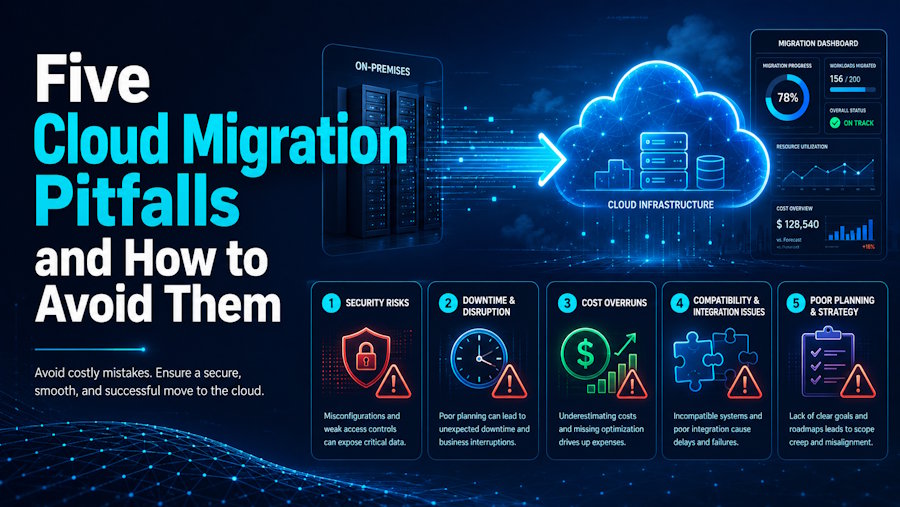
Cloud migration looks straightforward on paper. You move your data, applications, and infrastructure from on-premises systems to the cloud, and efficiency follows. In practice, migrations regularly go sideways — not because the technology fails, but because the planning does. Having worked through dozens of these projects with businesses of varying sizes, I can tell you the same five mistakes appear time and again.
The first pitfall is skipping a thorough workload assessment before migration begins. Organizations often assume every application is cloud-ready, but legacy software with hard-coded IP addresses, local dependencies, or outdated licensing models can break entirely when lifted and shifted. A proper pre-migration audit maps each workload to the right cloud model — whether that is infrastructure-as-a-service, platform-as-a-service, or a hybrid approach. Providers offering Managed IT Services typically conduct this assessment as part of their onboarding process, which saves companies from costly surprises mid-project.
The second pitfall is underestimating the true cost of cloud operations. Cloud pricing models are complex, and consumption-based billing can escalate quickly when teams spin up resources without governance in place. Many businesses migrate expecting immediate cost savings, then receive a billing shock at the end of month one. The fix is establishing a cloud cost management framework before go-live, including budget alerts, resource tagging policies, and regular rightsizing reviews. Without this discipline, the financial case for migration falls apart fast.
The third pitfall is neglecting data security and compliance requirements during the transition period. The migration window itself is a period of elevated risk. Data is in motion, access controls are being reconfigured, and teams are under pressure to hit deadlines. This is precisely when misconfigurations happen. Small and mid-sized businesses face the same regulatory obligations as large enterprises — HIPAA, PCI-DSS, and state-level data privacy laws do not grant exemptions based on company size. Working with a provider experienced in Small Business Managed IT Services means having someone accountable for securing data throughout the migration, not just at either end of it.
The fourth pitfall is poor change management and staff training. Technical execution can be flawless, and the migration can still fail operationally if employees do not understand how to use the new environment. Cloud platforms introduce different workflows, new authentication methods, and unfamiliar interfaces. Without structured training and clear internal communication, productivity drops and shadow IT fills the gap. Change management is not a soft-skills afterthought — it is a core project deliverable with its own timeline and success metrics.
The fifth pitfall is migrating without a strategic technology roadmap. Businesses that treat cloud migration as a one-time project rather than a phase in a longer technology strategy tend to accumulate technical debt quickly. The cloud evolves rapidly, and decisions made during migration have long-term architectural consequences. This is where having access to senior technology leadership pays for itself. Virtual CIO Services provide the strategic oversight needed to align cloud investments with business objectives over time, ensuring that each technology decision builds toward a coherent architecture rather than creating a patchwork of disconnected tools.
Getting cloud migration right requires disciplined planning, security-conscious execution, and strategic thinking that extends well beyond the cutover date. The businesses that navigate it successfully treat migration as a foundation-setting exercise, not a checkbox. They ask hard questions about workload compatibility, cost governance, compliance obligations, and long-term technology direction before a single server is moved.
If you are evaluating a cloud migration or dealing with the aftermath of one that did not go as planned, reach out to Carmichael Consulting Solutions to learn more about how they can help you move forward with confidence.

