

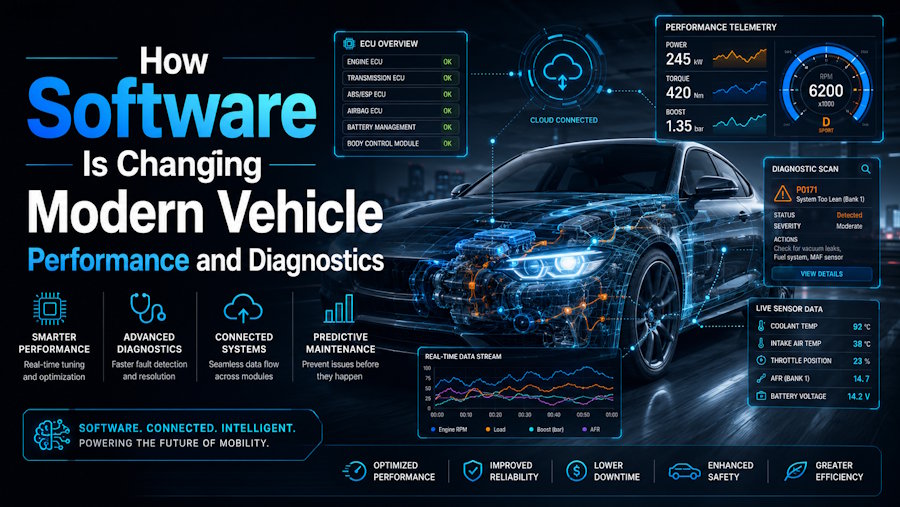
Modern cars are increasingly becoming computers on wheels. While engines, turbochargers, and mechanical components remain fundamental to vehicle performance, software now plays a major role in determining how those components behave.
At the centre of this is the Engine Control Unit (ECU).
The ECU continuously receives information from sensors throughout the vehicle and uses this data to control important engine functions. Depending on the vehicle, this can include fuel delivery, ignition timing, turbo boost, throttle response, and emissions-related systems.
This means two mechanically similar engines can potentially behave very differently depending on how their software has been calibrated.
Sensors Have Changed Vehicle Diagnostics
Modern vehicles generate enormous amounts of operational data.
Sensors can monitor parameters including air pressure, temperature, oxygen levels, engine speed, and exhaust conditions. When something operates outside its expected range, the vehicle's electronic systems can record diagnostic information that technicians can access using specialist equipment.
As a result, diagnosing performance issues is no longer purely mechanical.
Technicians increasingly need to understand both the physical components of a vehicle and the electronic systems controlling them.
Vehicle Calibration and ECU Remapping
The growing importance of software has also changed how vehicle performance can be optimised.
ECU remapping involves modifying specific parameters within the software controlling the engine. When performed correctly, calibration can alter characteristics such as power delivery, torque, and throttle response while taking the capabilities of the vehicle's hardware into account.
This is why professional vehicle calibration requires more than simply uploading a generic software file.
Performance specialists such as Rushworth Performance combine ECU calibration with vehicle diagnostics and testing to understand how a vehicle responds to changes rather than treating software and mechanical performance as separate areas.
Why Dyno Testing Still Matters
Software may control many aspects of a modern engine, but physical testing remains extremely important.
A dynamometer, commonly known as a dyno, allows specialists to measure vehicle performance under controlled conditions. Data collected during testing can show how power and torque are being delivered and help identify areas requiring further investigation or calibration.
This creates a useful relationship between software and physical testing.
The ECU determines how numerous systems operate, sensors provide continuous information about what is happening, diagnostic technology allows that information to be analysed, and dyno testing demonstrates how the vehicle actually performs.
Cars Are Becoming More Software-Driven
The automotive industry's move towards connected and software-defined vehicles means this relationship is likely to become even more important.
For workshops and performance specialists, understanding engines alone is increasingly not enough. Modern vehicle performance sits at the intersection of mechanical engineering, electronics, data, and software.
As vehicles become more technologically sophisticated, the tools used to diagnose and optimise them are evolving alongside them.

