

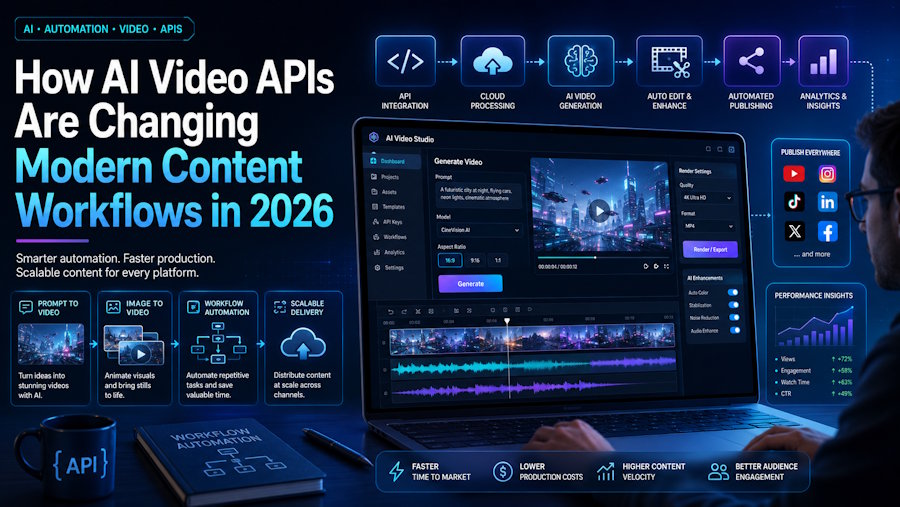
Video has become a core format for product launches, customer education, social campaigns, and internal communication. Yet traditional production still creates a bottleneck for teams that need to publish frequently. Every new clip may require a script, storyboard, footage, voice-over, editing, captions, and several rounds of review. AI video APIs are changing that workflow by turning video generation into a programmable service. Instead of treating every asset as a separate manual project, developers can connect generation capabilities to the tools that teams already use.
This shift matters because modern content operations are built around systems rather than isolated files. Marketing teams work in campaign platforms, product teams manage release notes, support teams organize knowledge bases, and localization teams maintain translation workflows. An API can connect those sources to a repeatable video pipeline. It can accept structured input, create a draft, return a file or job status, and trigger the next step automatically. The result is not simply faster rendering. It is a more coordinated way to move from approved information to a publishable visual asset.
From one-off tools to connected production systems
Early AI video tools often required users to open a separate interface, paste a prompt, generate a clip, download it, and then move the file into another application. That process was useful for experimentation but difficult to scale. APIs remove many of those handoffs. A content management system can send a new article summary to a generation service, a project-management tool can create a draft when a task reaches a certain status, or a product database can automatically produce short feature demonstrations when approved information changes.
The key advantage is consistency. A well-designed integration can use the same prompt structure, aspect ratios, duration limits, naming rules, and storage locations for every job. Teams no longer depend on each user remembering dozens of settings. Developers can encode those decisions into the workflow. This makes the process easier to audit and reduces the number of avoidable mistakes, especially when several departments or external partners are involved.
Structured inputs create better outputs
An API works best when it receives more than an unstructured sentence. Useful requests can include a scene description, audience, visual style, camera behavior, duration, aspect ratio, pacing, negative constraints, and brand-related details. The exact schema varies by provider, but the principle is consistent: structured direction makes results easier to predict and compare. Teams can build forms or templates that collect the right information before a generation job begins.
For example, a product-marketing form might ask for the feature name, customer problem, desired outcome, proof point, call to action, and target channel. The application can transform those fields into a prompt and a sequence plan. This is more reliable than asking every marketer to write a complex prompt from scratch. It also creates clean data for future analysis, because teams can compare which inputs produced the best-performing videos.
Why asynchronous job handling is essential
Video generation usually takes longer than a normal web request. A production integration should therefore treat it as an asynchronous job. The client sends the request, receives a job identifier, and checks progress through polling or a webhook. When rendering finishes, the application retrieves the output and stores it in an approved location. This design prevents timeouts and allows users to continue working while the video is created.
Reliable job handling also requires clear states. A dashboard should distinguish queued, processing, completed, failed, and needs-review jobs. Failed requests should return useful error information without exposing secrets. Retry logic should be limited so a broken request does not consume the budget repeatedly. When a team evaluates a text to video workflow, these operational details are as important as visual quality because they determine whether the capability can support daily production rather than occasional demos.
Building human review into the pipeline
Automation should not mean automatic publication. Generated video can contain visual inconsistencies, inaccurate text, strange motion, or details that conflict with a product claim. A strong workflow creates a review checkpoint before distribution. Reviewers need access to the source brief, the generated output, and a clear checklist. They should be able to approve, reject, or request a revised version without leaving the system.
Different content categories need different reviewers. A social clip may require a brand check, while a product tutorial may need approval from a subject-matter expert. Regulated or sensitive topics may also require legal or compliance review. Routing can be automated based on metadata. The API creates the draft, but responsibility remains visible and assigned to a person. This balance preserves speed while protecting accuracy and trust.
Versioning prompts and creative settings
Prompt changes can affect style, pacing, and factual presentation. Teams should version prompt templates in the same way that software teams version code. Each generation job can record the template version, model setting, source content, and output identifier. If results suddenly change, developers can trace the difference. If a high-performing campaign needs to be reproduced, the team has a clear record of the configuration that created it.
Versioning also supports controlled experiments. A team can test two opening styles while keeping the rest of the request constant, or compare shorter and longer scene durations across the same audience segment. The results can be tied to engagement metrics later. Without version control, experimentation becomes guesswork because no one can be certain which creative variable changed.
Managing cost, latency, and quotas
Video generation is compute intensive, so integrations need budget controls. Developers should estimate cost before submitting a job when the provider exposes pricing information. Teams can set limits by project, department, or user and require approval for unusually long or high-resolution requests. A usage dashboard should show completed jobs, failed jobs, average cost, and output duration. These controls keep experimentation open without allowing accidental overspending.
Latency also influences product design. A user waiting for a draft needs an accurate progress indicator and a notification when the file is ready. Batch jobs may be scheduled during lower-priority periods, while urgent campaign work may use a faster queue if available. Caching reusable assets, avoiding duplicate requests, and generating low-resolution previews before final renders can improve both speed and cost efficiency.
Security and data governance
API keys must be stored on the server, never embedded in public front-end code. Access should follow the principle of least privilege, with separate credentials for development and production. Logs should avoid storing private prompts or customer information unless there is a clear retention policy. When source material contains confidential product details, teams should verify how the provider processes, retains, and uses submitted data.
Generated files also need governance. Applications should assign predictable names, attach ownership metadata, and store outputs in locations with appropriate permissions. If a video is replaced, the system should preserve the relationship between the old and new versions. These practices sound administrative, but they become essential once hundreds or thousands of assets move through the pipeline.
Localization at scale
APIs make it easier to create regional variations from a common campaign structure. A workflow can send approved translations, localized calls to action, and market-specific examples while keeping visual identity consistent. However, localization should not be reduced to word replacement. Timing, text density, cultural references, voice selection, and platform conventions can differ substantially between markets.
Local reviewers should approve each important version. The system can accelerate repetitive production steps, but cultural judgment remains human. Teams that separate global elements from local variables can scale more safely. A master brief defines the message and brand guardrails, while regional inputs control language, examples, and channel requirements.
Observability and performance measurement
A production pipeline needs more than generation logs. Teams should connect each output to downstream performance data. Useful fields include campaign, channel, audience, prompt-template version, video duration, format, cost, approval time, and engagement result. This creates a feedback loop between creative operations and business outcomes. The team can learn which formats deserve more investment instead of measuring success only by the number of videos produced.
Operational metrics matter too. Time from brief to first draft, review turnaround, failure rate, and revision count reveal where the workflow still creates friction. If generation is fast but approvals take days, the next improvement should focus on review design rather than model speed. Good observability helps teams solve the actual bottleneck.
A practical implementation roadmap
The safest way to adopt an AI video API is to begin with one narrow, repeatable use case. A team might automate short product-update summaries or create social drafts from approved blog posts. The first version should include structured inputs, asynchronous status handling, secure credential storage, human review, cost limits, and basic logging. Once the workflow is reliable, the team can add more formats and departments.
Developers should treat quality controls as product features, not last-minute safeguards. Clear error messages, preview states, approval records, and version history make the system usable for nontechnical colleagues. A small but dependable pipeline creates more value than a broad integration that produces inconsistent assets and unclear ownership.
The next phase of programmable media
AI video APIs are moving video production closer to the rest of the software stack. They allow teams to connect approved data, creative templates, review steps, and distribution channels in one workflow. The most successful implementations will not be the ones that generate the largest number of clips. They will be the ones that make quality, accountability, and learning repeatable.
In 2026, programmable video is becoming an operational capability rather than a novelty. Teams that combine strong engineering with editorial judgment can reduce production friction while keeping people responsible for the message. That foundation makes it possible to experiment faster, serve more channels, and create video that remains accurate, useful, and aligned with the audience.

