

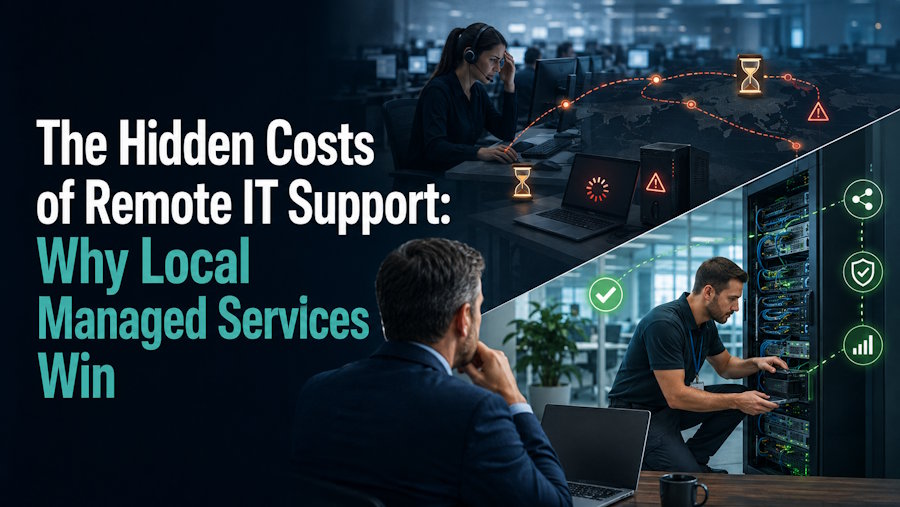
Tired of slow remote tech support? Discover why partnering with a local IT service expert saves your Central Valley business time and money.
You sit at your desk, watching a loading screen spin endlessly. A core software application just crashed, and your entire team is locked out of the system. You pick up the phone, call your distant remote IT support provider, and brace yourself for the inevitable hold music.
This is an everyday frustration for countless business owners. Sitting in a remote helpdesk queue while business operations grind to a halt is stressful and expensive. A technician hundreds of miles away eventually answers, asks you to reboot your machine, and places you back on hold. Meanwhile, your employees are idle, and your clients are waiting.
While remote support can handle minor software glitches, protecting your revenue requires the hands-on, proactive approach of a local partner. Treating IT as a strategic local partnership, rather than a distant reactive service, drives massive business efficiency. Relying on an outsourced call center limits your growth. Bringing in a local team that understands your physical environment and business goals changes everything.
The Cost of Waiting on Remote Tech Support
What is the true financial cost of network downtime for your business? Many leaders assume an IT outage only costs them the hourly rate of the repair technician. This ignores the massive hidden costs of idle payroll, delayed client deliverables, and lost sales opportunities.
When your servers go offline, every employee relying on that system stops working. Yet, you are still paying their wages. A widely cited Gartner benchmark study highlights that the average cost of IT downtime is $5,600 per minute. For smaller operations, the cost is still staggering, easily wiping out an entire week's profit in a single afternoon.
The impact compounds even faster for larger organizations. According to a 2024 ITIC survey, 91% of mid-size and large enterprises report a single hour of downtime costs them $300,000 or more. These numbers prove that sitting idle while waiting for an out-of-state technician to return your email is a financial risk you cannot afford.
When your network goes down, waiting hours in a remote helpdesk queue isn't just frustrating—it actively drains your revenue. Instead of relying on reactive fixes from a distance, partnering with a local expert—a managed IT provider in Bakersfield—ensures your systems are proactively monitored and maintained to prevent downtime before it starts. This shift from waiting on repairs to preventing outages entirely is the most effective way to protect your bottom line.
Why Remote-Only Helpdesks Prolong the Problem
Why do remote-only IT helpdesks often take so long to resolve critical issues? The primary reason is a complete lack of visibility. When a distant technician attempts to fix a network failure, they are flying blind. They rely entirely on you or your non-technical staff to describe flashing lights on a router or error codes on a screen.
This diagnostic guessing game leads to massive delays. Three hours of waiting means three hours of zero productivity. When a Tier 1 helpdesk agent cannot figure out the issue, they escalate the support ticket to a Tier 2 engineer. This places your business right back at the bottom of another waiting list.
Remote helpdesks also frequently rely on basic, consumer-grade remote access tools to peer into your systems. Using unverified or poorly secured remote desktop software creates significant vulnerabilities. Hackers actively scan for these exact tools to breach corporate networks. Relying on simple screen-sharing software to fix complex organizational infrastructure is both inefficient and dangerous.
Ultimately, distant support teams are built for volume, not speed. Their goal is to close as many tickets as possible across hundreds of clients nationwide. They simply do not have the time or the regional focus to dedicate immediate, undivided attention to your specific network environment.
When an On-Site, Physical IT Presence is Non-Negotiable
When is an on-site, physical IT presence absolutely necessary? The reality is that technology exists in the physical world. While a remote worker can update software or reset a password, they cannot fix a fried server motherboard.
Physical hardware failures require immediate physical intervention. If a power surge destroys your main network switch, or if an internet service provider line gets severed outside your building, no amount of remote troubleshooting will bring you back online. You need a professional standing in your server room, testing cables, and replacing hardware components on the spot.
Beyond emergencies, complex infrastructure upgrades demand hands-on technical execution. If you are migrating to a new office, someone has to physically run network cables, rack the servers, and test the wireless access points. Comprehensive disaster recovery also requires local intervention. If a ransomware attack locks down your entire network, a local team can isolate the infected machines physically, preventing the virus from spreading further.
A local team provides emergency response capabilities that a distant call center fundamentally cannot offer. When things go catastrophically wrong, you do not want a support agent telling you they will ship a replacement part by next Tuesday. You want a technician driving across town with the required hardware in the back of their van, ready to get your business running again that same day.
The Strategic Advantage of a Bakersfield IT Partner
What specific advantages does an out-of-state remote service lack when supporting Central Valley businesses? Every region has its own unique infrastructure challenges. From navigating the specific service tiers of local internet providers to understanding the regulatory needs of the agriculture and energy sectors, local context matters.
Partnering with an IT service expert in Bakersfield means working with professionals who understand your specific market. They know the local vendors, they understand the common physical infrastructure challenges of the area, and they are physically close enough to walk into your office when you need them. You are not just an account number in a massive national database.
How can a local IT partner help with long-term technology planning and vendor management? Business owners waste countless hours on the phone arguing with software vendors, internet service providers, and hardware manufacturers. A local managed service provider takes this entirely off your plate. They act as your single point of contact, offloading vendor management so you can focus on running your business.
Furthermore, a great local partner steps into the role of a Virtual CIO (vCIO). A vCIO does not just fix computers; they sit down with you quarterly to discuss your business trajectory. They build a strategic IT roadmap that aligns your technology budgets directly with your growth goals. Whether you plan to hire ten new employees next year or open a second location, a vCIO ensures your technology scales seamlessly alongside your ambitions.
Conclusion
While distant helpdesks offer temporary band-aids for minor computer glitches, lasting business efficiency requires proactive, hands-on technology management. Waiting hours for a remote technician to guess what is wrong with your network is an outdated strategy that actively harms your revenue and productivity.
Eliminating unpredictable repair bills and massive downtime costs is easily achieved through a predictable, fixed-fee managed IT structure. By aligning your IT provider's goals with your own, you guarantee that your network is constantly monitored, updated, and secured against modern threats.
Stop settling for long wait times and frustrating remote support calls. It is time to start viewing your IT provider as a dedicated, local partner for growth. When you invest in a team that knows your business and can physically step into your office, you stop worrying about technology failures and start focusing entirely on your future success.

